
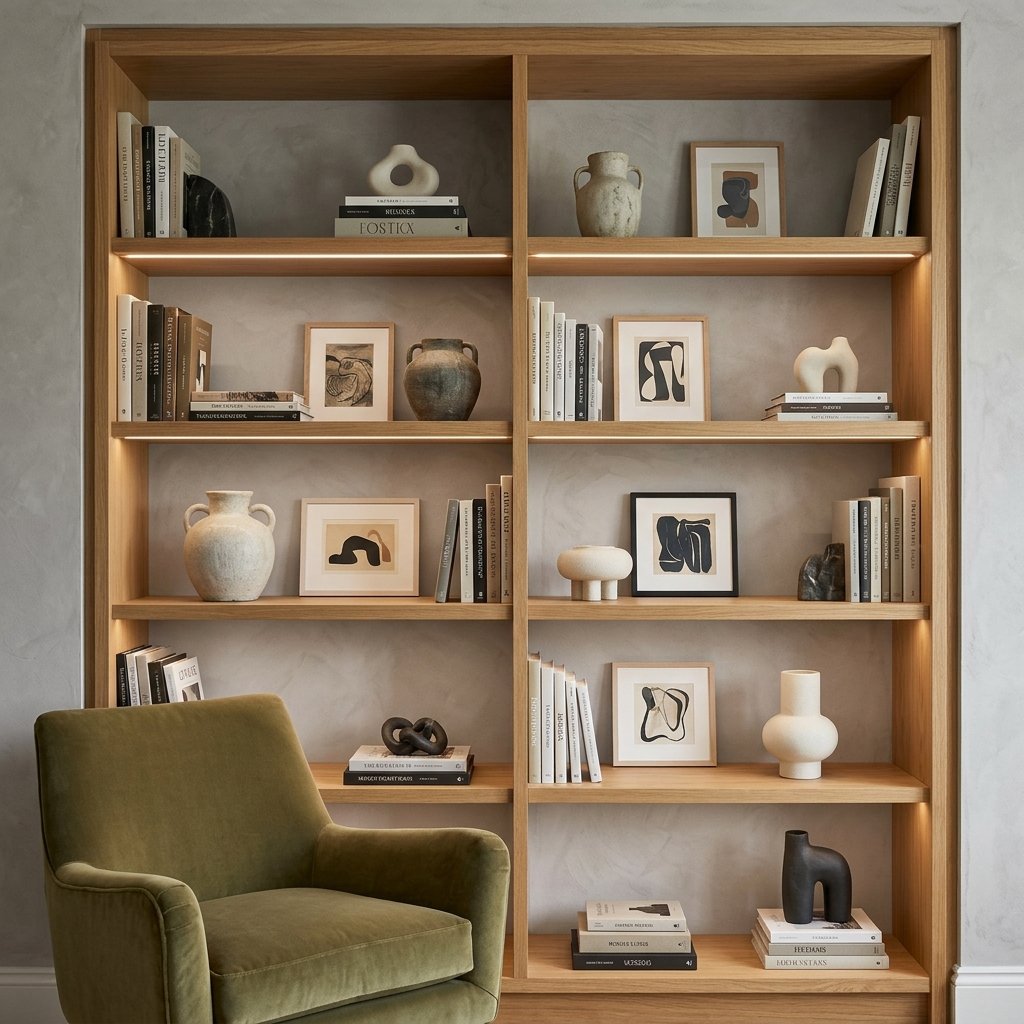
Picture this: you finally clear the junk mail and stray remotes off that empty wall in your living room. You have no idea what belongs there. A bookshelf is usually the answer. Done right, it stops being a dumping ground for paperbacks. It becomes one of the hardest-working design elements in the room.
In this guide, you’ll find 12 living room bookshelf ideas that blend smart storage with real style. Every idea below comes with specific details: shelf spacing, materials, lighting. These are the details that separate a shelf that looks staged from one that actually works in a real home.
Why Living Room Bookshelves Are a Design Essential
A bookshelf earns its keep in two ways. It holds your things, and it gives the room a focal point a bare wall never could. Most standard bookshelves use 10 to 14 inches between shelves for average hardcovers. Oversized art or coffee-table books need 12 to 16 inches, so measure your collection before you buy or build. Beyond storage, a shelf is one of the few spots in a living room where you get to show off your actual personality instead of a showroom look.
Shelving adapts to almost any footprint. In a small living room, a narrow vertical unit adds storage without eating floor space you need for seating. In a larger room, a full-wall bookshelf can anchor the seating area the way a fireplace or media console usually does. The same shelf can lean minimalist with a tight neutral palette. Or it can feel warm and collected with mixed textures and color. The styling, not the shelf itself, sets the tone.
How to Choose the Right Bookshelf Style for Your Room
Before you commit to a style, take stock of three things: your wall space, your budget, and how much you actually own. A narrow apartment living room usually does better with a vertical or floating unit than a wide horizontal bookcase. Floor clearance matters more than shelf count when the room is tight. Budget varies widely by format. A freestanding wood bookcase can run anywhere from $150 to $600. Custom built-ins typically price between $150 and $600 per linear foot, depending on materials and whether they include cabinet doors.
Also think about how you’ll actually use the shelf day to day. A unit built around a TV needs to handle cable management and ventilation for electronics. A purely decorative shelf in a formal sitting area can prioritize looks over function instead. If you’re not sure which of the 12 formats below fits your space, start with your wall’s dimensions. Work backward from there rather than picking a style first and forcing it to fit.
Built-In Bookshelves for a Seamless Look

Built-in bookshelves read as custom architecture, not furniture, because they’re framed directly into the wall instead of sitting in front of it. That’s what makes them feel intentional the moment you walk into a room. Standard depth for a built-in that holds books runs 12 inches. Closed lower cabinets often go to 14 or 16 inches to fit baskets and media gear. If you’re working with a contractor, ask for adjustable shelf pins on 1-inch increments. Your book collection will change, and fixed shelves won’t. Built-ins pay off especially well flanking a fireplace, where two matching towers balance the mantel and use wall space that would otherwise sit empty.
Floor-to-Ceiling Bookshelves That Make a Statement

Running shelving all the way to the ceiling pulls the eye upward. This makes an 8-foot ceiling read taller and a small room feel bigger than it is. Keep the bottom two or three shelves practical: everyday reads, media boxes, baskets. That’s the zone you’ll actually reach without a step stool. As the shelves climb, shift to lighter styling, like single art books laid flat, a small sculpture, or a plant that can handle indirect light. A warm-white LED strip, around 2700K to 3000K, tucked under the top shelf adds a soft glow without the glare of a spotlight. It’s also a straightforward weekend install with peel-and-stick fixtures.
Minimalist Open Shelving for a Clean Aesthetic

Open shelving keeps a room feeling light because there’s no bulky cabinetry to visually block the wall behind it. Stick to two or three colors, say white, warm oak, and a single accent tone, and the whole unit reads as cohesive instead of busy. Leave roughly a third of each shelf empty. That breathing room is what makes minimalist styling look intentional rather than unfinished. A common mistake is treating “minimal” as “empty everywhere,” which just looks like you ran out of decor. A few well-chosen pieces, spaced generously, do more than a shelf packed edge to edge.
Floating Bookshelves for Small Living Rooms

Floating shelves keep the floor completely open. That matters most in a studio or apartment living room, where every square foot is doing double duty. Most floating brackets hold 20 to 50 pounds per shelf, so check the rating before you stack a full row of hardcovers. Always anchor into studs rather than drywall alone. For the cleanest look, align the top shelf with the height of a nearby doorframe or window trim. That way the eye reads one continuous line across the wall. If you’re furnishing a tight footprint, our small living room decor ideas round-up has more layout tricks worth pairing with floating shelves.
Bookshelves Around the TV for Functional Balance

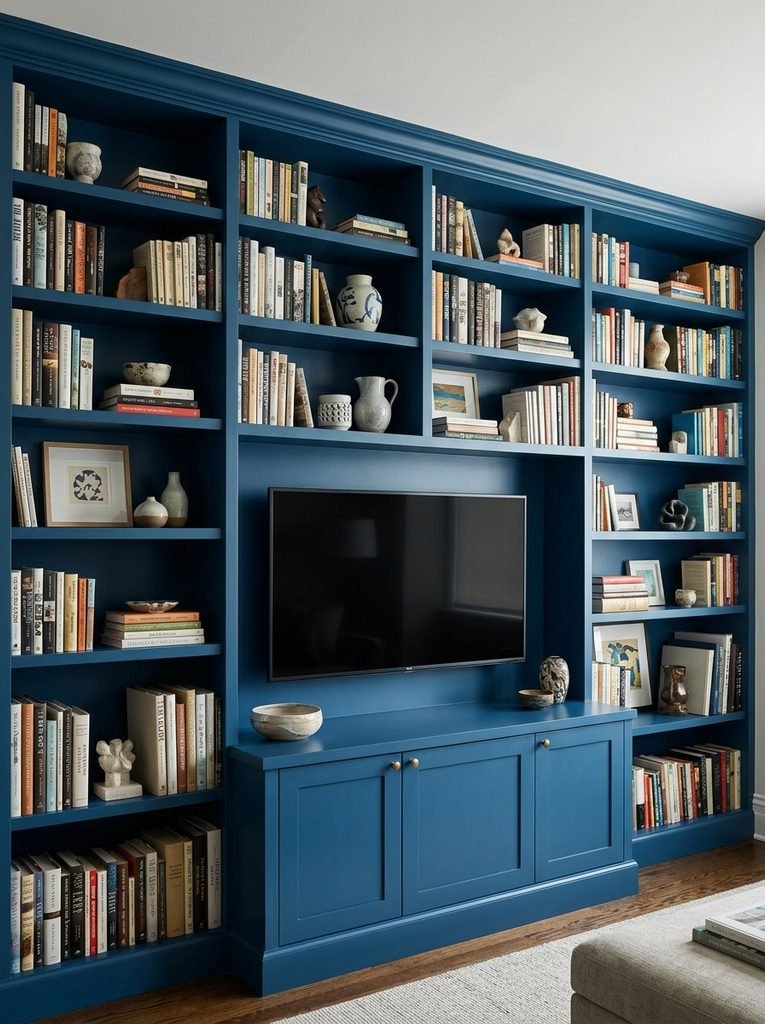
A flat-screen alone on a wall can feel stark. Flanking it with bookshelves turns that wall into a full media-and-library setup instead of a single black rectangle. Keep the shelves closest to the screen simpler, with plain book spines and low-contrast objects, so nothing competes with the TV when it’s on. Save the busier styling, like stacked art books or a cluster of frames, for the outer shelves where it won’t fight for attention. This layout also solves a real problem. It gives you somewhere to hide the cable box, router, and game consoles behind a closed lower cabinet instead of leaving them out on an open console.
Dark-Toned Bookshelves for a Cozy Luxury Feel

Charcoal, espresso, or true black shelving adds drama that white or natural wood simply can’t. The trick to keeping it from feeling like a cave is contrast. Pair the dark cabinetry with a cream or ivory sofa, and let brass or warm wood accents catch the light. Warm-toned bulbs matter more here than in a lighter room, since cool white light can make dark surfaces feel flat instead of rich. If you’re leaning into this moodier direction for the whole room, not just the shelf, our cozy living room ideas guide has more ways to layer warmth into a darker palette.
Bookshelves with Integrated Cabinets

Open shelves show off your best pieces. Closed cabinets hide the stuff you don’t want anyone to see, like cords, board games, or a pile of takeout menus. Combining both in one unit gives you a structured hierarchy: solid, grounded storage on the bottom, and lighter display space on top. Design editors at Better Homes & Gardens have pointed out that a matching paint color or wallpapered backing behind the open shelves helps the whole piece read as one built element, rather than two mismatched pieces stacked together. Aim for roughly 40 percent closed storage and 60 percent open display. That ratio usually keeps clutter contained without hiding your entire collection behind doors.
Asymmetrical Bookshelf Designs for a Modern Edge

Staggered or offset shelving breaks the rigid grid look of a standard bookcase. It reads as more contemporary as a result. The key to making asymmetry work, rather than just looking uneven, is repetition. Echo a material or color in at least two spots, like a brass object on one side and a gold-framed photo on the other. That repetition gives your eye a path to follow across the staggered layout. Keep negative space intentional, too. An asymmetrical shelf with every gap filled just looks cluttered, while one with a few empty pockets looks designed. This style suits homes that already lean modern or eclectic elsewhere in the room.
Rustic Wood Bookshelves for Warmth and Texture

Natural wood with visible grain and knots brings warmth that painted or laminate shelving can’t match. Reclaimed pine, white oak, and walnut are the three most common choices, and each carries a different price point and tone. Pine runs budget-friendly and light, while walnut is pricier and much darker. Rustic shelving works especially well as an affordable upgrade, since a single freestanding unit can anchor a wall without the cost of a full built-in installation. Let the imperfections show. Sanding out every knot or grain line defeats the point of choosing rustic wood in the first place.
Glass and Metal Bookshelves for a Light Look

Glass shelves let light travel through the unit instead of stopping at a solid surface. That makes them a smart pick for a small or dim living room where a heavy wood bookcase would feel oppressive. Tempered glass is worth the extra cost over standard glass. It’s roughly five times stronger and shatters into small, dull pieces rather than sharp shards if it ever breaks. Pair the glass with matte black metal framing for a bolder, more industrial look, or soft brass for something closer to glam. Because these units show everything, styling discipline matters more here than on a solid-backed shelf. Group books by color or size so the visible clutter looks curated.
Corner Bookshelves to Maximize Unused Space

Corners are usually the most neglected square footage in a living room. A corner-fitted bookshelf turns that dead space into real storage. Standard corner units run 12 to 16 inches deep on each wall, small enough to slide into a room where a wide, straight bookcase simply wouldn’t fit. Because they follow the angle of the room instead of competing with it, corner shelves tend to disappear visually while still holding a surprising amount. That makes them one of the better options for a living room that’s already tight on furniture space.
Styled Bookshelves with Personal Touches

The shelves people remember aren’t the perfectly staged ones. They’re the ones that tell you something about who lives there. Group family photos in two or three matching frame finishes so the collection reads as curated rather than random. A travel souvenir, like a hand-carved bowl or a stone from a specific trip, adds a story that a generic decor object never will. One small framed print tucked behind a stack of books, rather than hung on the wall, gives the shelf a layered, gallery feel without adding clutter. Personal touches are also the cheapest styling upgrade on this list, since most of them are things you already own.
Bookshelf Styling Mistakes That Undercut the Look
A few habits show up again and again in living rooms that otherwise have great bones. The most common is overcrowding: packing every inch of every shelf until no individual piece stands out. That reads as clutter rather than curation, no matter how nice each object is on its own. The opposite mistake, lining up books by height like a library card catalog, is technically tidy but visually flat. Mixing vertical stacks with a few horizontal ones breaks up the monotony instantly.
Lighting gets overlooked too. A shelf that looks great at noon can disappear entirely once the sun goes down if there’s no dedicated light source. Plan for at least one warm-toned fixture, whether that’s a picture light, a plug-in sconce, or an LED strip. Finally, resist styling a shelf once and never touching it again. Swapping a few objects seasonally, or after a trip, keeps the display feeling current instead of static.
Turn Storage into Style
A living room bookshelf is one of the few furniture pieces that pulls double duty: real storage and a genuine design statement in the same footprint. Start with the format that fits your space and budget, whether that’s a simple floating shelf or a full built-in wall. Then layer in the specific details above, like shelf spacing, lighting temperature, and material choice, that keep it from looking generic. Ready for more inspiration? Explore our other living room guides, and save your favorite bookshelf looks to revisit when you’re ready to style your own.
2 comments