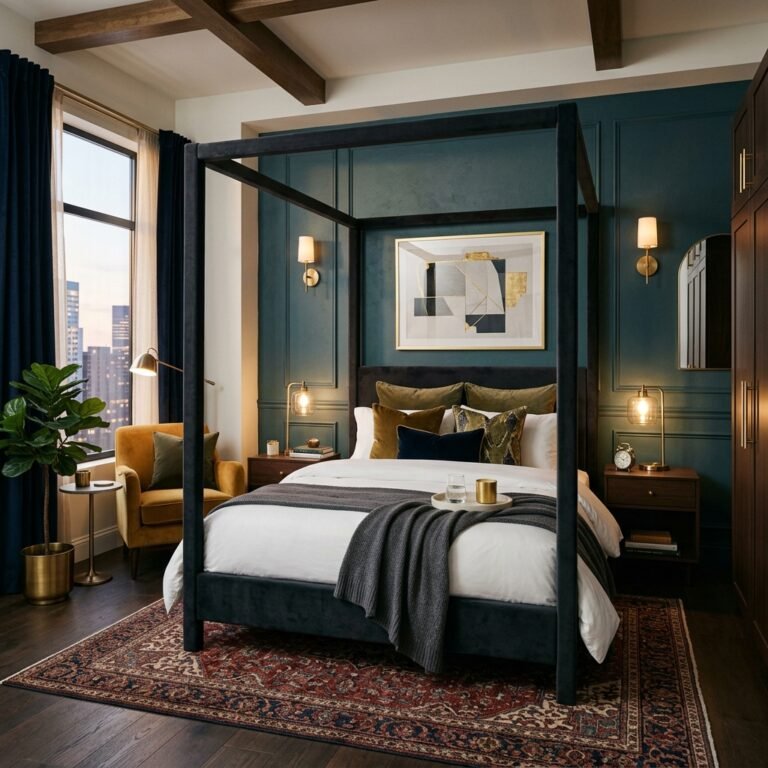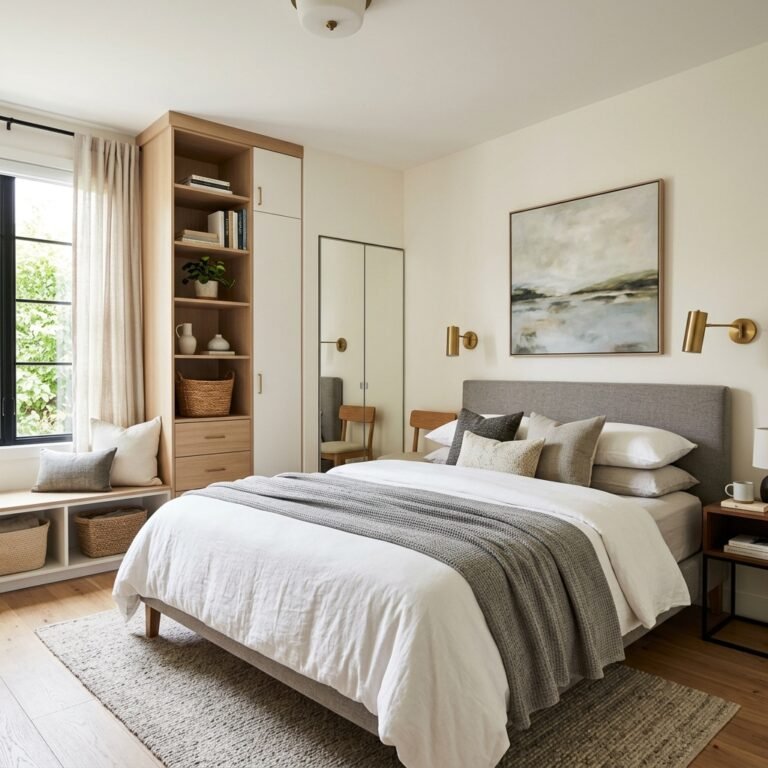

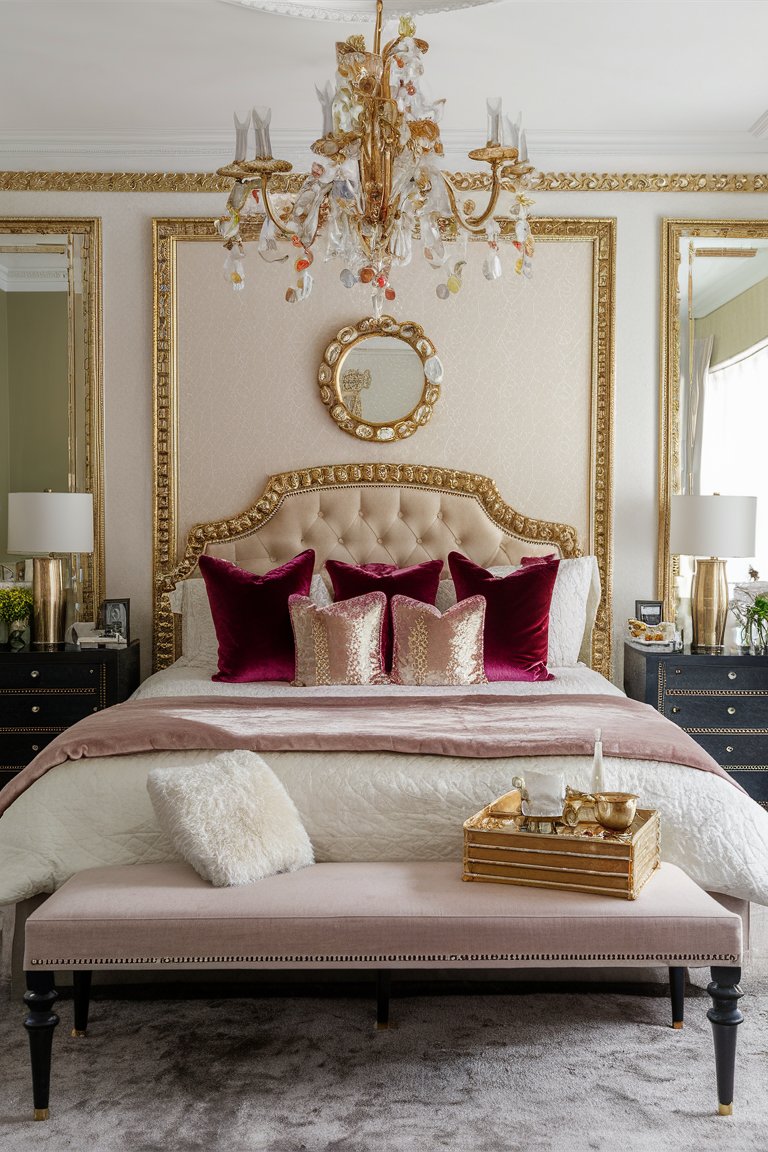
It’s 6:40 on a Sunday evening, and you’ve just hung the last gold-framed mirror. The canopy is up. The chandelier is on. The velvet pillows sit in a neat row, like tiny sofas. You stand in the doorway expecting the Upper East Side. What you get feels more like a hotel suite staged for a photo shoot. Nothing is wrong, exactly. Everything is just loud.
That’s the Blair Waldorf bedroom mistake: copying every signature piece at the same volume. A TV set gets framed, lit and edited, so the viewer only sees the best angle. You live in all of it at once, at 7 a.m. and at midnight. A Blair-inspired bedroom works when a few pieces lead and the rest stay quiet. Here’s how to make that call piece by piece, so the room reads as glamorous instead of costumed.
What the Costume Effect Looks Like in a Real Bedroom
You can spot it in about ten seconds. Your eye lands on the canopy, jumps to the chandelier, slides to the wallpaper, and never finds a place to rest. Four pieces are all asking for attention, so none of them gets it.
Three more signs show up in almost every room that goes wrong. First, the golds don’t match. The lamp bases lean yellow, the mirror frame leans pink, and the drawer pulls land somewhere in between. Second, every fabric has the same sheen, so the bed reads as one shiny block instead of layers. Third, the furniture arrived as a set. Bed, two nightstands and a dresser in one finish look like a showroom floor.
Try a quick check. Photograph the room from the doorway and switch the photo to black and white. If you can’t point to one thing that leads, you’ve found the problem.
Why Pinterest Boards Set You Up for It
A saved board is a pile of heroes. Each pin shows one great canopy, one great chandelier or one great wall, photographed alone and styled around that single star. You save forty of them. Then you shop the list and bring every star home to the same room.
The math works against you, too. A standard bedroom runs about 11 by 12 feet, and a queen bed takes roughly 60 by 80 inches of it. A canopy, a chandelier and a feature wall then fight over the same sightline. Budget finishes make it worse. Gold on a $40 lamp and gold on a $40 mirror frame come from different factories, and they rarely agree.
The fix isn’t buying less. It’s deciding which pieces lead before you buy anything else.
Pick One Lead Piece and Let the Rest Go Quiet
Choose a single lead piece, one supporting piece, and let everything else sit in the background. The bed zone gives you three honest options.
The canopy is the most dramatic. Skip the full frame and hang a ceiling-mounted rod or ring over the bed, then drop four lined velvet panels around it. Velvet is heavy: a lined pair can weigh 10 pounds or more. Screw the hardware into a ceiling joist, or use toggle bolts rated well above the load. Built this way, a canopy costs roughly $150 to $350. Once it leads, keep the headboard plain.
A tufted headboard is the calmer lead. Pick blush, cream or pale gray, and keep the top edge around 54 to 60 inches from the floor. Taller looks dramatic but swallows the wall in a compact room, and our piece on the headboard mistake that makes small bedrooms feel cramped shows how to judge the scale. With the headboard leading, leave the canopy out and let two matching lamps do the supporting work.
The chandelier works when the bed stays simple. Add your room’s length and width in feet, and that number in inches is a good diameter. An 11-by-12 room points to a fixture near 23 inches. Hang the bottom at least 7 feet above the floor, and put it on a dimmer. If you’d rather see a quieter, neutral take on the same idea, our guide to luxury bedroom decor ideas for an expensive look goes deeper.
Keep Your Golds From Fighting Each Other
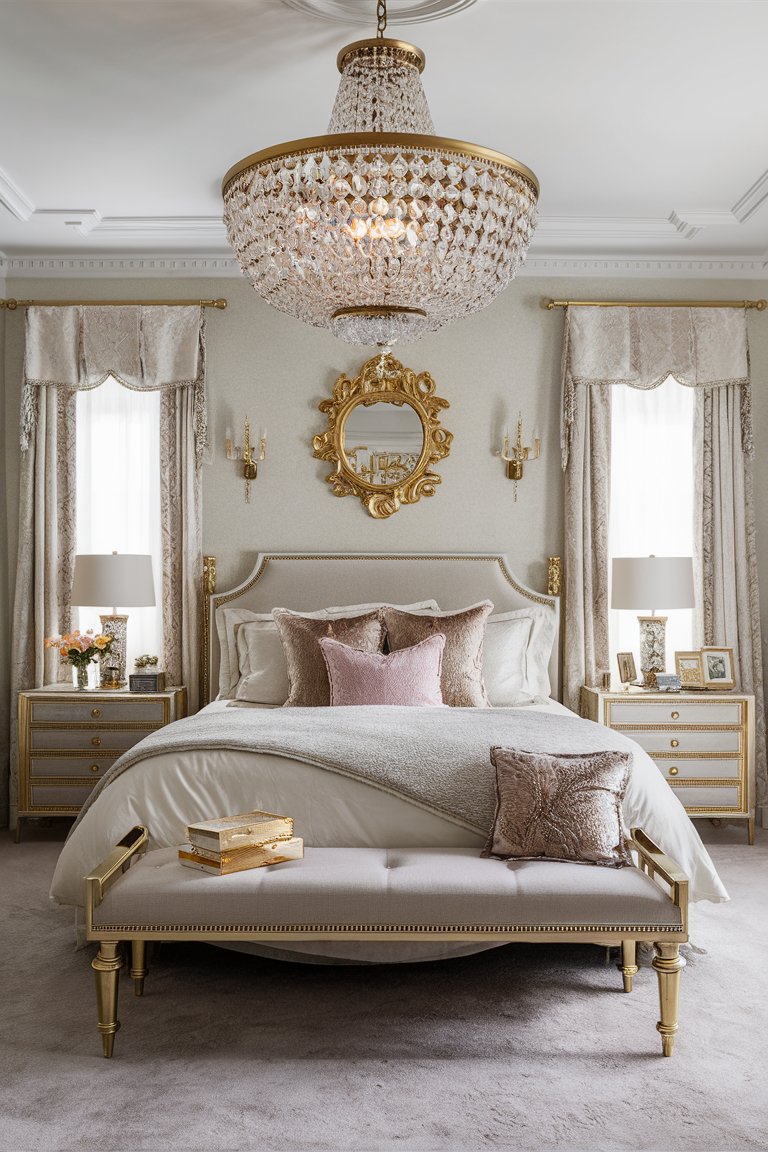
Gold is the thread that ties a Blair-style room together, so it has to be one gold. Brass, champagne, antique gold and rose gold sit on different undertones, and they clash when they share a shelf.
Gather your metal pieces on the bed in daylight. Set aside anything that looks noticeably pinker or greener than the rest. Then pick one finish, such as warm brushed brass, and repeat it in at least three places: lamp bases, the mirror frame and cabinet hardware. Repetition is what makes it look deliberate.
Hardware is the cheapest fix. New pulls for a six-drawer dresser run about $50 to $120. Measure the center-to-center hole spacing first, since 3 inches and 96 millimeters are the common sizes. The wrong spacing means drilling new holes.
For the mirror, lean a tall gold frame against the wall opposite the window so it catches daylight instead of overhead glare. A designer quoted in an Apartment Therapy feature on Gossip Girl-inspired decor recommends balancing curves with a few harder metal elements. That works for gold too: the metal is the contrast, not the whole room.
Nightstands with gold trim follow the same logic. Slim gold legs or pulls on a cream body read as jewelry. A fully gilded nightstand reads as a prop.
Give Pattern One Job
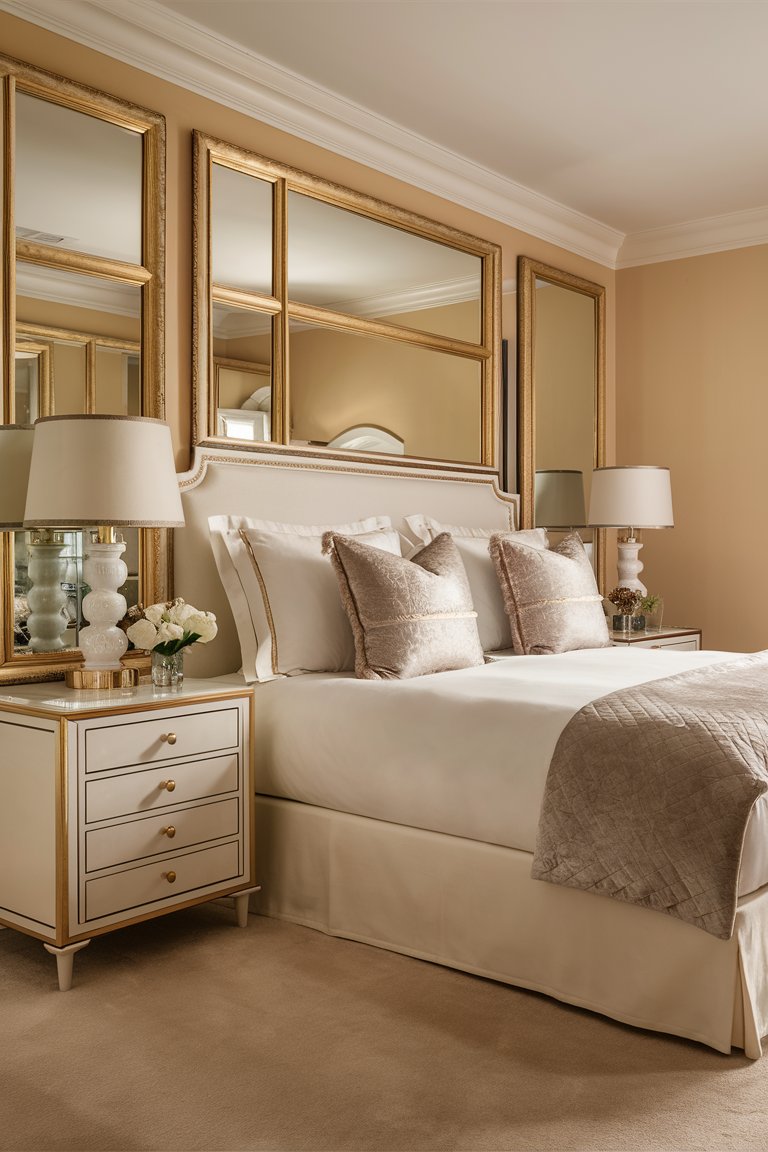
Pattern tips a Blair-inspired room into costume fastest. Floral wallpaper, damask pillows, a striped bench and a patterned rug leave the wall fighting the bed.
Put wallpaper behind the bed only, in one scale, and keep everything in front of it solid. A Parisian stripe or small damask suits a compact room. A large, loose floral reads more modern and gives you the focal point you’d otherwise build with a canopy. Pick one, not both.
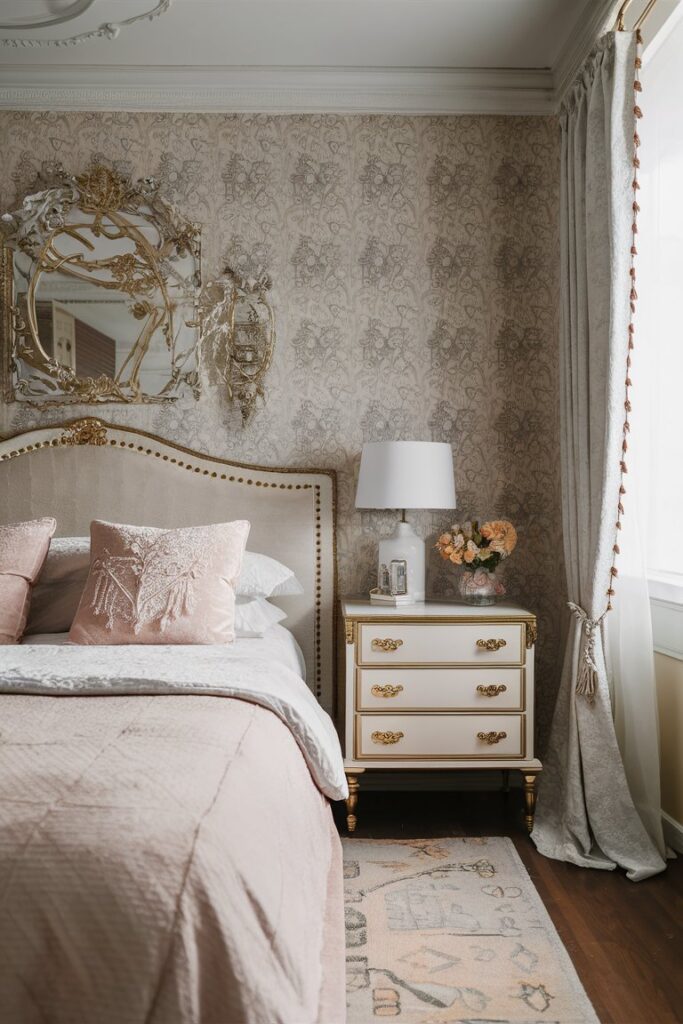
Do the wall math before ordering. A 12-foot-wide, 8-foot-tall wall usually needs three double rolls once you count pattern-repeat waste. Peel-and-stick runs about $30 to $90 per roll. Order 10 to 15 percent extra, and keep a spare panel for repairs.
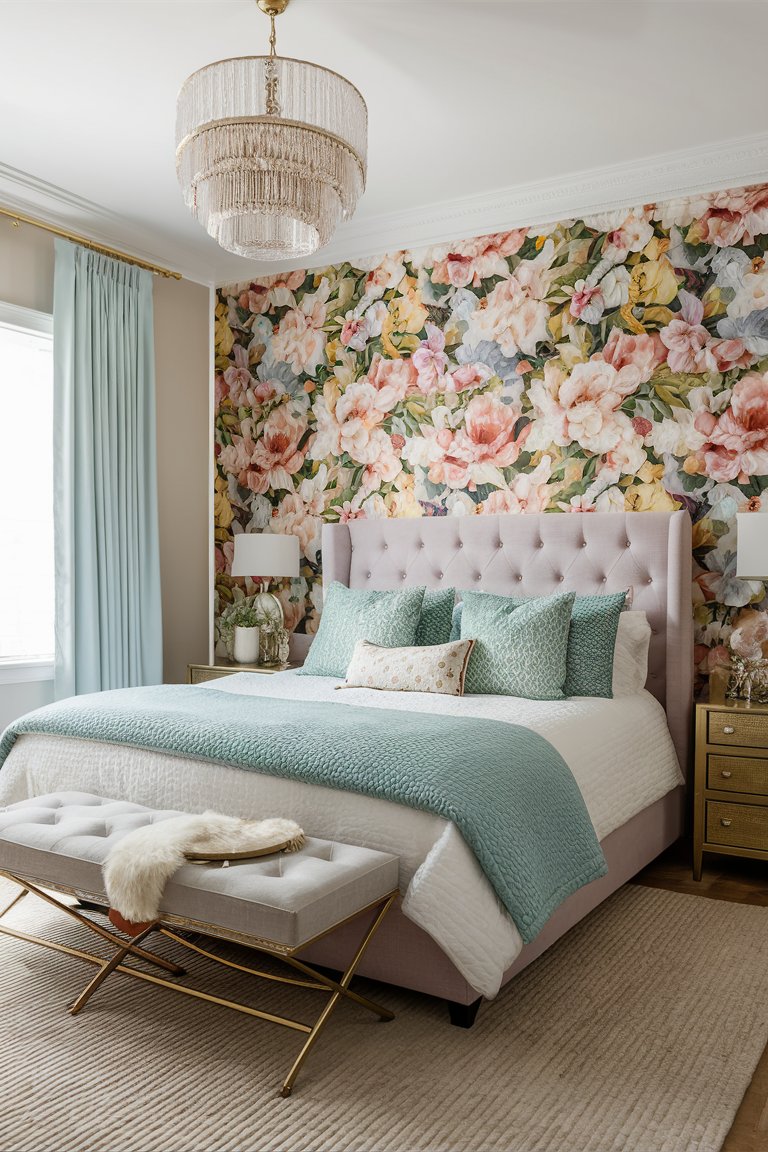
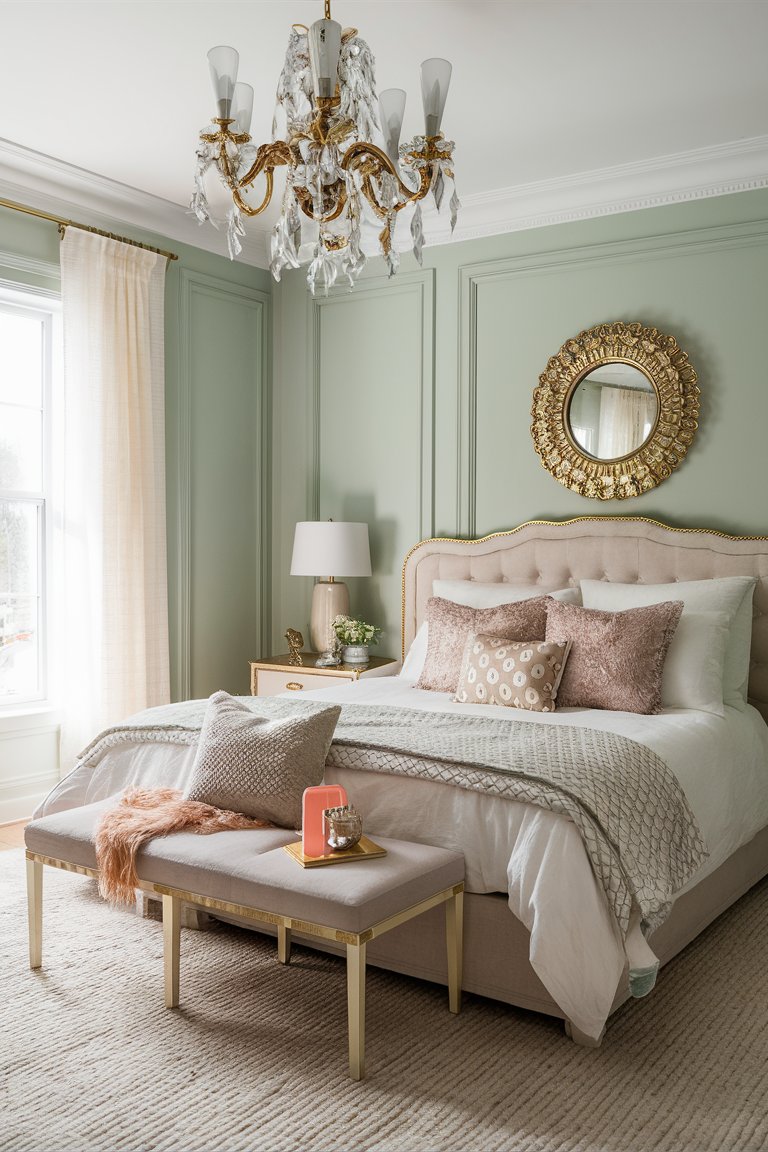
Color follows the same rule. Blush, cream and soft green all live in the pastel family, but when all three sit at equal strength the room looks washed out. Try cream at about 60 percent, blush at 30 and sage at 10. The sage is the surprise, so give it only a pillow, a throw or a lampshade.
Layer Fabrics by Weight, Not by Count
Glam bedding fails when every layer has the same sheen. Mix weights instead: a matte cotton base, one shiny layer and one heavy layer.
Start with crisp cotton sheets. Add satin or silk in one place, such as a duvet cover or a throw across the foot. Satin duvet covers slide against a cotton insert and bunch at the corners, so tie the insert in at each corner. Silk pillowcases are the easier entry. They’re small, they feel good, and they won’t dominate the bed.
A queen bed handles five or six pillows: two sleeping pillows, two 26-inch Euro shams and one lumbar. Past that, the bed turns into a heap. Limit yourself to three textures, such as velvet, linen and satin, all within one color family.
Monogramming is the one custom detail that earns its place. Embroider a single initial on one pillowcase or the folded edge of the duvet, in cream-on-cream or soft gold thread. Expect roughly $10 to $25 per item. One monogram feels personal. Three feel like a hotel gift shop.
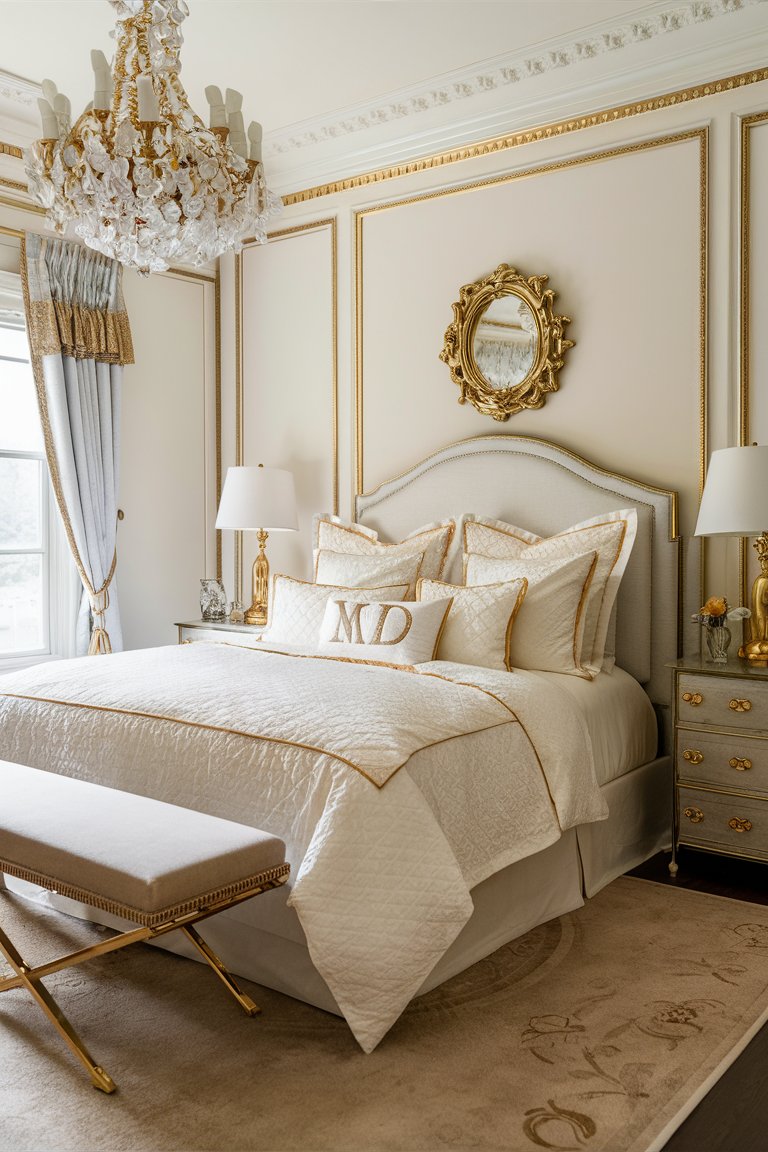
Underfoot, buy at least an 8-by-10 rug for a queen bed. It should extend 18 to 24 inches past each side, so your feet land on it getting out of bed.
At the window, set the rod 4 to 6 inches above the frame. Panels should be two to two and a half times the window’s width, ending a half inch above the floor.
Collect Furniture Instead of Buying a Set
French-style pieces give the room its Parisian streak, but only when they look gathered over time. One carved dresser or one curved-leg accent chair is plenty. Thrifted French provincial dressers usually run $150 to $400 and take paint well. Sand lightly, prime, and finish in warm cream or soft gray.
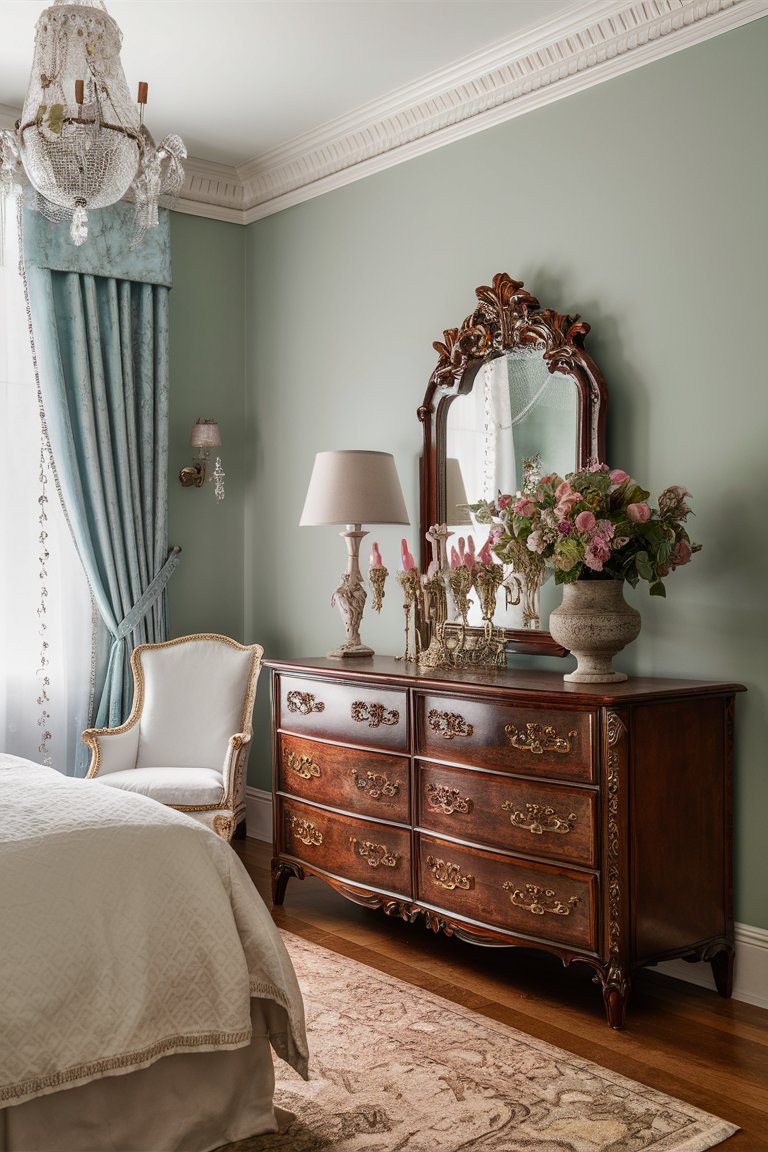
Let your nightstands differ. Two different tables work if their tops sit within about two inches of your mattress height and the pair shares a color or a metal. Match the proportions, not the product number.
A velvet bench at the foot of the bed finishes the zone. Choose one about three-quarters the width of the bed, and leave at least 24 inches of walkway past it. The antique vanity wants natural light, so place it near a window with a stool that tucks fully underneath. Hang the mirror with its center around 60 inches off the floor.
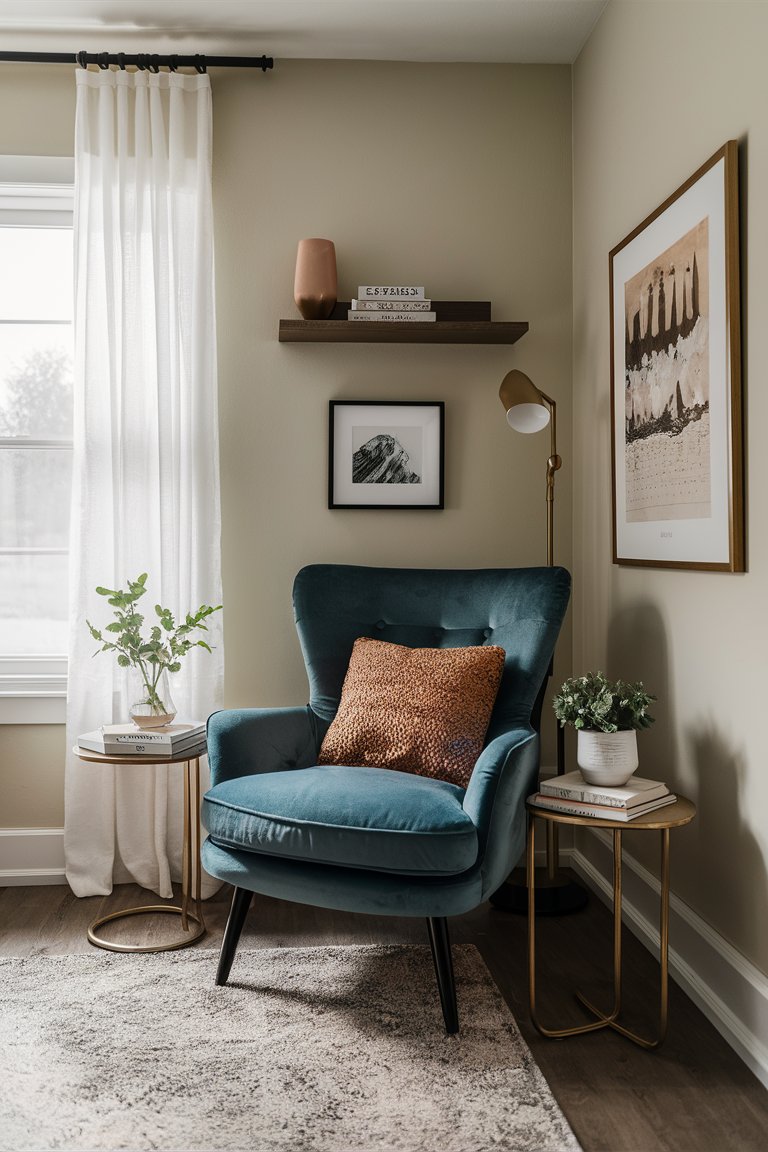
A reading nook only earns floor space if you have a clear 30-by-30-inch patch. A chair jammed against a dresser just reads as overflow.
Light It Like a Dressing Room, Not a Stage
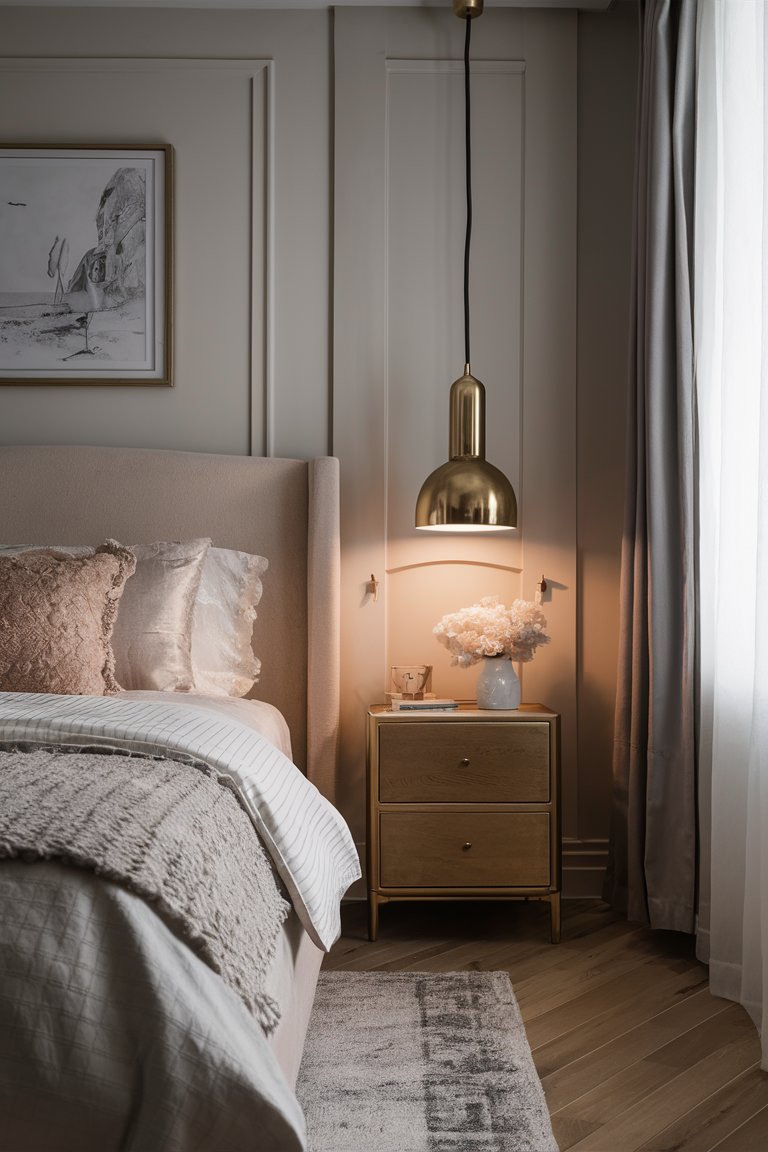
Warm light does more for a glamorous bedroom than any single piece of decor. Use 2700K bulbs with a color rendering index of 90 or higher, so blush and cream look like blush and cream instead of gray. Put every fixture on a dimmer. Plug-in dimmer cords run about $15 to $25 and suit rentals.
Plug-in wall sconces, about $30 to $90, can flank the bed with cord covers hiding the wires. Mount them so the bulb sits near shoulder height when you’re sitting up reading.
Style Surfaces in Small Groups
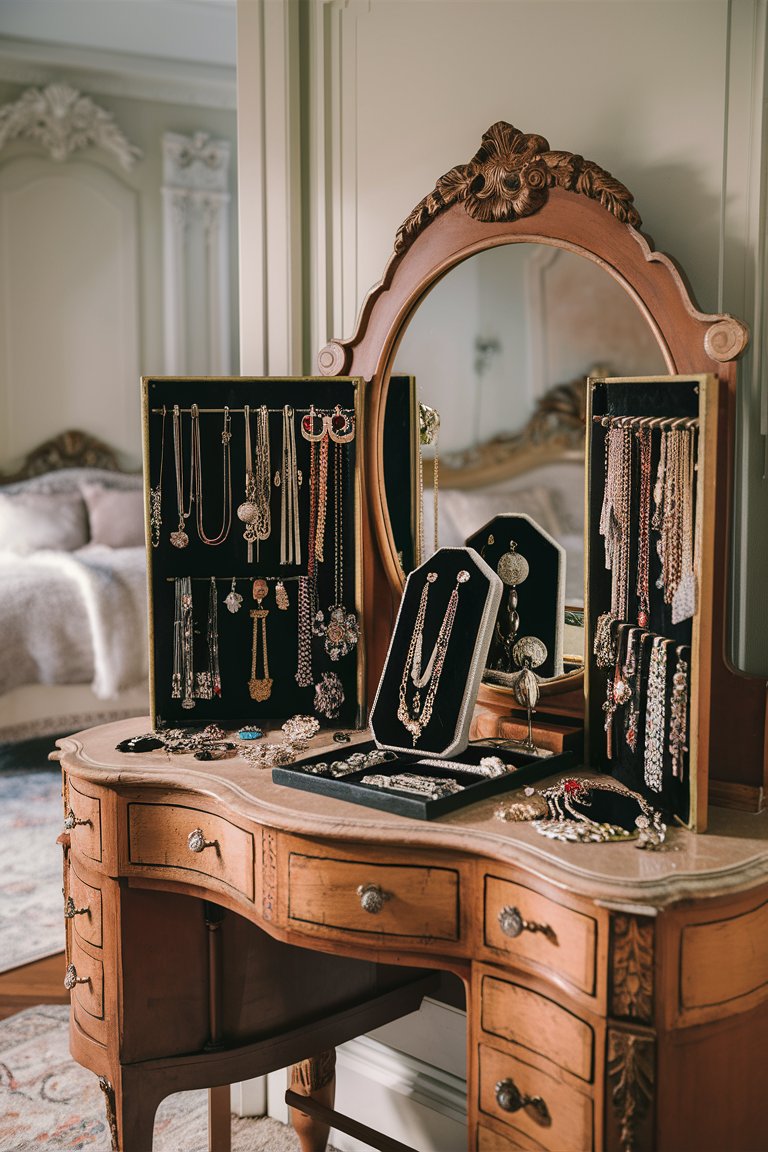
A tray makes a cluster look intentional. Set three to five perfume bottles on a 10- to 14-inch tray, vary the heights, and leave a visible rim of tray around them. Add one soft element, such as a single stem in a bud vase.Jewelry works the same way. An antique-finish organizer with a few pieces on display reads as styling. A tangle of necklaces reads as clutter. Keep daily wear out and the rest in a drawer.
Treat Walls, Ceiling and Closet as the Quiet Frame
A gallery wall in matching gold frames needs 2 to 3 inches between pieces and a center point near 57 inches. If wallpaper already sits behind the bed, hang the gallery on another wall.
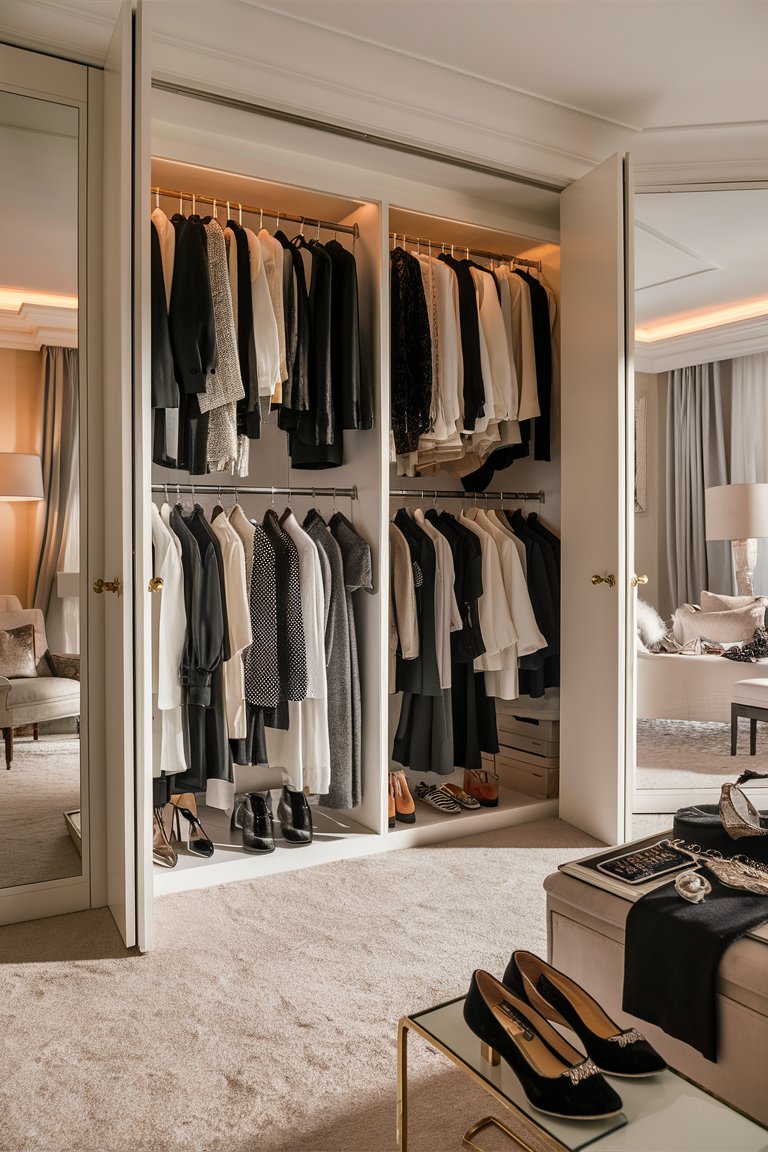
Crown molding adds architecture cheaply. Paint it the wall color for a soft, seamless edge. Pre-primed MDF runs about $1 to $3 per linear foot, so an 11-by-12 room needs roughly $50 to $140 in material, plus caulk. In the closet, uniform slim hangers and sorting by category do most of the work. Stick-on motion-sensor LED strips, about $15 to $30, finish the dressing-room look without an electrician.
Making the Look Work in a Small Bedroom
In a room under 10 by 10 feet, pick the lead piece and cut the supporter. Choose a semi-flush fixture under 18 inches, hang curtains near the ceiling, and swap a bulky nightstand for a shelf or a 14-inch-wide table. Slide a 5-by-8 rug under the lower third of the bed.
The Doorway Edit Test
When the room feels finished, photograph it from the doorway in black and white. Point to the one thing your eye hits first. Count the metal finishes; more than two means something goes back. Cover the pattern with your hand. If the room suddenly feels calmer, the pattern is competing.
Then remove one object and wait a day before judging. Most overdone rooms are exactly one object away from right.
Frequently Asked Questions
What paint color gives a Blair Waldorf bedroom feel?
A warm cream with a slight yellow undertone is the safest base. Add a soft blush on a gray base as the accent, so it doesn’t read bubblegum. Sample both on two walls and check them at 8 p.m. under lamplight, because blush often shifts pinker at night. Most sample pots cost $5 to $9.
Can I get a Blair-inspired bedroom in a rental?
Yes, and almost nothing needs a drill. Use a freestanding canopy frame, peel-and-stick wallpaper, plug-in sconces and a leaning mirror. When you move out, warm the wallpaper with a hair dryer for about 30 seconds per section. It usually lifts cleanly from satin or semi-gloss paint, though flat paint can pull.
How much does it cost to build this look?
Plan on $400 to $900 if you thrift the furniture and buy new textiles, lamps and a mirror. Add $600 to $1,500 for a new upholstered headboard and wallpaper. The biggest savings come from skipping the matched set: a $250 thrifted dresser painted cream beats a $900 boxed one.
How is Blair Waldorf style different from Hollywood Regency?
Blair’s look is softer and leans prep-meets-Parisian, while Hollywood Regency relies on high-contrast black and white, lacquer and mirrored furniture. Blush, cream and curved wood sit on one side. Glossy finishes and bold geometry sit on the other. More than one mirrored furniture piece means your room is drifting toward Regency.
What fabric holds up best on velvet headboards and benches?
Performance velvet in polyester holds up best. Look for 30,000 double rubs or more on the Wyzenbeek test, the heavy-use residential benchmark. Vacuum weekly with an upholstery brush, blot spills instead of rubbing, and keep it out of direct afternoon sun, which fades deep pinks and greens faster than cream.
Conclusion
Blair’s bedroom works because someone decided what the room’s main event was. Yours can do the same. Choose the canopy, the headboard or the chandelier. Settle on one gold and repeat it three times. Let a single wall carry the pattern, and keep the fabrics different in weight rather than all shiny. Do that, and the room reads as glamorous and lived in, not staged. Start this weekend with the smallest step: gather every gold item in daylight and see which ones don’t belong.