

Six weeks ago your living room was beige. Now it has an emerald velvet sofa, a sunburst mirror, a marble coffee table, two brass floor lamps, and a chevron rug. Every piece looked incredible in the store. On the first evening you sit down, glance around, and think of a hotel lobby: handsome, expensive, and a little like you’re waiting for a check-in desk.
Nothing in that room is wrong on its own. The trouble is that every piece speaks at the same volume. The Art Deco interiors that Neo-Deco borrows from ran on hierarchy: one dramatic centerpiece, a few supporting players, and quiet surfaces that let both breathe. Copy the materials without the hierarchy and you get a showroom. Here are the specific ways that happens, what causes each one, and how to fix it without starting over.

Why Five Statement Pieces Cancel Each Other Out
Walk to your doorway and squint. If you see four or five shapes of equal weight, your eye has nowhere to land, and the room gets filed under “staged.” That is the core mistake, and every other problem below is a version of it.
It happens because you shop one item at a time. A sunburst mirror looks great on a white product page. So does the sofa. So does the lamp. Judged alone, each earns the word “statement.” Together they compete.
Fix it by assigning roles before you buy anything else. Pick one lead, the thing you want to see first from the door. It could be the sofa, a saturated wall, or a chandelier, but only one. Pick two supports at roughly half that visual volume. Everything else is background: solid, calm, and quieter than feels necessary. Repeat the squint test after every change. When one shape wins the first look and a second wins the next, the hierarchy is working.

Metals That Share a Name but Not a Sheen
You bought polished brass lamps, brushed gold cabinet pulls, and chrome table legs. All three say “metallic,” so they should get along. They don’t, because undertone and sheen decide whether metals agree, not the word on the label. Polished brass reads yellow and mirror-bright. Brushed gold looks softer and a little pink. Side by side, one always looks like the knockoff.
Test undertone with a sheet of plain white paper. Hold each piece against it in daylight and note the cast: yellow, rose, or faintly green. Then sort by sheen. Polished goes with polished, satin with satin. Where two metals still disagree, put a matte black or glass object between them on the shelf or console. It works as a neutral buffer. If one piece is the outlier, replace the smallest, cheapest item first, such as a lamp finial or a drawer pull, before you replace the lamp.
Finish changes with age, too. Unlacquered brass darkens and warms over several months, so a lamp that matched in March may not match in September. Lacquered brass stays bright, but abrasive polish strips the coating and leaves cloudy patches. Decide which aging you want before you mix the two in one room.

The Lobby Effect: One Switch Lights Everything
Hotel lobbies are lit evenly from above because they serve hundreds of strangers. Your living room serves you, in the evening, with a drink in hand. If one ceiling fixture on one switch controls all the light, the room reads as a lobby no matter what furniture sits under it.
Turn the overhead off for a week. Build three or four pools of light instead: a table lamp on a console, a floor lamp behind the sofa, and a lamp or pair of sconces on the far wall. Put each on its own switch or smart plug, so you can change the mood without crossing the room. Set shades so the bottom edge sits near seated eye level, about 40 to 42 inches from the floor, which keeps the bulb out of your eyes. A bulb in the 450 to 800 lumen range, the old 40 to 60 watt equivalent, gives a soft pool instead of a spotlight.
Bulb quality matters as much as placement. The U.S. Department of Energy’s Energy Saver guidance on lighting terms suggests roughly 2700 to 3600 K for general home lighting. It also treats color rendition, meaning how faithfully a bulb shows true colors, as the more important quality. So check the box for a CRI of 90 or higher, which keeps jewel tones rich instead of muddy. Buy bulbs for a matched pair of lamps from the same box, since batches vary slightly. Add an LED-rated dimmer, which typically costs $20 to $40.

Velvet Pieces That Never Quite Match
You bought the emerald sofa in January. In March you added an emerald chair from a different brand. By evening the two greens drift apart, and one looks flatter than the other. Velvet is the touchiest fabric in a Neo-Deco room because its pile reflects light differently depending on the angle you view it from.
Three things cause the mismatch: fiber, dye lot, and pile direction. Cotton velvet absorbs light and looks matte, while polyester velvet glints. Dye lots differ between production runs. Even pillows cut from one bolt read as two shades if the pile runs up on one and down on its neighbor.
Let one velvet piece lead in your saturated color, then answer it with other textures in the same family: a boucle chair, a wool throw, linen-blend curtains. If you truly want two velvets, order swatches from both makers and compare them side by side under your lamps at night. In a store or in daylight, they will lie to you. When buying a matched set, ask for pieces from the same dye lot.
One practical warning before you order anything curved: a curved sofa cannot be tipped on its end the way a straight one can. Measure stair turns and doorways, not just the room, because the path in decides whether it arrives at all.

Pattern on Every Plane
Geometric wallpaper behind a geometric mirror, above a chevron rug, beside fan-print cushions. Each choice felt safe because Deco motifs share a family. A shared family still isn’t a calm room. When every surface carries a pattern at a similar scale, you read static.
Give patterns a pecking order. Use one large-scale pattern as the lead, usually the wallpaper or the rug. Add one medium-scale pattern on a textile, and one small detail such as piping or a border. Keep everything else solid. If the floor already carries a pattern, like graphic tile or herringbone, keep the rug solid or border-only.
Here is a one-minute diagnostic. Photograph the room and switch the photo to black and white. High-contrast patterns jump out and fight each other. Patterns that soften into texture are doing their job. Then step to the far side of the room. At ten feet, a pattern should read as either a texture or a shape, never both. If wallpaper still looks like fussy individual motifs, the repeat is too small for the wall. A larger scale will look calmer, not louder.

Dark Walls With Nothing to Light Them
You painted one wall emerald on a Saturday. By four on Sunday afternoon the room feels like a cave. Dark paint absorbs light instead of bouncing it, so a room with one window and no wall-level lighting cannot carry it.
Test before you commit. Paint two coats of the sample on a two-foot square of poster board, then move it from wall to wall and check it at 8 a.m., noon, and 8 p.m. Dark shades shift more than light ones as daylight changes, and a color that looks rich at noon can turn near-black by evening. Ask the paint counter to tint your primer toward gray, which can save a coat on deep colors.
Choose a washable matte or eggshell. Flat dark paint shows rub marks wherever a sleeve or a sofa back touches it. In a small room, carry the color across the ceiling and trim, because a hard white ceiling line chops the walls into a box. Then give the wall company: a lamp or sconce at wall height with a warm bulb, plus something reflective opposite the window so the light has somewhere to travel.

Mirrors That Reflect the Wrong Thing
The sunburst mirror above the sofa looked right in the listing. Now you sit down and see the back of the TV, a radiator, and last week’s mail. A mirror is a second window onto whatever it faces, so placement matters more than the frame.
Sit where you usually sit and look at the mirror before you drive a nail. It should show a light source, a plant, a piece of art, or an interesting ceiling, never clutter. Hang it 6 to 8 inches above a sofa or console so it reads as part of the furniture group.
Watch for glare, too. A mirror opposite a window can throw a bright hot spot onto a TV screen at certain hours of the day. Check the weight before you hang it. A large metal sunburst often weighs 15 to 30 pounds, which calls for a stud or a rated wall anchor, not a single nail.

Too Many Hard Surfaces and Not Enough Give
Clap your hands in the middle of the room. If you hear a sharp flutter, there are too many hard surfaces. Marble, mirror, glass, polished tile, and brass all bounce sound back, and that echo is part of why the space feels cold even when the palette is warm.
Fix it with soft mass, not more decor. Hang lined, floor-length curtains that stop about half an inch above the floor. The lining adds weight and absorbs sound, and ready-made lined panels often cost $50 to $120 each. Slide a thick felt pad under the rug, which dampens footsteps more than the rug alone. Add one bulky upholstered piece, such as a velvet ottoman, in the corner where the echo is worst. Then clap again.

A Subtraction Audit You Can Finish in One Afternoon
If your room already feels like a lobby, do not buy a calming accessory. Take things away. The whole job takes about three hours.
Photograph the room from the doorway. Clear every small object off shelves and tables and pile it all on the bed. Then label each large piece lead, support, or background, using the roles from the first section. You get one lead. If two pieces claim it, demote one: swap its pillows, give it a plainer lamp shade, or move it to another room.
Now put objects back one at a time, leaving a hand’s width of empty surface beside each. Stop when a surface looks like it could breathe, then compare the room with your photo. Live with the result for a week before you add anything.
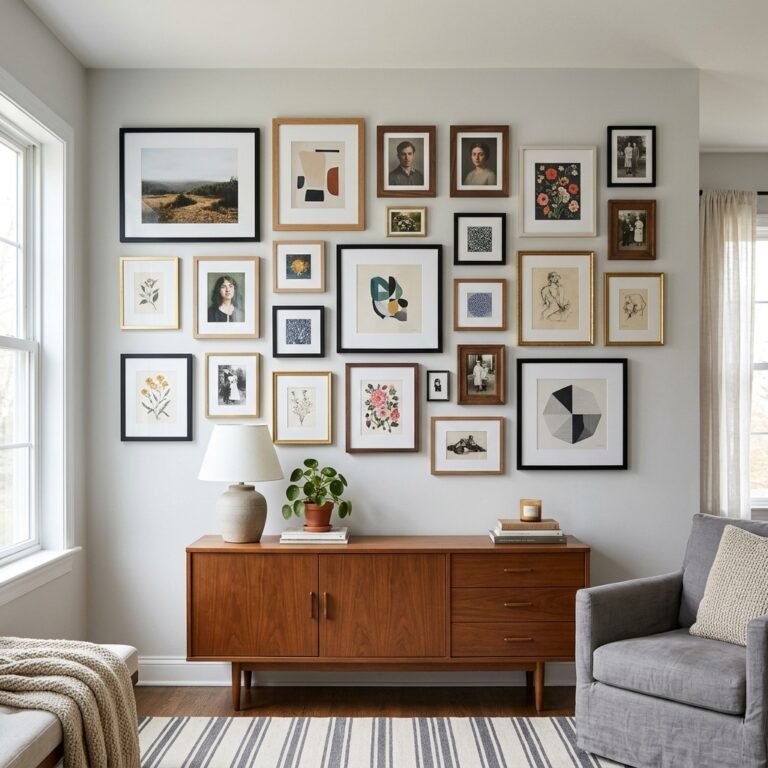
Walls need the same edit. If the area behind your lead piece is crowded, our guide to the gallery wall mistake that makes it look cluttered instead of curated covers spacing. Once the room is calm and you want ideas again, our Neo-Deco ideas for a million-dollar luxe home is the next stop.
Start with the mirror. Carry it to another room, leave the gap for three days, and see if you miss it.

Frequently Asked Questions About Neo-Deco Rooms
Is Neo-Deco the same as Art Deco?
No. Art Deco is the 1920s and 1930s movement, while Neo-Deco is a modern reinterpretation that keeps the geometry and metals but simplifies the silhouettes. The materials differ too. Original Deco leaned on lacquer, inlaid wood, and chrome, whereas Neo-Deco rooms usually use performance velvet, LED lighting, and fluted surfaces that are easier to live with.
Can I mix Neo-Deco with a minimalist room?
Yes, and it often works better than a full Deco room. Keep walls and large furniture quiet, then add one or two Deco pieces, such as an arched mirror and a pair of brass sconces. A useful limit is one lead piece per room, with everything else in matte, neutral finishes that give it space.
How do I clean velvet and brass without damaging them?
Check the tag first. Velvet carries a cleaning code: W means water-based cleaner, S means solvent only, WS allows either, and X means vacuum only. Vacuum weekly with a soft brush attachment. For lacquered brass, wipe with a damp microfiber cloth and skip abrasive polish, which strips the coating.
Can I make a gray sofa I already own work in a Neo-Deco room?
Yes, because gray makes a quiet background. Dress it with two velvet pillows in a single jewel tone, add a metal-framed side table, and let a different piece act as the lead. If the legs are plain wood, replacement legs in a brass finish often run $30 to $80 per set and change the silhouette.
How long should I wait before buying more pieces for the room?
Wait one to two weeks after your last purchase. A room needs several full days of morning and evening light before you can tell what is missing and what is too much. Keep a running note on your phone, and buy only the item that shows up on that list more than once.

1 comment