
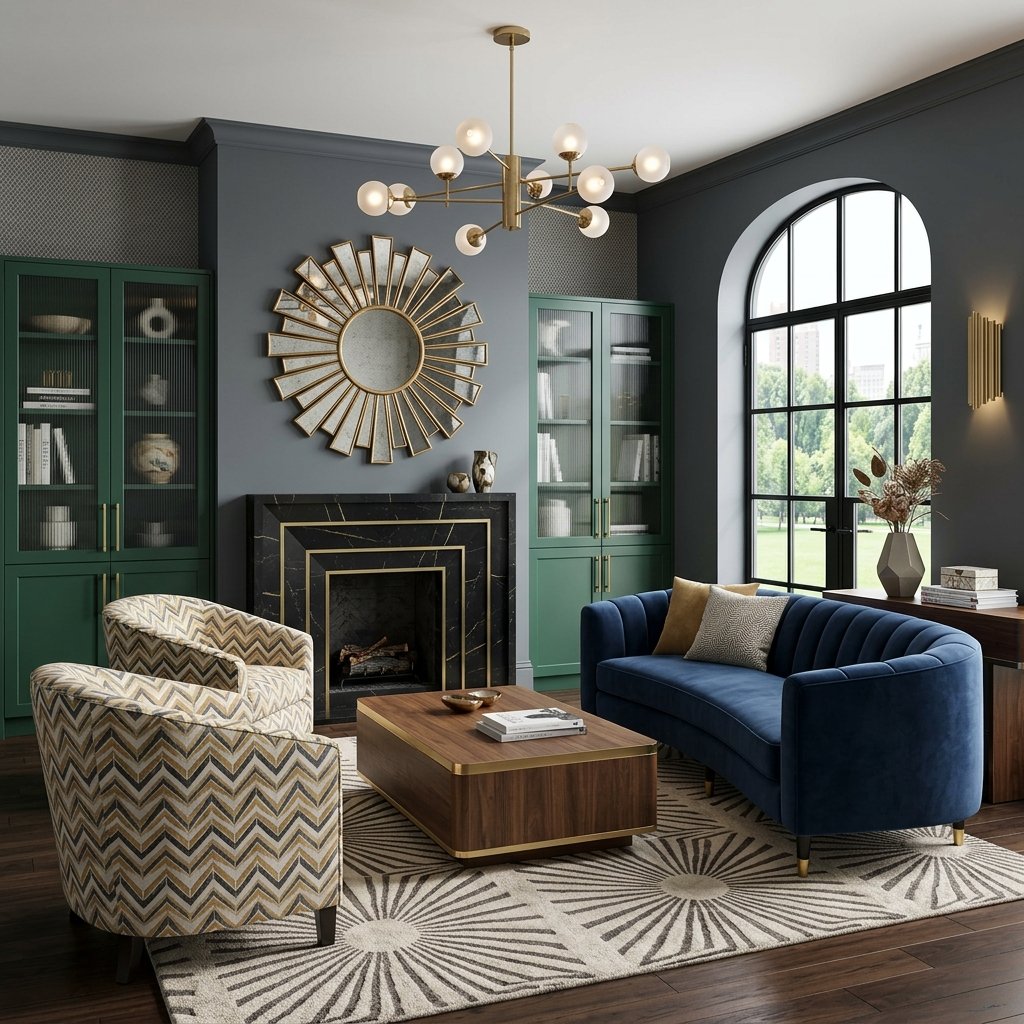
You get home after a long day, drop your keys on the console, and really look at the living room for the first time in weeks. The sofa is fine. The rug is fine. Everything is fine, and that is exactly the problem. You catch yourself thinking, “Is my home ugly?”
It almost never is. It is usually flat. The light is flat, the color is flat, and nothing makes your eye stop and linger. Neo-Deco fixes flatness better than almost any other style, because it runs on contrast: shiny against matte, curved against angular, dark against light.
This guide covers twenty ways to use it. Each one starts with a symptom you can spot from your sofa, then gives a fix with real measurements. You do not need all twenty. Pick the two or three that match what bothers you most.

Understanding Neo-Deco: A Blend of Past and Present
Neo-Deco is Art Deco with the volume turned down and the editing turned up. To see why that works, it helps to know what it borrows.
Origins of Art Deco
Art Deco peaked in the 1920s and 1930s. It takes its name from the 1925 Paris exhibition of modern decorative and industrial arts. The style celebrated machines, speed, and new materials, so it favored streamlined shapes over the flowery curves of Art Nouveau.
Look for a few signature motifs. Sunbursts, chevrons, zigzags, and stepped forms that echo ziggurats all come from this era. So do chrome, glass, lacquer, and mirrored surfaces. The original palettes were dramatic, with black, gold, and deep jewel tones.

How Neo-Deco Reinvents Classic Design
Original Art Deco filled a room with ornament. Neo-Deco keeps the best three or four ideas and drops the rest. You get one dramatic mirror instead of a wall of them, and one sculptural chair instead of a matched suite.
The changes are easy to spot. Curves soften the hard angles. Brushed brass and champagne gold replace the shiny chrome of the 1930s. Lighting is warm and layered instead of theatrical. The palette leans on earthy neutrals, with jewel tones saved for a few chosen spots.
That restraint is what makes the style livable. It also explains why Neo-Deco can look expensive without costing a fortune. The effect comes from contrast and placement, not from buying more.
Geometric Glam
Symptom: the room has no pattern, so your eye slides right off it.
Choose one hero pattern. A zigzag rug, a chevron wallpaper, or an angular mirror frame will do. Then repeat that same shape twice in smaller items, such as a lamp base and a cushion. Three appearances read as planned. Five read as chaos.
In a small room, go tone on tone. A pattern in two close shades adds depth without shrinking the walls. Save high contrast for rooms with space to carry it.

Bold Color Statements
Symptom: everything is beige and you cannot say why it feels dull.
Try a simple ratio. Keep about 60 percent of the room neutral, 30 percent in a secondary shade, and 10 percent in your boldest color. Emerald, navy, and plum all suit Neo-Deco.
Paint one wall or the lower half of a wall, not the whole room. Dark colors soak up light, so test first. Paint a two-foot square of sample on poster board and tape it up. Check it in morning light and again at night under your lamps.

Metallic Accents Everywhere
Symptom: you own brass, chrome, and gold pieces, and they look like an accident.
Pick one lead metal and one supporting metal. Brass leading with black as support is a safe pair. Limit yourself to three finishes in the whole room.
Then repeat each finish at least three times, spread across different heights. A brass lamp, a brass frame, and brass drawer pulls tie a room together. A single brass vase sitting alone looks lost.

Mirrored Elegance
Symptom: a dark corner or a narrow room that never feels bright.
Hang the mirror where it catches window light, on the wall beside or opposite the window. A mirror facing a messy shelf only doubles the mess.
Size it to the furniture below. Aim for roughly two thirds the width of the console or sofa, and hang it six to eight inches above the surface. Bronze or smoked glass softens the shine and suits a muted palette better than clear silver.

Luxe Lighting Fixtures
Symptom: you installed a gorgeous fixture and the room still looks harsh at night.
The fixture is rarely the culprit. The bulb is. ENERGY STAR explains that light color is measured in kelvins, and a lower number means warmer, more yellow light. For Neo-Deco, choose bulbs labeled soft white or warm white, around 2700K. Brass glows under them. Under cool bulbs it looks like a dental office.
Shop by lumens, not watts, since lumens measure brightness. About 800 lumens replaces an old 60-watt bulb. Then layer three light sources at different heights, such as a ceiling fixture, a table lamp, and a floor lamp, and put the main fixture on a dimmer. Over a walkway, keep a chandelier at least seven feet above the floor.

Sculptural Furniture
Symptom: everything matches, and the room still has no personality.
Matched sets are the usual cause. Replace one piece with something that has an unusual outline. A scalloped-back chair, an asymmetrical armchair, or a faceted coffee table all work.
Let that piece breathe. Leave about a foot and a half of clear floor around it so the silhouette reads. Keep the pieces nearby simple. A sculptural chair beside a sculptural sofa and a sculptural table just creates noise.

Layered Textures
Symptom: the colors are right, yet the room looks flat in photos.
Use the rule of three textures. Choose one soft material, like velvet or wool. Add one hard or shiny material, like glass, brass, or polished stone. Then add one matte natural material, like oak, linen, or leather.
Stay within two color families so the texture does the work. A velvet cushion beside a marble tray beside a woven throw creates depth that no paint color can match.

Statement Rugs
Symptom: the furniture seems to float, and the rug looks like a postage stamp.
Size is the fix. In most living rooms, an 8 by 10 rug works. Choose 9 by 12 for larger rooms. At minimum, the front legs of every seat should sit on the rug.
If the rug is boldly patterned, keep the sofa a solid color. Let the floor be the loud element and the furniture the calm one. Deep jewel tones and geometric weaves both suit the style.

Curved Sofas and Chairs
Symptom: the room is all right angles and feels boxy.
A curved sofa breaks that up fast, but it takes more floor than a straight sofa of the same width. Before you buy, mark its footprint on the floor with painter’s tape. Leave 30 to 36 inches for walkways around it.
Pair it with a round coffee table so the curves echo each other. Slim brass or chrome legs keep the look light. A single curved chair in a corner also works if the sofa has to stay straight.

Monochrome Magic
Symptom: you want calm, but gray keeps turning dull.
Monochrome works when you vary the finishes rather than the colors. Use black, white, and charcoal, then mix matte paint, high-gloss lacquer, and nubby fabric. A polished chrome frame against a matte charcoal wall gives the room its edge.
Watch the lighting here. Black and white under cool bulbs turns clinical fast. Warm 2700K bulbs keep it elegant.

Art-Inspired Walls
Symptom: your walls are bare, or your art looks too small for them.
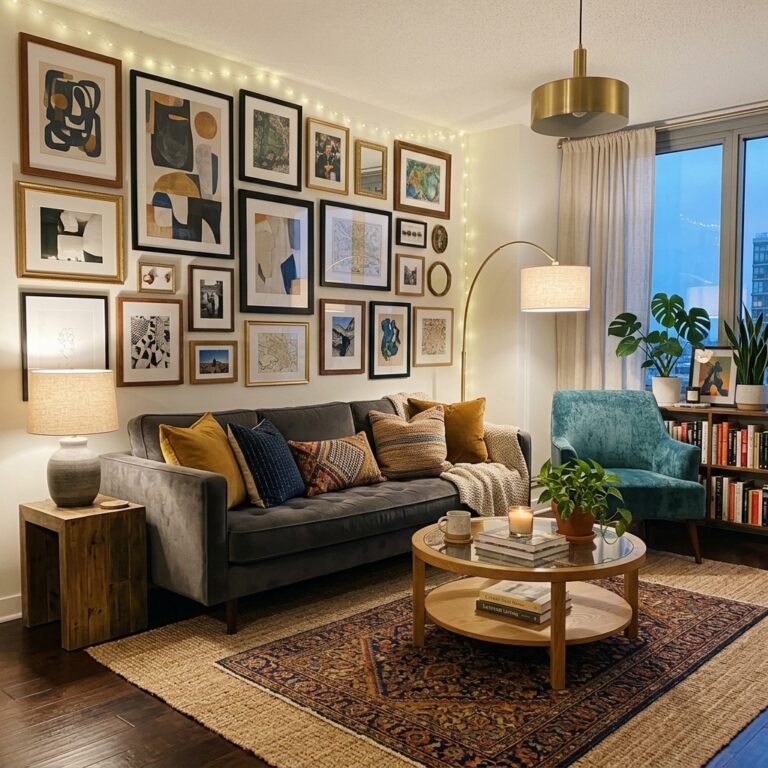
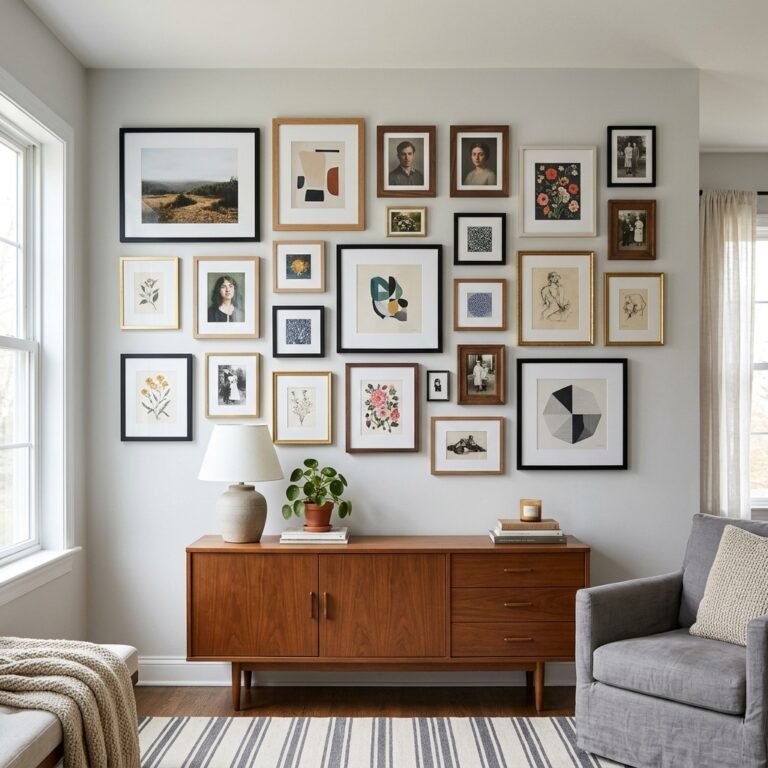
Hang art with its center around 57 inches from the floor. That puts it at eye level for most people. Above a sofa, choose art about two thirds the sofa’s width, with its lower edge six to eight inches above the cushions.
For a group of frames, keep two to three inches between them. Use matching frames in brass or black. A slim brass picture light adds the gallery glow.

Minimalist Neo-Deco
Symptom: the room is either cluttered or cold, with nothing in between.
Edit with a firm rule. Leave about a third of every surface empty. Give each zone one statement piece, such as a curved armchair or a geometric chandelier, and keep everything else quiet.
Add shine in small doses. Brushed brass legs on a table or a chrome detail in a light fixture is enough. Textured fabrics like bouclé stop the calm palette from feeling clinical.

Vibrant Glass Decor
Symptom: the console and windowsill feel dead, and shelves look heavy.
Colored glass solves both, because light passes through it. Put saturated vases and bowls where sunlight or a lamp can reach them. Emerald and amber glow best.
Group them in threes, at different heights, in related colors. A mirrored tray underneath doubles the sparkle. Clear glass adds almost no visual weight, so it helps on crowded shelves.

Jewel-Toned Accessories
Symptom: you love the color, but you are not ready to repaint.
Start with the smallest things. Swap two pillow covers, add one lacquer tray, and set out a few candles. Velvet pillow covers cost far less than new sofas, and you can change them with the seasons.
Cap the accent colors at three. Pull one from your rug or art so the room feels linked. Pair them with brass or gold to bring out their depth.

Elegant Partitions
Symptom: your open-plan apartment has no zones, so the sofa floats in the middle of nowhere.
A folding screen defines space without building a wall. Choose one about six feet tall. It blocks sight lines from the door, yet leaves the ceiling visible, so the room still feels open.
Look for geometric cutouts, sunburst patterns, or fluted glass. These let light through. Place the screen behind the sofa or between the entry and the seating.

Retro Futuristic Corners
Symptom: one corner of the room has been empty for a year.
Build a small triangle there: a rounded chair, a slim side table, and a chrome arc or floor lamp. The three points give the corner a purpose. Soft rounded edges keep it playful, not cold.
For reading, set the lamp so the bottom of the shade sits at about eye level when you are seated. Then the light falls on the page and not in your eyes.

Nature Meets Deco
Symptom: all that marble and glass makes the room feel hard and echoey.
Add one large plant with strong leaf shapes. Its irregular outline contrasts nicely with straight lines. Pick the plant to suit the light. A fiddle leaf fig wants bright, indirect light, while a snake plant tolerates dim corners.
Choose the planter as carefully as the plant. A brass or faceted geometric pot echoes your metals. Put a saucer underneath, since moisture will mark marble and polished wood.

Statement Headboards
Symptom: the bed looks small, and the bedroom has no focal point.
An oversized upholstered headboard fixes both. Choose velvet or a tufted, channeled, or scalloped shape. It should run a few inches wider than the mattress on each side. Taller is more dramatic.
Flank it with matching lamps or sconces at the same height. Brushed gold nightstands against soft velvet give you the hard-and-soft contrast Neo-Deco loves. For more ideas on the room as a whole, see our apartment bedroom ideas with a boutique hotel feel.

Neo-Deco Bathrooms
Symptom: your bathroom is builder beige and forgettable.
Geometric tile does the heavy lifting. Hexagons, chevrons, or a black-and-white pattern all work on a floor or a single wall. Add a brass faucet and a faceted mirror, and a small powder room starts to feel like a jewel box.
Lighting matters most here. Place a sconce on each side of the mirror, about 60 to 66 inches off the floor, to avoid shadows on your face. Near water, check that fixtures carry a damp or wet rating.

Personalized Glam Corners
Symptom: the house looks styled, yet it does not look like yours.
Glamour needs a human touch. In one corner, set a family heirloom on a metallic pedestal, or frame a few vintage prints above a favorite chair. One personal object per vignette is plenty.
Tie the corner back to the room by repeating its metal. If you rent and cannot change much, start here. Our budget Neo-Deco ideas for renters show what to do without touching the walls.

Conclusion
Your home is probably not ugly. It is probably under-edited, and that is much easier to fix. Start with the cheapest changes: warmer bulbs, a rug that fits, and one mirror hung in the right place.
Then add a single bold move, like a curved chair or a deep wall color. Repeat your metals, keep your textures varied, and stop before the room feels crowded. Check the room again in a week. You may find the question has changed from “Is my home ugly?” to “Where did that glamour come from?”
1 comment