Walk into a room done right in Neo-Deco, and you feel it before you can name it. The lamp glows a little warmer. The sofa curves instead of squares off. A mirror catches the light and throws it back twice as bright. Nothing in the room is loud on its own. But together it reads as intentional the kind of space that makes a friend stop mid-sentence and ask who did your place.
That’s the whole appeal of Neo-Deco: it takes the glamour of 1920s Art Deco and strips out the fussiness. You get the geometry, the metallics, and the jewel tones, but paired with furniture you can actually sink into. Below are 20 ways to bring that look into your own home, room by room. Each one comes with specific materials, finishes, and placement tips so you’re not left guessing.

What Is Neo-Deco Design?
Neo-Deco is the modern, livable descendant of Art Deco the design movement born in 1920s Paris and popularized in buildings like New York’s Chrysler Building. Where original Art Deco leaned heavy and ornate, Neo-Deco keeps the bold geometry and rich materials but trims the silhouettes down. Furniture gets simpler outlines. Patterns get quieter. The result is a style you could live in every day, not just admire in a hotel lobby.
Three things define it. First, geometry: stepped shapes, fan motifs, and fluting show up on everything from moldings to vases. Second, contrast: dark grounded tones paired with bright metallics or crisp whites. Third, restraint: a Neo-Deco room usually has three or four standout pieces, not fifteen competing ones. Get those three right, and the rest of the room falls into place.

Create Architectural Interest with Geometric Wall Molding
Wall molding is one of the fastest ways to make a builder-grade room look custom. Have a carpenter install it, or take on the project yourself with a miter saw and a well-stocked hardware store. Stepped rectangles, arched panels, and diamond grids all work well using 1-to-2-inch primed pine trim. Paint the molding the exact same color as the wall for a tone-on-tone effect. Or go bolder: black trim against a warm off-white like Benjamin Moore’s White Dove reads as more dramatic. A single accent wall, roughly 10 to 12 feet wide, is usually enough to read as intentional without turning the whole room into a project.
Best placement: a living room feature wall, a dining room, an entryway, or the wall behind a headboard.

Choose a High-Contrast Neo-Deco Color Palette
A high-contrast palette is the foundation of the whole look. Pair black with ivory, emerald with brass, or navy with cream. Let one shade dominate the walls, and keep the other to trim, lighting, and textiles — that’s the classic 60-30-10 design ratio at work. Benjamin Moore’s Art Deco-inspired palette leans on deep, saturated colors like plum and amethyst in a satin or high-gloss finish. Sheen does as much work as the color itself: a flat wall reads dull, while the same shade in gloss catches light like lacquer. Burgundy with champagne gold and charcoal with warm beige are two softer alternatives if full black-and-ivory feels too stark for your space.
Don’t want to pick blind? Benjamin Moore’s Art Deco color guide breaks down several ready-made combinations. Sample a few on your own walls before you commit to a full room.

Make Lighting the Centerpiece
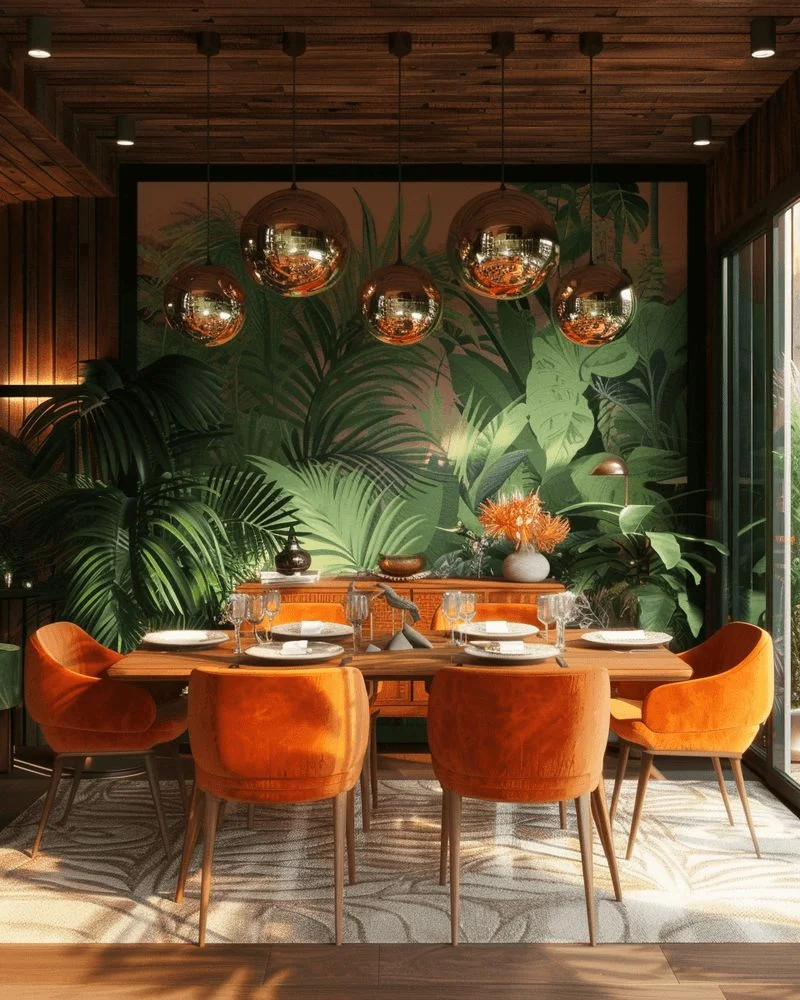
Treat your ceiling fixture like jewelry, not just a utility. Look for globe bulbs, tiered silhouettes, and symmetrical brass or gunmetal arms these geometric shapes are what give the room its “wow” factor. Size matters here. A dining fixture should hang roughly 30 to 34 inches above the table, with a width between one-half and two-thirds the table’s own width. Warm bulbs in the 2,700K to 3,000K range keep brass and marble looking rich instead of clinical. The entryway, the dining room, and above a kitchen island are the three spots where a statement fixture earns its keep.

Add a Curved Velvet Sofa for Modern Glam
A curved sofa is the single piece most likely to make a room feel designed rather than furnished. Look for saturated velvet in emerald, sapphire, smoky plum, or deep charcoal colors that hide everyday wear better than pale neutrals. Balance the sofa’s soft curve with a sharp-edged coffee table in stone or metal. Skip that contrast, and the room can start to feel like a costume rather than a considered design. A curved sofa in the 80- to 96-inch range works well as the anchor of a mid-size living room without overwhelming it.

Use Fluted Wood and Reeded Glass for Texture
Fluted wood and reeded glass add rhythm without adding clutter. Try fluted cabinet doors on a media console or ribbed panel inserts on a partition. Reeded glass cupboard fronts work too, hiding what’s stored behind them while still catching light. Not ready to commit to a full piece of furniture? A ribbed ceramic vase or a fluted lamp base works as an easy entry point. The linear grooves throw soft shadow lines across the day, which is exactly the kind of detail that makes a room feel custom rather than store-bought.

Introduce Brass Accents That Look Like Jewelry
Brass works best in small, deliberate doses rather than covering every surface. Concentrate it on the pieces closest to eye level: sconces, cabinet pulls, a mirror frame, a table base. That way it reads as a rhythm rather than a coating. Mixing finishes is fine brushed brass hardware with a polished brass lamp, for instance. Just stay in the warm-metal family, and avoid cool-toned chrome or nickel in the same sightline. Set against a matte black or deep charcoal backdrop, even a handful of brass details will carry the whole room’s sense of polish.

Upgrade the Entryway with a Deco Mirror + Console
Your entryway sets the tone for everything after it, so it’s worth treating as its own small project. Pair a slim console with a striking arched or fan-shaped mirror. A console 12 to 16 inches deep fits most hallways, and the mirror should hang with its center about 60 inches off the floor. Finish the surface with one statement bowl or sculptural vase and a lamp on a warm bulb rather than an overhead light. That combination of hard metallic lines and soft, low light does a lot of talking. Guests sense the rest of the house has been thought through before they’ve even taken off their shoes.

Use Dramatic Marble (or Marble-Look) Surfaces
In Neo-Deco rooms, marble is meant to be noticed, not tucked away. Look for bold veining and a high polish rather than a subtle, uniform stone. Natural marble not in the budget, or not practical for a busy kitchen? Marble-look quartz or porcelain slabs deliver nearly the same drama, with far less maintenance and a lower price per square foot. Use it on a coffee table, a fireplace surround, or a kitchen backsplash, where its sweeping pattern can offset the room’s straighter, more geometric lines. Even a single marble side table can do the job if a full surface isn’t realistic.

Add Black Lacquer for Depth and Contrast
Black lacquer gives a room the kind of high-gloss depth that photographs beautifully and never looks dated. Keep it to one or two standalone pieces a bar cabinet, a sideboard, a single nightstand rather than lacquering every surface in sight. Pair it with brass hardware, cream walls, or a soft textile nearby to soften the intensity. Black lacquer next to another dark, matte finish can flatten a room instead of lifting it. Done in moderation, it reads as a curated antique rather than a heavy block of color.

Feature Deco-Inspired Wallpaper in One Zone
Wallpaper lets you add pattern without adding clutter, which makes it one of the easiest Neo-Deco upgrades in a small space. Look for fan motifs, stepped geometry, or thin metallic lines that catch light as you move past them. Rather than papering an entire room, commit to one zone: a powder room, the wall behind a bed, or a reading nook. That way the pattern reads as a deliberate feature, not an overwhelming backdrop. A single roll or two is often enough to cover a standard accent wall.

Choose Sculptural Coffee and Side Tables
Coffee and side tables are a chance to work in three-dimensional geometry. Cylinders, arches, and stacked cubes all read as more “designed” than a plain rectangular top. A table with a strong, visible base does more visual work than most decor sitting on top of it. For material pairings, try glass and brass for a lighter feel, or stone and black metal for something more grounded. Marble with a gold-trimmed edge is the most classic option of the three. One well-chosen table can anchor an entire seating area on its own.

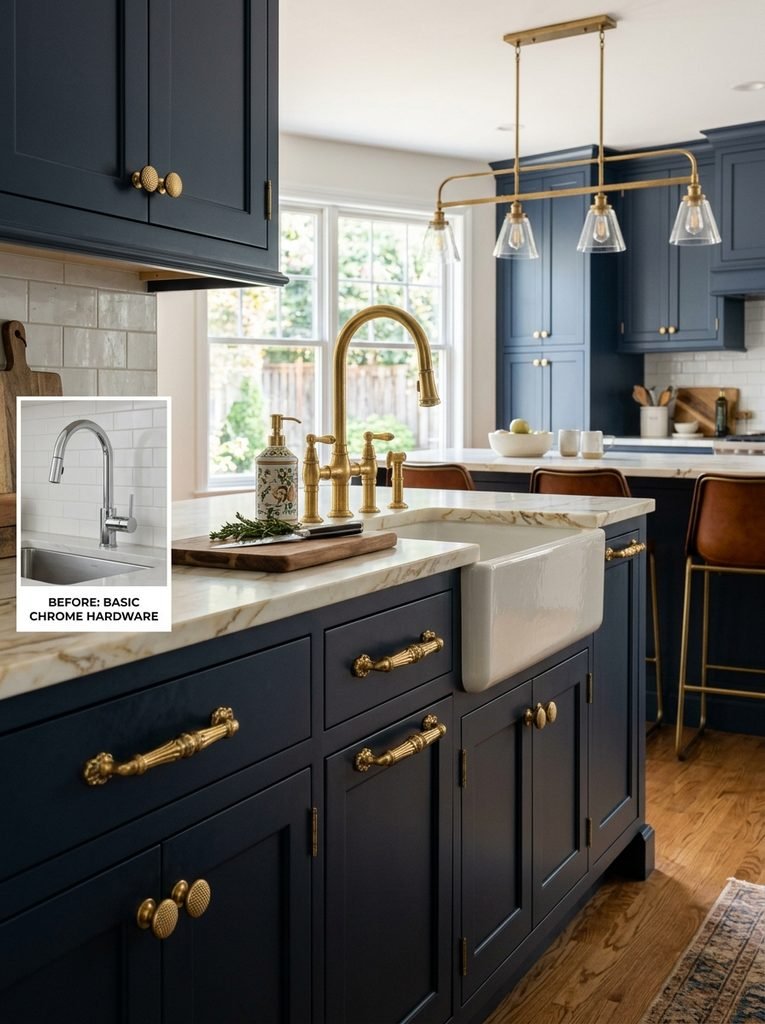
Replace Basic Hardware with Luxe Finishes
Cabinet pulls and door handles are small, but they carry an outsized share of a room’s perceived value. Swap generic builder-grade hardware for brushed brass pulls or matte black geometric handles. A kitchen’s worth typically runs $150 to $400 depending on cabinet count, making this one of the cheapest upgrades on this list per dollar of visible impact. If brass feels too warm for your palette, polished nickel gives a similar mirror-like shine with a cooler cast than standard chrome. This is the fix to start with if your budget for the whole project is tight.
Style a Neo-Deco Bar Corner
A bar corner turns a leftover patch of wall into one of the most-used spots in the house. Start with a mirrored tray to double the light bouncing off your glassware. Add crystal decanters, coupe glasses, and a ribbed glass bottle or two for texture. Finish with a small lamp on a warm bulb overhead light kills the mood here so the space glows rather than glares. Even a bar cart 24 to 30 inches wide can hold this whole setup in a studio apartment or small dining nook.

Use Smoked Glass for Moody Luxury
Smoked glass delivers the moodiness of Neo-Deco without the visual weight of solid black surfaces. Its charcoal-tinted, translucent finish reads as more modern than clear glass on pendant shades, cabinet doors, and side tables, while still letting light pass through. Not ready to commit to a full furniture piece? Start small with a vase or a single lamp shade — the tint does a lot of work even in modest doses. It grounds a room’s lighter, more reflective elements without making the space feel closed in.

Lean into Symmetry
Symmetry is the quiet ingredient that makes a room look professionally designed, even when nothing in it is expensive. Paired sconces flanking a mirror, twin nightstands, or matching chairs on either side of a fireplace all create a visual rhythm the eye reads as intentional. That doesn’t mean every single item needs a twin. An asymmetrical piece of art or a single sculptural lamp can sit happily inside an otherwise symmetrical layout. Start with the two or three largest items in a room and mirror those first; smaller decor can stay looser.

Add Bold Art with Clean Lines
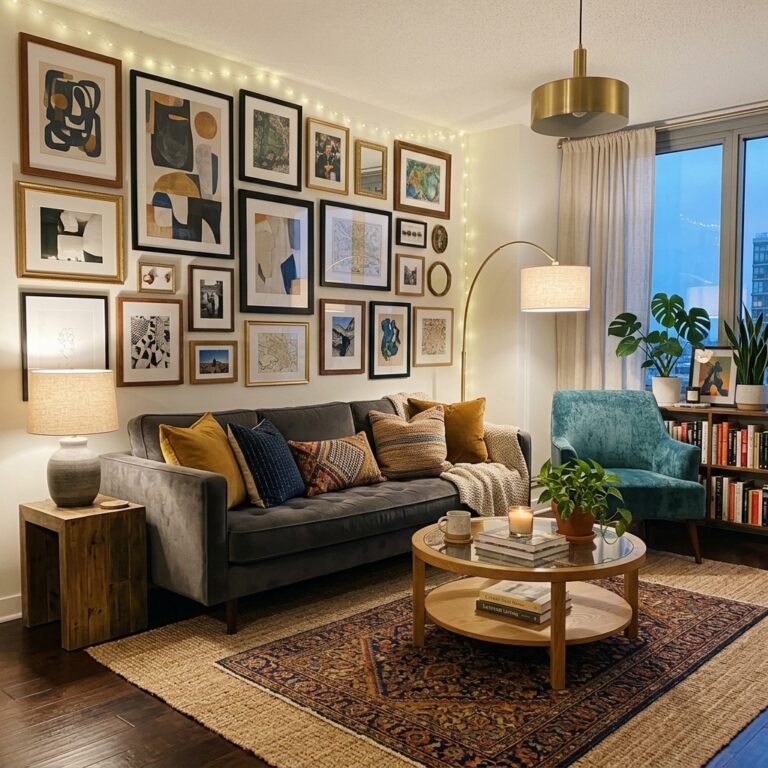
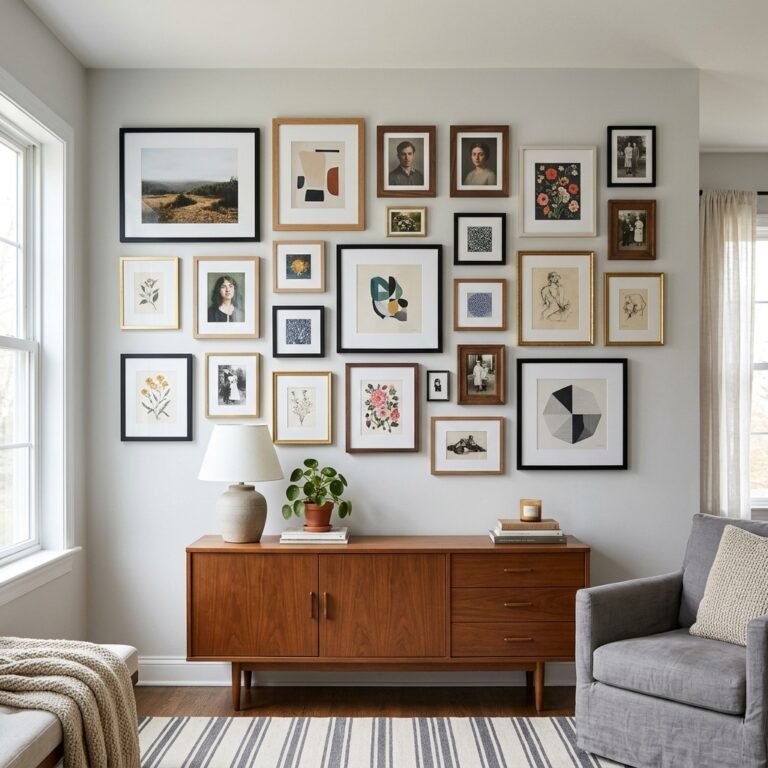
Neo-Deco art should reinforce the room’s geometry rather than fight it. Look for abstract arches, minimal figure studies, structured line drawings, or black-and-white prints in metallic frames. Framing matters as much as the art itself: thin brass frames, black lacquer frames, or a wide ivory mat can elevate even an inexpensive print. Group two or three pieces of similar scale rather than one oversized piece if you want the wall to feel curated instead of accidental.

Layer Textiles for Soft Glam
Neo-Deco can feel cold if you stop at hard surfaces. Layer in velvet pillows, textured throws, a high-pile rug in a neutral tone, and curtains with a subtle sheen. Mixing matte and shiny fabrics in the same space adds more depth than sticking with one texture throughout. A matte wool throw next to a satin curtain is a simple way to start. A rug with pile height around half an inch to three-quarters of an inch adds enough softness underfoot without swallowing a room’s cleaner lines. This is the fastest way to make a Neo-Deco room feel lived-in rather than staged.

Upgrade the Bedroom with a Statement Headboard
A Neo-Deco bedroom usually starts with the headboard arched, scalloped, or channel-tufted upholstery in a rich fabric. Pair it with symmetrical bedside lighting on matching sconces or lamps, plus minimal nightstands so the headboard stays the focal point. Add one dramatic piece of art rather than a full gallery wall. A headboard that extends 4 to 6 inches wider than the mattress on each side reads as more substantial without overwhelming a standard-size room. The goal is hotel-level calm with just enough Deco glamour to keep it interesting.

Turn the Bathroom into a Modern Art Deco Spa
A powder room or primary bathroom is one of the best places to go bold. It’s a small footprint with a big visual payoff. Globe sconces mounted at roughly eye level, brass fixtures, and an arched mirror all read instantly as Neo-Deco. So does black-and-white tile in a checkerboard or basketweave pattern, paired with fluted vanity fronts. Because the room is small, materials that would feel like too much elsewhere in the house tend to work well here. Think high-gloss black tile or heavily veined marble. It’s a low-cost way to make a daily routine feel like a small luxury.

Finish with Quiet Luxury Styling
The last step is restraint, and it’s the one people skip. Neo-Deco looks most expensive when a room has fewer pieces, each one doing real work. Think one sculptural vase, one statement tray, one strong centerpiece, and a single consistent metallic finish brass or chrome, not both in the same room. Resist the urge to add “just one more” accent once a space already has its three or four anchor pieces in place. That discipline, more than any single material on this list, is what actually gets you the neighbors-secretly-jealous result.

Neo-Deco rewards patience more than budget. Start with one room. The entryway or a powder room are the cheapest testing grounds, so layer in color, brass, and one sculptural piece there before you touch anything else. Want more room-specific direction? See our guide to Home decor. Our take on living room decor ideas. is a good next stop too.