
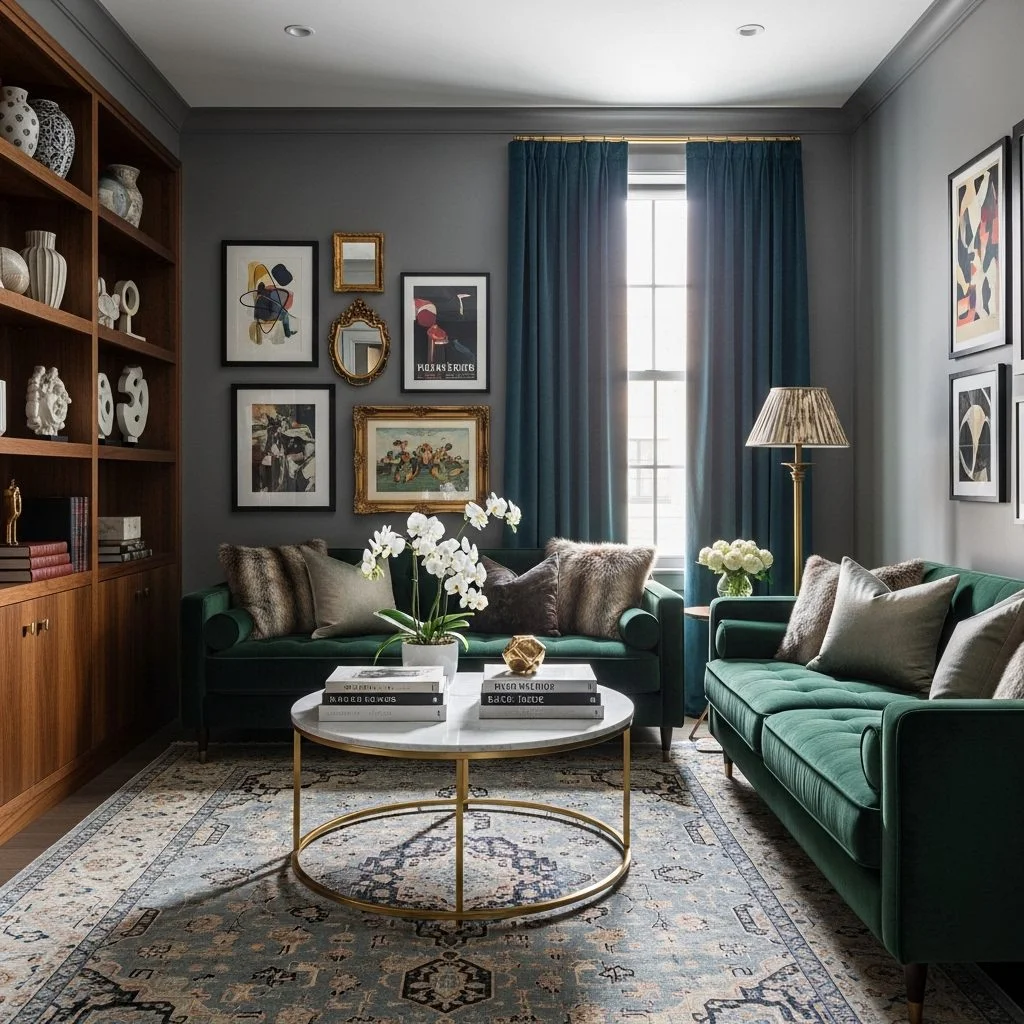
Stand three feet from your sofa and look at what sits at eye level: a yellowed switch plate, a lamp cord, a bare bulb glowing under a shade that is too small. In a living room under 150 square feet, nothing is more than eight feet from your eyes, so every detail gets judged at close range. That is why a small room full of good furniture can still look cheap, while a plain one with careful finishes looks expensive.
This list skips the big purchases. It covers finishing details you can measure, buy for roughly $5 to $60, and fix in an afternoon. Most work in a rental. If you want the larger moves, our budget living room ideas that look expensive cover those. Start anywhere, because each detail works on its own.

Why Small Rooms Get Judged Up Close
In a big room, the eye reads the whole composition. In a small one, it lands on edges, joins, and surfaces. Take three photos from your sofa at seated eye level, then zoom in. The things that make a room look budget are rarely the furniture. They are glossy plastic, visible cords, bare bulbs, sagging cushions, and mismatched finishes within arm’s reach. Fix those first, and the room reads as chosen rather than assembled.
Matte Walls With Satin Trim Around Doors and Windows
When walls and trim share the same sheen, a neutral room looks flat. Use matte or eggshell on the walls and satin on the trim and doors. Sherwin-Williams’ sheen chart lists matte, eggshell, and satin for living room walls, and satin or semi-gloss for trim and millwork. The slight gloss difference draws a faint outline around each opening, which reads as architecture without changing color. A quart of satin runs roughly $20 to $40 and covers all the trim in a small room. Wipe the trim, fill nail holes, and caulk gaps first. If the trim is old and dented, choose satin over semi-gloss, since higher gloss exaggerates every flaw.
Vent Covers Painted to Disappear
A beige plastic return-air grille on a white wall is the first thing many guests notice and the last thing anyone thinks to fix. Unscrew it, scuff the surface with fine sandpaper, wipe it clean, and spray it in the wall color with a metal-safe paint. Use two thin coats so the slats do not clog, and let the paint cure for 24 hours before reinstalling so the screws do not scrape it. The whole job costs under $15 and takes twenty minutes plus drying time. For baseboard heater covers, check the manufacturer’s paint guidance first, because heat limits your options.
Screwless Switch Plates in One Metal Finish
Builder-grade plastic plates yellow within a few years, and the visible screws catch the light. Swap them for screwless plates in brushed brass or matte black, roughly $6 to $14 each. A typical small living room needs three or four, so the project runs about $40. Match the finish to a metal already in the room, such as a lamp base or picture hook. Turn off the breaker before unscrewing anything, and check that the new plate has the right cutout, because toggle and decorator switches differ. Test one plate first in daylight and at night, since brass can read orange under warm bulbs.

Cords Hidden Along the Baseboard
One tangle of charger cords behind a side table undoes an hour of styling. Run each cord along the top edge of the baseboard with adhesive clips, spaced about 12 inches apart. Where cords must cross a wall, use a paintable raceway, about $8 to $15 for five feet, and paint it the wall color. Put the power strip in a lidded cord-management box, around $20, and keep remotes in a small basket within reach. Tuck any slack into a loop with a hook-and-loop tie instead of coiling it behind the furniture. The goal is simple: no cord visible from the sofa.
A Rug Pad Cut One Inch Smaller Than the Rug
A rug that curls at the corners or creeps across the floor looks cheap at any size. A quarter-inch felt-and-rubber pad fixes both. Trim it about one inch shorter than the rug on every side so the edge lies flat and the pad never peeks out. A pad for a 5-by-8 rug runs roughly $30 to $70. It also cushions each step and protects the floor from rubber backing, which can discolor some finishes. Unroll the pad first, then lay the rug on top and step on the corners. Check door clearance before buying anything thicker than a quarter inch.

Frames Hung on Two Hooks, Not One Nail
Single-nail frames drift crooked within weeks, and a crooked frame is the fastest way to make a nice print look careless. Cut a paper template the size of the frame, tape it to the wall, and mark the hook positions through the paper. Use two hooks, each about one-third of the frame’s width in from the edge. Add a dab of museum putty to the bottom corners, about $4 a pack. The frame stays level through slammed doors and vacuuming, and the paper template saves you from patching spare holes.

A Mirror That Reflects Something Worth Doubling
A mirror doubles whatever it faces, so check the reflection before you drill. Lean the mirror, or a piece of cardboard cut to its size, against the wall and sit on the sofa. You want to see a lamp, a plant, or a window, not a TV, a shelf of clutter, or a cord bundle. A 30-by-40-inch mirror weighs about 30 pounds with its frame, so skip the single nail. Use two rated wall anchors or a French cleat, and hang it with the bottom edge about six inches above any furniture. Clean the glass with a microfiber cloth, since streaks show in angled evening light.

Matched Plug-In Sconces Instead of Table Lamps
In a small room, a side table that holds only a lamp wastes floor space. Mount a matched pair of plug-in sconces on either side of the sofa or art instead. Center them about 60 to 66 inches from the floor, and make sure both sit at exactly the same height, since a half-inch mismatch shows. Expect $40 to $90 each. Run the cords down the wall in paintable raceways, painted to match. Most mount on two screws, so a rental deposit survives with a little spackle. Pick a style with an on-off switch on the fixture, so you are not reaching behind the sofa.

A Lampshade Sized So the Bulb Never Shows
Lamps look expensive or cheap mostly because of the shade. A shade that is too narrow shows the bulb and looks pinched. Choose a drum or empire shade wide enough that its bottom edge sits at about eye level when you are seated, so the bulb is hidden and glare stays off the page. A lined, off-white linen shade costs roughly $25 to $60. Take the old shade to the store, or the lamp’s measurements, because shade fitters vary and the harp size matters. A white or cream liner diffuses light more softly than a colored one.

Dimmers and High-CRI Bulbs on Every Lamp
One dimmer switch, around $15 to $35, changes the room more than most furniture. Pick an LED-rated model, since older dimmers make LED bulbs buzz. Then check bulb boxes for the CRI number, which measures how accurately light shows color. Many standard LEDs sit near 80, while better ones list 90 or more, and fabrics, wood, and skin look richer under them. A 90-CRI dimmable bulb costs about $5 to $8. In the evening, dim to roughly half and notice how the corners soften.

Three Fabrics With Three Different Sheens
Expensive rooms rarely rely on one fabric. They mix a matte base, such as linen or wool, with something nubby, like bouclé, and a small amount of soft sheen from velvet. The trap is too much shine, where polyester satin makes every cushion glow and the room looks like a showroom. Squint at your sofa from ten feet away. If every textile catches the light the same way, swap one for a matte weave. Keep the biggest piece, the sofa, in the quietest fabric. A bouclé pillow cover costs about $25 to $45, enough to test the idea.

Pillow Inserts Two Inches Larger Than the Covers
Flat, floppy pillows are the clearest sign of a cheap setup. The fix is the insert, not the cover. Buy inserts two inches larger than the cover, for example a 20-inch insert in an 18-inch cover. The extra fill pushes into the corners and gives the cover a full, tailored shape. Feather-down blends cost about $20 to $40 each, compared with $8 to $12 for polyester. Fluff them daily and give each a firm squeeze in the center to build a soft crease.

Sofa Cushions Rebuilt to Hold Their Shape
A seat cushion that has slumped in the middle makes a good sofa look tired. Unzip the cover and wrap the foam core in a layer of polyester batting about one inch thick, then slide it back into the cover. A roll costs roughly $15 and rebuilds a full set. Flip and rotate the cushions every week so wear spreads evenly. If the foam itself has gone soft, replace it. A new foam core for one seat usually costs $30 to $70, far less than a new sofa.

Wood Tones That Share an Undertone
Oak, walnut, and pine can all look expensive, but only when their undertones agree. Pick warm woods, which lean yellow or red, or cool woods, which lean gray or ash, and stay on one side. Hold two pieces side by side in daylight and look at the grain, not the color name. Limit the room to two wood tones, and repeat each at least twice, such as a shelf and a frame for the lighter one. A single orphan wood piece reads as a mistake. Metal legs and black frames are neutral, so they never count toward the two-wood limit.

Plants Moved Out of Their Nursery Pots
A pothos in a black plastic nursery pot looks store-bought. The same plant in a ceramic cache pot looks styled. Choose a pot one to two inches wider than the nursery pot, and slip the plastic one inside, drainage holes and all. Add a thin layer of sheet moss or bark across the top to hide the rim. Cache pots run about $15 to $40. When it is time to water, lift the plastic pot out, drain it in the sink, and drop it back in.

Where to Start If You Only Have an Hour
Begin with the details you can reach from the sofa. Put a dimmer on the main switch, swap the yellowed switch plates, and clip the cords along the baseboard. That is about an hour and well under $100. Next weekend, handle the pillow inserts and the rug pad. If curtains are the next thing on your list, our guide to the curtain length mistake that makes windows look cheap covers the measurements.
Frequently Asked Questions
What color temperature should living room bulbs be?
Choose warm white, between 2700K and 3000K, for evenings. Go to the 3000K end if your room gets cool, bluish north light, because it keeps the glow from looking yellow by comparison. Avoid anything at 4000K or higher, which reads as office lighting. Color temperature and CRI are separate numbers, so check both on the box.
Are plug-in sconces safe in a rental?
Yes, because they plug into a normal outlet and need no wiring. Most hang on two screws or a heavy-duty adhesive strip, and you can patch the small holes with spackle in ten minutes when you move out. Check your lease for hole rules, and keep the cord covered with a raceway so it never hangs loose.
Can I mix gold and black metal finishes in one room?
You can, as long as one finish clearly leads. Let one metal cover roughly two-thirds of the pieces, such as brass lamp bases, frame corners, and switch plates, and use the second as an accent in two or three places. Repeat each finish at least twice so it looks chosen rather than accidental.
How do I make fake plants look real?
Choose varied leaf shapes and sizes, avoid glossy plastic, and bend the stems so they do not stand perfectly straight. Dust them monthly with a damp cloth, since dust is the quickest giveaway. Set the plant inside a cache pot and cover the base with a layer of real moss or bark.
Why do my LED bulbs flicker on a dimmer?
Usually the bulb is not marked dimmable, or the dimmer is an older model built for incandescent bulbs. Replace it with a dimmer labeled for LEDs, and check that the total bulb wattage meets the dimmer’s minimum load. A single 8-watt bulb on a switch rated for 40 watts may still flicker.
Do feather-down pillow inserts trigger allergies?
They can for some people, though many feather inserts are washed and treated to reduce dust. If you are sensitive, choose a down-alternative fill, which usually costs $15 to $25 per insert. It holds the same oversized shape, though it flattens slightly faster, so plan to fluff it more often.

1 comment