
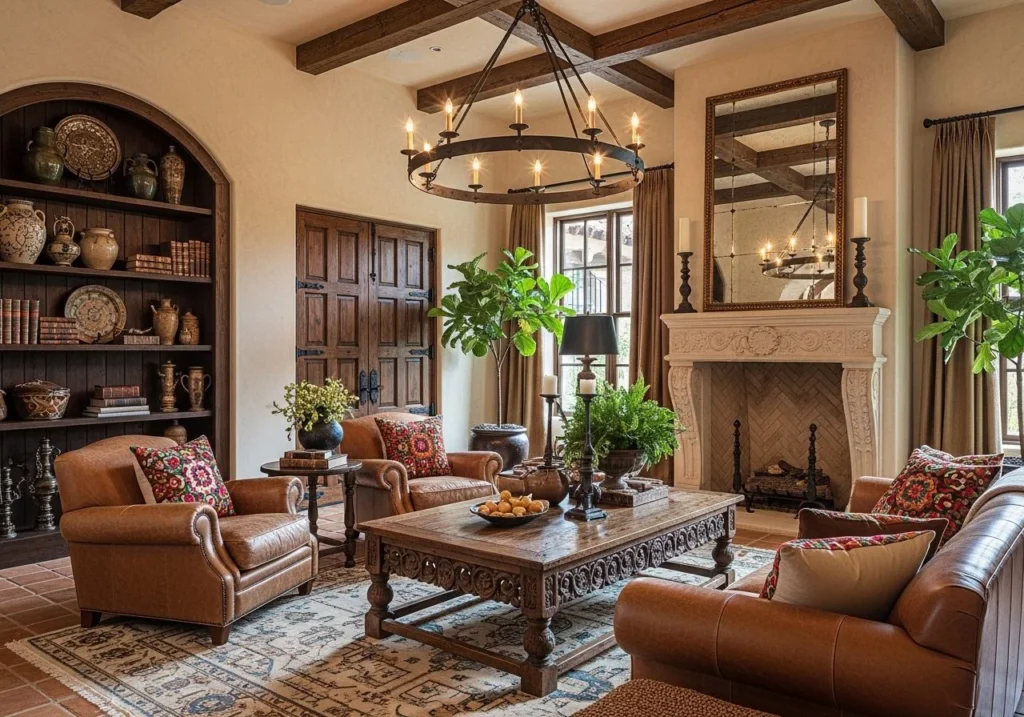
The sideboard is 74 inches wide and weighs about as much as a refrigerator. The chandelier measures 38 inches across. The rug is red, the floor tile is red, and the throw pillows are somehow red too. You stand in the doorway expecting a villa outside Seville. Instead the room feels like the waiting area of a tapas restaurant, and the console table looks suspiciously like a host stand.
Nothing in that room is a bad piece. Every item is a well-made, correct choice. That is exactly the problem. Here is why a room full of authentic Spanish furniture can still look staged, and how to fix it with walls, spacing, and a tougher edit than most people expect.
When Every Piece Is Shouting at the Same Volume
The mistake is buying Spanish style as a kit. Dark carved wood, wrought iron, terracotta, patterned tile, and saturated reds all arrive at full strength, in one room, in one season.
Theme restaurants use this recipe on purpose. A diner has to read “Spain” from the door in two seconds, so every surface carries the message. A living room gets used for ten years, and that constant loudness wears you out by about month three.
Three buying habits usually cause it:
- Ordering the whole suite from one catalog, so the sofa, tables, and console share the same stain and the same carving.
- Choosing the most ornate version of each piece because it looks most authentic in a product photo.
- Filling every empty wall and corner, because “Spanish” gets mistaken for “full.”
What Real Spanish Rooms Get Right That Kits Get Wrong
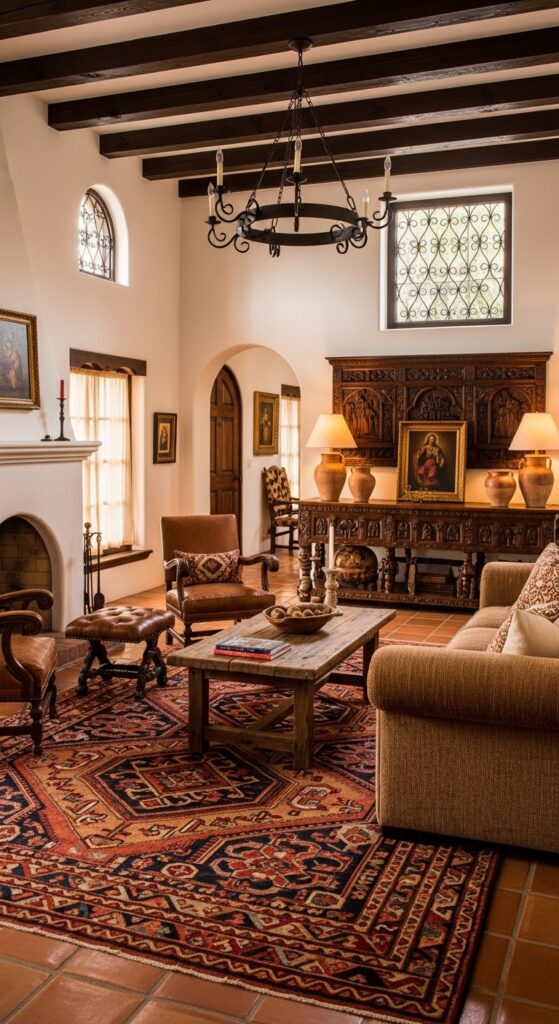
Spanish Colonial Revival homes were built across California, Florida, and the Southwest from roughly 1915 to 1940. Their loudest feature was never the furniture. It was the shell: thick plaster walls, arched openings, tile floors, and dark ceiling beams.
Inside that shell, the furniture was sparse and came from different decades. A bare plaster wall with a deep-set window throws a soft shadow line that no carved cabinet can imitate.
Your drywall box has none of that. So the job is to borrow the calm of the shell first, then spend your budget on a few pieces that earn their weight.
Fix the Walls Before You Touch the Furniture
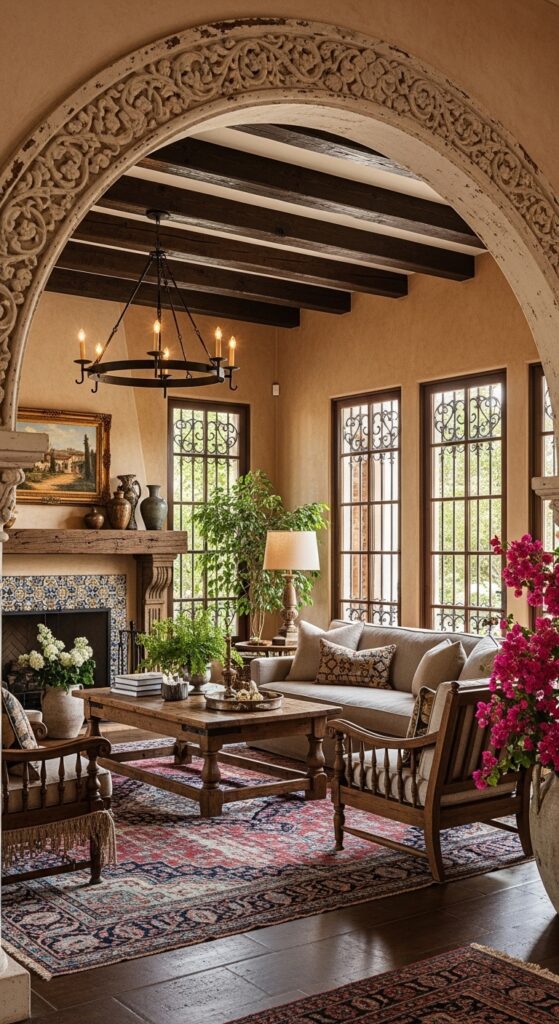
Walls make up most of what you see, and dark walnut needs a quiet background to look rich instead of heavy. Start with a warm white, not a stark one.
Check the light reflectance value, or LRV, printed on the paint swatch. Paint experts quoted by Apartment Therapy explain that darker pigments absorb more light and carry a lower LRV, and that the number helps you anticipate how light or dark a color will look in a room. For a living room full of dark wood, aim for walls in the 75 to 85 range with a yellow-leaning undertone. Sherwin-Williams Alabaster sits in the low 80s.
Paint a two-foot square on two different walls. Look at both at 8 a.m., noon, and 8 p.m. Cool whites often turn gray and dingy in a north-facing room.
For the plaster look, use limewash or a textured plaster-effect paint, always matte. Limewash typically runs about $50 to $100 a gallon, and a 15-by-18-foot room needs three to four gallons for two coats. Brush it on in crossing strokes so the variation reads as hand-troweled. Paint the trim the same color as the walls. Dark trim plus dark furniture is how a room starts to feel like a cellar.
Borrow the Shell: Beams, Deep Sills, and Niches
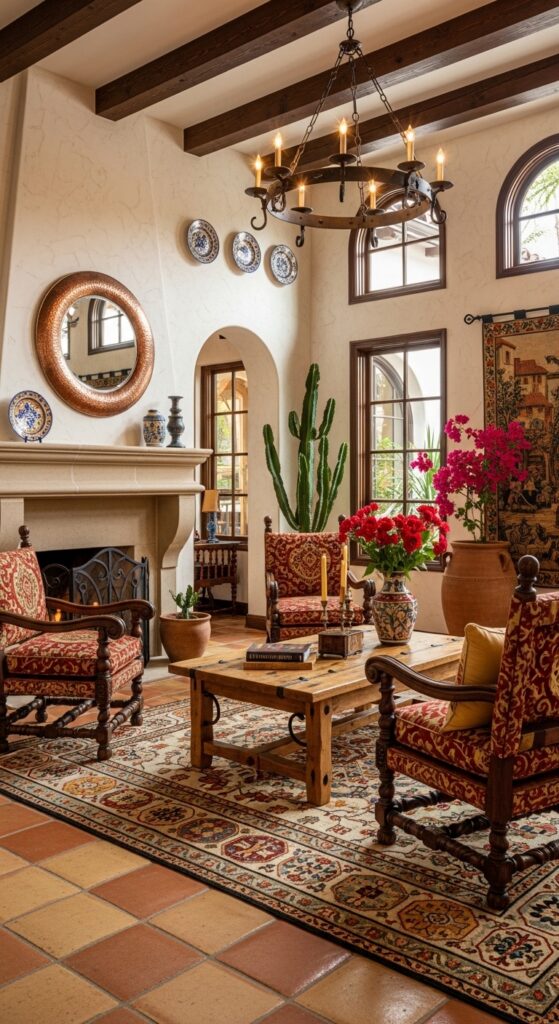
You cannot pour 18-inch walls into a 1990s living room, but three shell details are easy to fake.
Hollow box beams come first. In 4-by-6 or 6-by-8 sizes they typically cost about $15 to $60 per linear foot, depending on the material, polyurethane or rough-sawn wood. Each beam also lowers the ceiling by its own depth. On an 8-foot ceiling, a 6-inch beam leaves 7 feet 6 inches of clearance. That is fine over a sofa and tight in a doorway. Skip beams entirely in rooms under 8 feet.
Deep window returns come next. A carpenter can build the sill out 4 to 6 inches and wrap it in plaster-effect paint, so the glass sits back from the wall face the way it does in old stucco houses.
The last detail is an arched niche. On an interior wall, a recess between two studs is about 3.5 inches deep. That is enough for one ceramic jar and a soft shadow line, for the price of drywall and an afternoon.
Give Each Sightline One Heavy Hero
Sit in your main seat and look in each direction. Every sightline gets one heavy piece: a carved sideboard, a chest, or an iron chandelier. Never all three stacked in the same view.
Numbers help here. A sideboard usually runs 60 to 72 inches wide and 16 to 20 inches deep. Leave a 36-inch walkway in front of it. Keep the coffee table 16 to 18 inches high and 14 to 18 inches from the sofa, and make sure at least the front legs of every seat sit on the rug.
As a rule of thumb, dark wood should make up about a third of what you can see. The rest belongs to plaster, linen, leather, and open floor. If you want specific pieces to shop for once the shell is calm, our guide to Spanish living room furniture pieces worth buying goes deeper on sofas, tables, and cabinets.
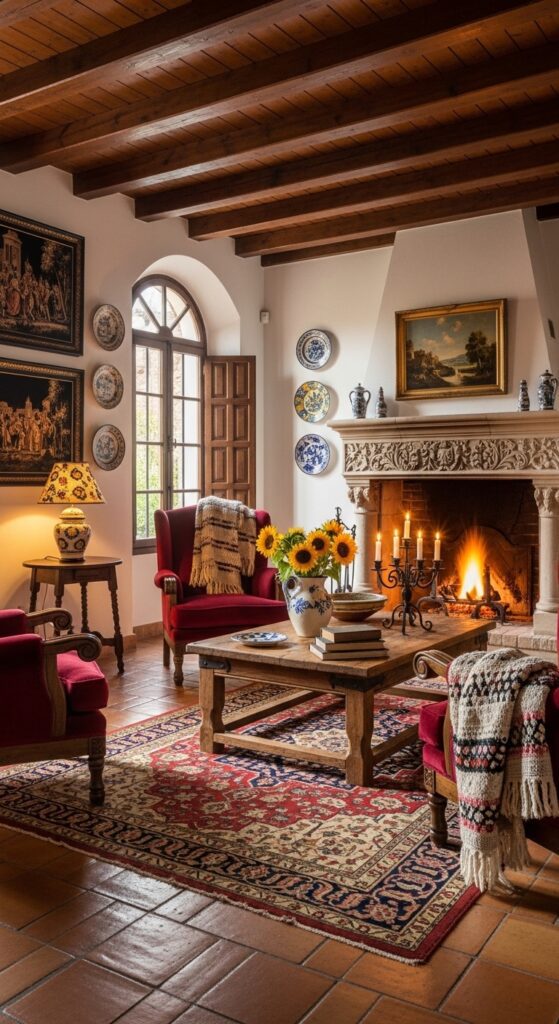
Mix Eras So the Room Looks Collected, Not Ordered
A collected room has three sources. Buy one carved antique or antique-style piece, one clean-lined modern piece such as a low linen sofa, and one handmade object like a ceramic lamp base or a woven stool. Never buy the matching coffee table, end table, and console set.
Mix two wood tones. Pair walnut with lighter oak or pine, and the heavy piece stops reading as the whole room.
Be skeptical of factory distressing. Crouch down and check the legs. If the same dings and scratches repeat on every leg, they were made with a chain, not with use. Real wear collects where hands, knees, and chair backs touch the furniture.
Budget honestly for the antique piece. A hand-carved antique sideboard commonly lists between $2,000 and $6,000, and a solid reproduction runs about $900 to $2,500. An estate-sale or auction find can land at $400 to $1,200 if you can haul it yourself. Spend there, and save on the sofa and side tables.
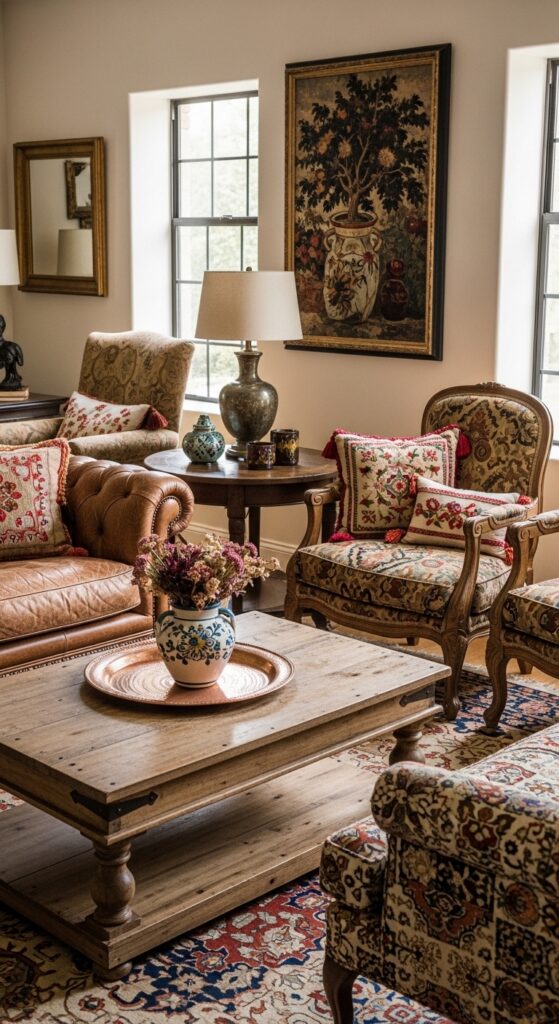
Use Iron Like Jewelry, Not Like Armor
Limit visible wrought iron to three pieces. A chandelier, one table base, and cabinet hardware is plenty. Add a fourth and the room starts to feel like a gate.
Size the chandelier with a simple formula: add the room’s length and width in feet, and the sum is the fixture’s diameter in inches. A 15-by-18-foot room takes a fixture about 33 inches across. Over a table, hang it 30 to 34 inches above the surface. In an open room with an 8-foot ceiling, keep the lowest point at least 7 feet off the floor.
Weight is the part people miss. Hand-forged chandeliers often weigh 40 to 100 pounds, and a standard ceiling fixture box is only required to support about 50. Anything heavier needs a brace anchored between the joists, which is a half-day job for an electrician. Choose matte or hand-rubbed finishes over glossy black powder coat. Gloss is the quickest way to make iron look catalog-bought.
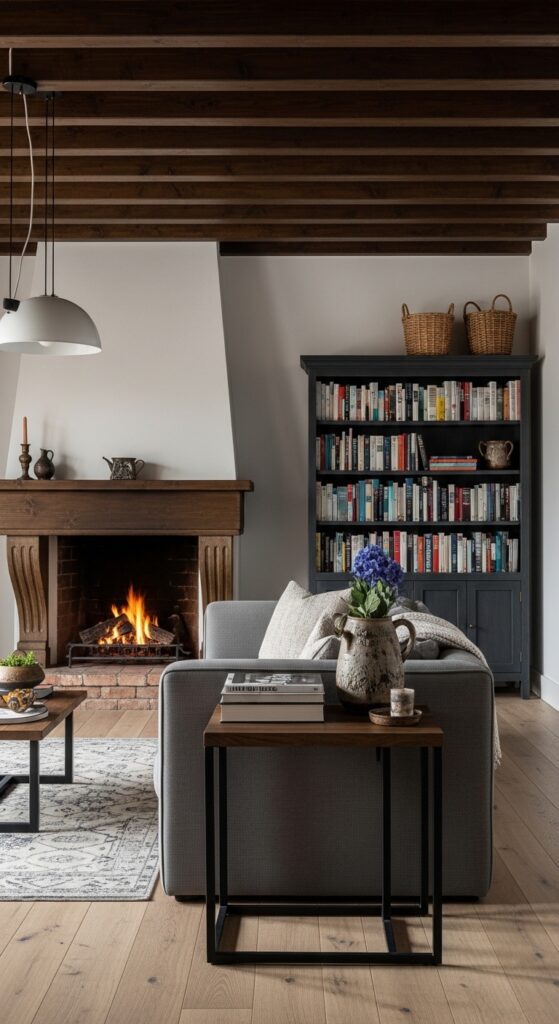
Pick One Pattern Lane: Tile, Rug, or Textile
One loud surface per room. If the fireplace has colorful tile, the rug goes quiet, such as flatweave wool in oatmeal with a single rust stripe. If you want a bold rug, keep the fireplace in plain plaster.
Tile math is friendlier than people fear. A fireplace face of 4 by 3 feet is only 12 square feet, so even cement tile at $12 to $30 a square foot stays under about $400. Saltillo floor tile usually costs $3 to $8 a square foot, but order 10 to 15 percent extra. Handmade pieces vary in size and tone, and some always crack in transit.
Seal terracotta before it sees a single glass of red wine. Unsealed clay drinks up oil and stains. Plan on a penetrating sealer plus a topcoat, and expect to reseal every couple of years. Terracotta also stays cold in winter, so a wool rug under the seating area is practical, not just decorative.
Pick warm gray or charcoal grout at a 3/8- to 1/2-inch joint for saltillo. White grout makes the floor look bright and modern, and it stains quickly near the entry.
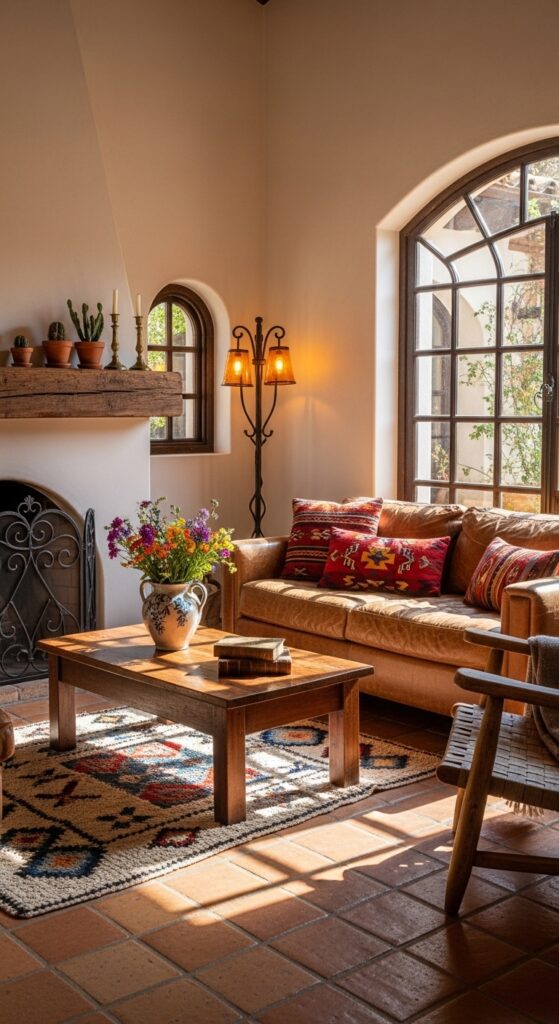
Soften the Weight With Fabric and Fewer Reds
Choose one red family and stay in it. Oxblood or terracotta works. Both together, plus ochre and orange, starts the restaurant effect all over again.
A reliable palette has three colors: cream, one deep tone such as olive or indigo, and one terracotta. Let texture do the rest. Washed linen, wool throws, and leather that darkens with use all add variation without adding color.
Pure linen wrinkles hard on a sofa. A linen-cotton blend rated for at least 15,000 double rubs holds its shape and still looks relaxed. Slipcovers in a pale tone are the fastest way to lighten a room that already owns a heavy sideboard.
If you add leather, ask for top-grain or semi-aniline. Bonded leather costs less, roughly $600 to $1,000 for a sofa, but the surface often flakes within a few years. An 84-inch top-grain sofa typically runs $1,800 to $4,000 and develops the patina this style depends on.
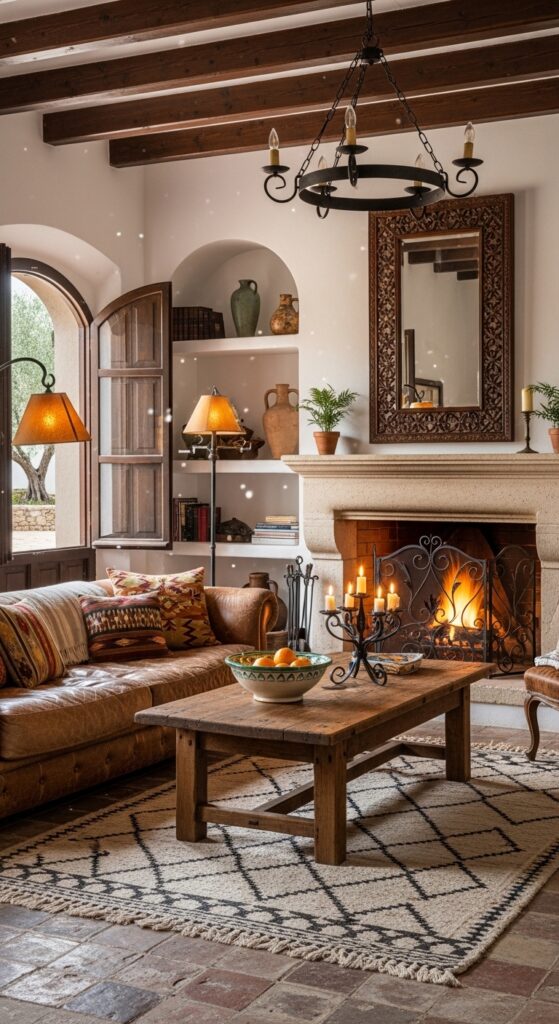
Light the Room Like a Candlelit Table, Not a Showroom
Dark wood and iron swallow light. Under one overhead fixture they turn into flat dark lumps, and the carving disappears.
Build three layers. Wall sconces go at roughly 60 to 66 inches from the floor. Ceramic-base table lamps handle reading light. A floor lamp or picture light rakes across a textured wall. Keep every bulb between 2200K and 2700K, and put a dimmer on every circuit. Avoid flickering “candle” bulbs, which look fake within a week.
Shade choice matters too. Parchment or linen shades in off-white glow warmly. Black shades on a table lamp add another dark mass to a room that probably has enough already.
Also check that the walls still look warm after sunset. Our breakdown of living room color combinations that hold up after dark shows how lamplight shifts different whites and deep tones.
A Ten-Minute Audit Before You Buy Another Piece
Run this check on the room you have now. It takes one phone and a roll of painter’s tape.
- Photograph the room from your main seat, in the lighting you use most.
- Turn the photo black and white.
- Count the separate dark masses. More than three means something has to leave.
- Squint. Wherever your eye lands first is the hero. Anything else competing for that spot gets edited out.
- Before buying anything new, tape its footprint on the floor and confirm a 36-inch path around it.
What to Do Tonight
Take the photo. Make it black and white. If you count more than three dark masses, carry the busiest piece into another room and live with the gap for a week. The room usually answers that question by itself.
Frequently Asked Questions
Is Spanish style the same as Mediterranean style?
No. Spanish style leans darker and heavier, with carved wood, wrought iron, and terracotta. Mediterranean style is broader and lighter, borrowing from Greek and Italian coastlines. A Mediterranean room often leans on sea blue and white, while a Spanish room favors ochre, olive, and oxblood against plaster walls.
Can you do Spanish style in a small living room?
Yes, with one heavy piece instead of five. Pick a single carved cabinet or chest under 60 inches wide, keep the coffee table under 40 inches long, and skip faux beams that lower an 8-foot ceiling. Arched mirrors and warm white walls carry the style without taking up floor space.
How do you tell real Spanish furniture from reproductions?
Check the joinery first. Real older pieces use mortise-and-tenon joints and hand-cut dovetails with slightly uneven spacing. Pull a drawer and look for staples or glue-blocked corners, which signal factory work. Iron hardware should show small hammer marks, and the underside of a table should look worn, not freshly stained.
What kind of rug suits a Spanish living room?
A flatweave wool rug works best. Look at traditional Spanish jerga rugs, which are handwoven flatweaves in simple stripes and muted colors. An 8-by-10 size usually reaches under the front legs of a standard sofa and two chairs, and a pile under half an inch keeps heavy furniture stable.
Can you fake arches without construction work?
You can. Hang an arch-topped mirror about 72 inches tall behind the sofa, or paint an arch shape on the wall using a template cut from cardboard. Another option is an arch-topped cabinet or open shelf. A framed drywall arch insert is also an option, but that is a weekend carpentry project.


1 comment