
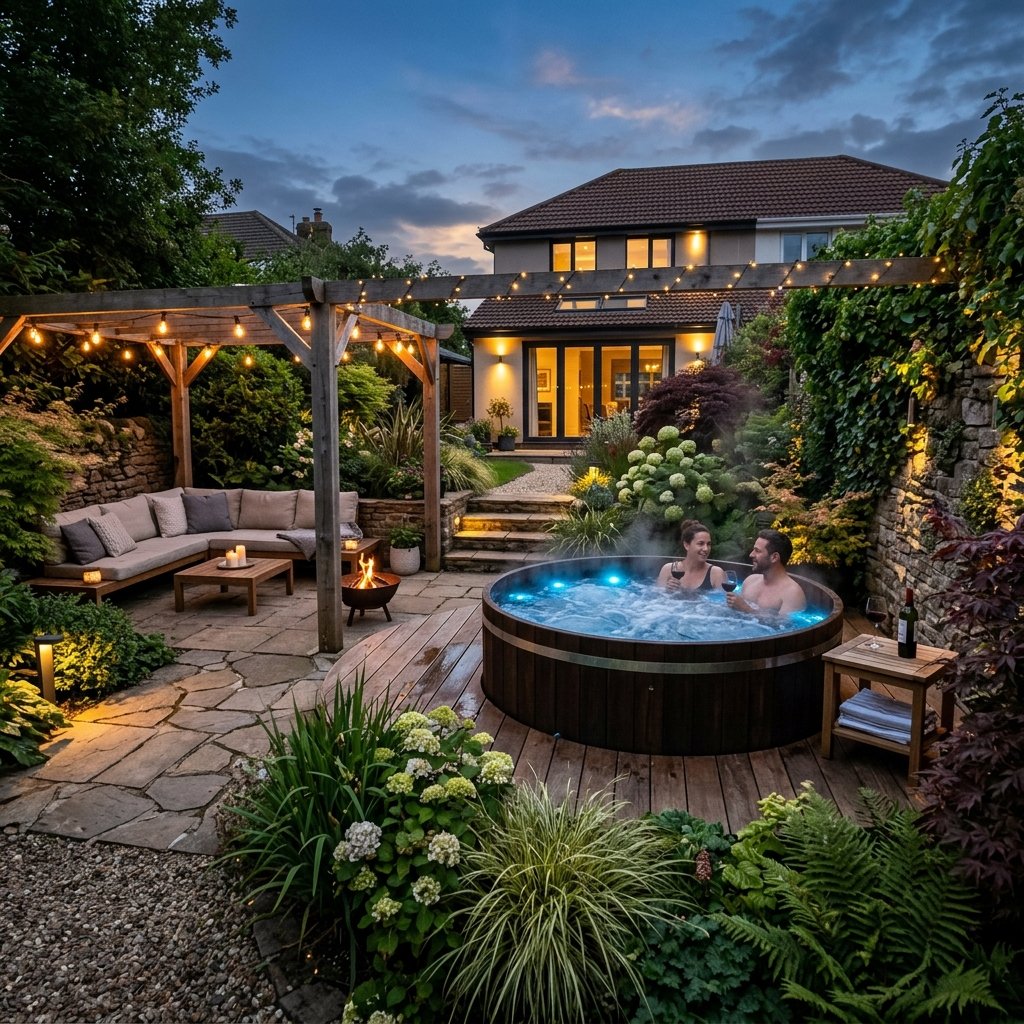
Ask anyone who owns one what they love most, and it’s rarely the parties. It’s the Tuesday soak with the phone left on the kitchen counter and the garden finally quiet. A jacuzzi outdoors delivers that on repeat, but the setup decides everything. The same tub can look like a resort feature or a plastic afterthought, and the difference is rarely money. This guide runs through fifteen setups, each matched to a real situation: a rented balcony, a rooftop terrace, a household with kids, a tight budget, a yard with nosy neighbors. Find the one that matches yours. For siting, water care, covers, and long-term upkeep, our resort-style outdoor jacuzzi guide covers the planning backbone in depth.

Indoor-Outdoor Minimalist Jacuzzi
The strongest minimalist setups don’t treat the spa as garden furniture. They treat it as another room of the house. Run the same flooring from your living room out to the tub — 24-inch porcelain tiles create the effect with few joints. Match the fixtures too: matte black spa hardware and a matching towel hook echo interior taps for a few hundred dollars. Sightlines matter most. Check where you’ll see the tub from the sofa or the kitchen window, then frame that view with one sculptural plant rather than a hedge. A flush threshold between inside and out keeps the floor plane unbroken. Done well, the jacuzzi reads as an extension of your floor plan — visible from the sink on a gray morning, glowing softly at night.

Wraparound Deck With Built-In Seating
Instead of surrounding the tub with loose chairs, build the seating into the deck itself. A curved bench wrapping two sides of the spa seats four without crowding a small yard, and it never needs hauling indoors before a storm. Build the bench 18 inches deep with a 15-inch seat height, angled slightly back for comfort. Leave four feet of clear deck around the tub on at least two sides so the cover can lift and fold flat. Use cedar, ipe, or thermally modified pine, and gap the boards so rain drains through rather than pooling. Add a lift-up hatch under the bench for towels and chemicals. One move, and the deck stops being a platform and becomes a social ring around the water.

Balcony and Renter-Friendly Setups
Renters and apartment dwellers aren’t excluded, but the math comes first. A filled two-person inflatable tub weighs well over 2,000 pounds with two occupants. Spread across a small balcony, that load can exceed what the structure was rated for, so check with your landlord or a structural engineer before ordering anything. If the balcony passes, choose a plug-in model that runs on a standard 120-volt outlet. No electrician, no plumbing, no permanent fixings — the whole setup reverses in an afternoon if you move. Look for inflatable or lightweight rotomolded tubs under 100 gallons, pair one with a folding bench, and plan to drain and store it over winter. More ways to stretch a tight footprint are in our small space ideas.

Louvered Roofs and Hard-Top Covers
An open pergola filters sun. A louvered roof controls weather outright. Aluminum louver systems tilt their slats from fully open to fully closed, so one afternoon of rain no longer cancels the soak, and midday glare becomes a dial rather than a problem. Closed slats channel water into integrated gutters, keeping the deck under the spa dry. Budget a few thousand dollars for a quality motorized kit over a typical spa footprint, and confirm the structure’s snow-load rating if winters are serious where you live. A hard-top gazebo achieves the same result in timber, with the bonus of a mounting point for a rated outdoor fan or heater. Set the lowest beam at least eight feet up so heads and steam clear comfortably.

European-Style Terrace Jacuzzi
Rooftop and terrace setups lean on hard surfaces and restraint. Porcelain pavers laid on pedestals handle drainage, hide wiring, and read upscale underfoot. Weight is the design constraint on any roof, so favor lighter tubs and confirm the structure’s capacity with a professional before committing. Around the tub, keep it simple: railing-height planters with lavender and rosemary, a pair of potted olive trees, and neutral cushions in outdoor-grade fabric. Wind is the quiet enemy up high, so solid planters double as windbreaks where open railings would strip the heat off the water. The result feels closer to a hotel rooftop in Barcelona than a suburban patio, and it works even where the garden is a shared afterthought.

Privacy Screens for a Garden Jacuzzi, Compared
Solid walls feel safe but stuffy. Fully open feels exposed. The fix is picking the right screen material for your yard. Slatted cedar screens block direct sightlines while letting breezes through, and at six feet they usually sit within local fence-height limits. Frosted glass panels do the same job with more light and a modern edge, at several times the cost. Bamboo roll fencing is the budget pick — attractive and fast to install, but expect to replace it within about five years of weather exposure. Outdoor curtains split the difference: cheap, adjustable, and washable. Whichever you choose, screen what actually matters. Stand in the tub, note which neighbor windows you can see, and spend your money on those sightlines only.

Fire Placement Done Safely
Fire beside water looks spectacular and works year-round, but placement rules come before styling. Follow the manufacturer’s listed clearances for any fire table or bowl, and keep open flames well away from overhangs, curtains, and low branches the National Fire Protection Association‘s outdoor-fire guidance boils down to giving flames room and never leaving them unattended. Mind the wind. Note which direction air typically moves across your yard and position the fire downwind of the spa, so smoke drifts away from the water instead of across it. A fixed gas line beats propane tanks for a feature you’ll light weekly, and a linear burner set low behind a wind guard stays lit on evenings when a fire pit would gutter out.

Tropical Style for Cooler Climates
You don’t need zone 10 to get the tropical effect. Big leaves do most of the work, and several hardy plants deliver them. Musa basjoo, the hardy banana, survives winters well below freezing once mulched and reaches eight feet in a single season. Fatsia japonica, hardy hibiscus, and tall miscanthus grasses layer in beneath it. True palms stay in pots, wheeled into a garage or basement before the first frost, which also lets you rearrange the scene each spring. Together they frame the tub in foliage that reads as resort, not garden center. Finish with warm amber lanterns, and the effect holds even in October — when a steaming tub under big leaves is at its most dramatic.

Sunken Jacuzzi: When Sinking It Makes Sense
A sunken spa looks effortless and is anything but to build. Sinking the tub flush with a patio removes the visual bulk, but it adds excavation, drainage, and a service plan to the budget. Before committing, check three things. First, your water table — a pit that collects groundwater needs a sump pump, which means one more thing to maintain. Second, equipment access: every sunken install needs a removable panel large enough to service the pump and heater for years ahead. Third, your timeline. Renting, or likely to move within five years? Keep the tub above ground. Sinking makes sense for a long-term home with a flat site and a patio project already planned — there, its clean horizon line earns the extra cost.

Rustic Stone in a Rock Garden Setting
On a natural or sloped lot, don’t fight the terrain — clad into it. Rather than choosing stone to match the house, use local fieldstone and boulders so the tub appears carved from the hillside itself. Group boulders in odd numbers around the rim, letting two or three double as low seats or step-stones. Between paved areas, plant creeping thyme or Scotch moss, which tolerate light foot traffic and release scent when brushed. Gravel mulch around the base handles splash far better than lawn, which turns to mud beside any spa. Uplight the largest boulders at dusk and the whole arrangement glows like it was always there. It’s the quietest, most grounded option on this list.

Zoning a Lounge Area Around the Tub
A jacuzzi seats four; the evening around it should seat eight. Think in three zones. The dry zone holds towels, robes, and a bench for dressing, kept far enough back to stay splash-free. The wet zone is the tub itself plus one step of paving around it. The social zone faces the water: two weatherproof loungers angled toward the view, an outdoor rug to define the floor, and side tables within arm’s reach of every seat. That rug matters more than it sounds — bare decking beside a spa feels unfinished, and it’s the cheapest comfort upgrade available. With the zones drawn, guests flow between water, fire, and food without anyone tramping wet feet through the dry zone.

Glass-Enclosed for Year-Round Soaks
A glass enclosure turns the spa into a four-season conservatory. Snow can fall an arm’s length away while you sit in still, warm air, and the garden stays visible the whole time. Two realities decide whether it works. Ventilation comes first: warm water fills a sealed room with humidity, so include operable panels or screens and crack them during and after each soak. Glass comes second — insist on tempered safety panels, and check whether your municipality treats the structure as a permit-worthy build. Condensation will gather regardless; a sloped roof and a drain path at the base handle it. Done right, this is the most expensive idea here and the only one that makes a January soak feel effortless.

A Zen Jacuzzi With a Dry-Landscape Garden
Where a Japanese soaking tub celebrates deep water, a dry-landscape garden celebrates everything around it. Lay fine gravel instead of lawn and rake it into long, straight lines or slow waves — the pattern is the design, and refreshing it takes ten minutes with a garden rake. Place stones in groups of three and five, never even numbers, with the largest partially buried so it looks settled rather than set. A stone water basin near the steps adds the sound of moving water without plumbing. Keep planting to two species: clipped evergreen and one feature maple. The discipline is the point. Sitting in warm water inside a raked gray field, the noise of the week loses its grip surprisingly fast.

Family-Friendly Safety and Layout
With kids in the house, the layout does the safety work. Choose textured porcelain or brushed stone paving rated for wet areas — a slip-resistance rating around R11 is the spec to ask for. Build wide steps with a handrail rather than a single climb-in height, and mount the cover locks high enough that small hands can’t reach them. Water temperature matters too: keep soaks with children shorter, around ten minutes, and a few degrees cooler than adult settings. One covered seat beside the tub gives the supervising adult a dry, shaded post. A self-closing, self-latching gate on the path to the spa completes the setup, because the best cover is the one backed by a barrier kids can’t open.

What a Budget Jacuzzi Setup Really Costs
Honest tiers beat vague promises. Inflatable tubs run roughly $400 to $1,000, set up in an afternoon, and last three to five seasons with care. Rotomolded one-piece spas step up to about $2,000 to $4,000 with real seats and a hard cover. Entry-level acrylic spas start near $5,000 to $8,000 installed, and that’s where jet quality and longevity begin. Running costs land around $30 to $60 a month in most climates, driven largely by how good the cover is — so put spare budget there, not on jets. Under any tub, a level pad of pavers on compacted gravel costs a weekend and a few hundred dollars. Solar path lights and a secondhand wooden bench finish it. Comfort is the goal; the resort look follows cheaply.

Finding Your Setup
A jacuzzi outdoors isn’t one purchase so much as a dozen small decisions stacked around warm water. Match the setup to your actual life — a balcony that passed the load check, a terrace with windbreak planters, a deck with a bench that seats the whole household — and the relaxing part takes care of itself. Style ideas age; situations don’t. Start with the one idea above that names your yard, and build from there.
1 comment