
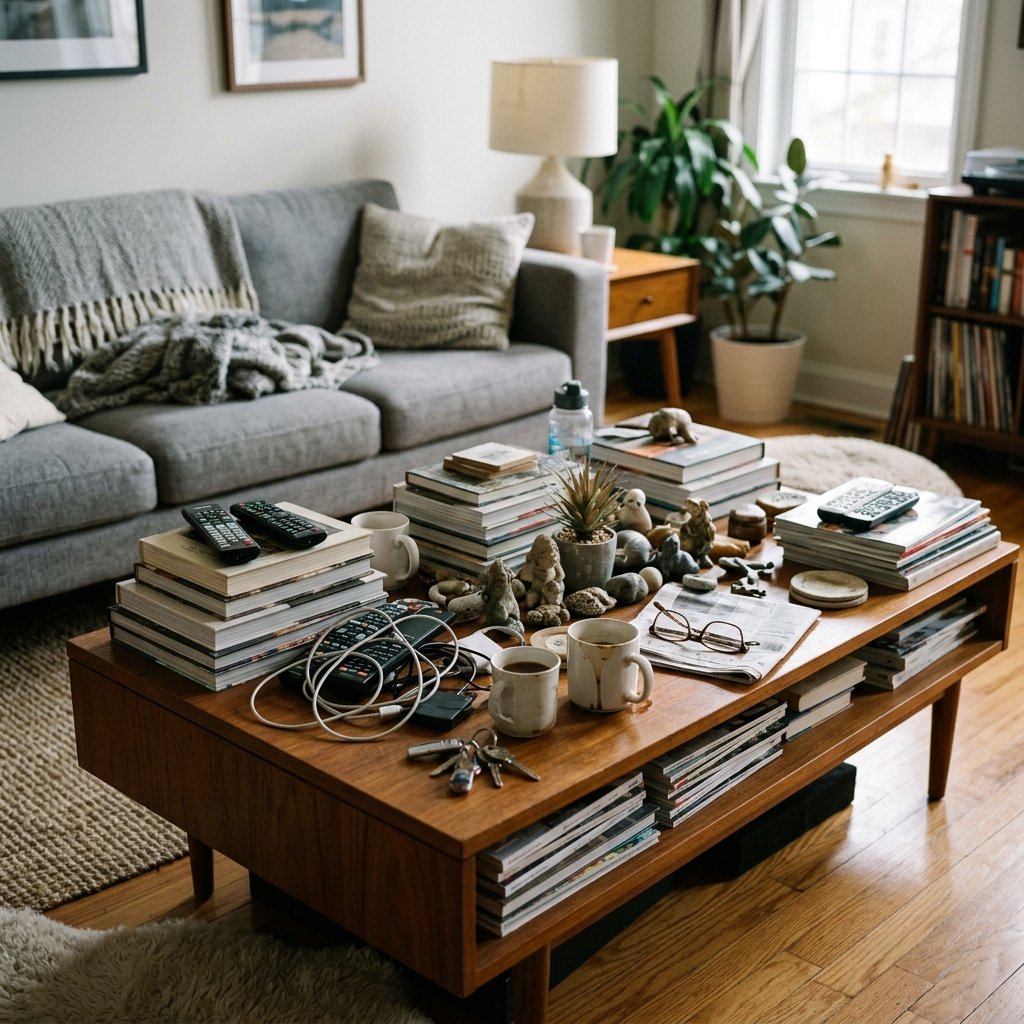
If you’ve ever looked at your living room and felt like something was “off” without being able to name it, there’s a good chance your coffee table is the culprit. It’s such a small piece of furniture, but it carries a surprising amount of visual weight in a room. And when it’s styled wrong, it can make an otherwise beautiful space feel chaotic, messy, or just plain busy.
The good news is that this is one of the easiest design mistakes to fix once you actually understand what’s causing it. You don’t need a full living room makeover or an expensive shopping trip. You just need to rethink how you’re using that flat surface in the middle of your room.
Let’s talk about the mistake that trips up so many people, why it happens so easily, and exactly how to style your coffee table so it looks intentional instead of overwhelming.
The Coffee Table Mistake Nobody Notices Until It’s Too Late
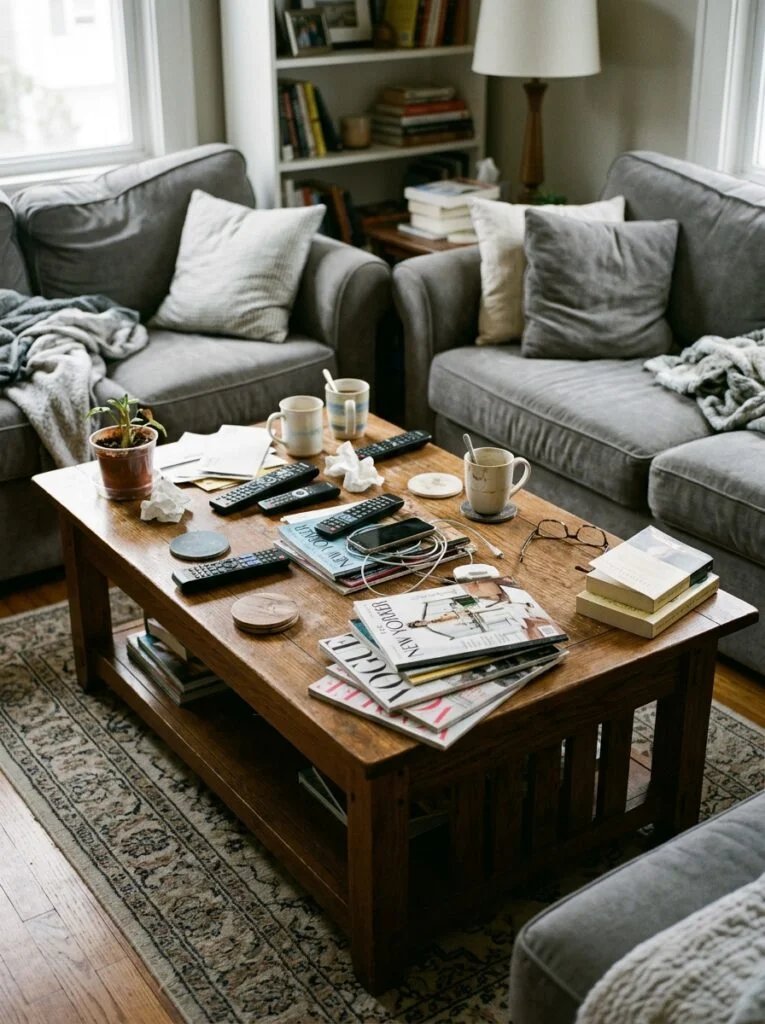
Here’s the mistake in plain terms: too many small, unrelated objects crammed onto one surface with no visual breathing room.
Think about it. A stack of coasters here, a candle there, a remote control peeking out from under a magazine, a bowl of decorative balls, a plant, a tray, another tray, some books, a little dish for keys. None of these things are bad on their own. The problem is what happens when they all pile up together without any thought behind the arrangement.
This is what designers often call “visual noise.” Your eyes don’t know where to land. Instead of resting on a calm, styled surface, they’re scanning across a dozen little items trying to make sense of them all. And that scanning creates a subconscious feeling of clutter, even if the rest of your room is spotless.
The frustrating part is that most people don’t realize this is happening. They think their living room needs new furniture or a fresh coat of paint, when really, the fix is sitting right there on the coffee table.
Why Coffee Tables Turn Into Clutter Magnets

Coffee tables have a strange gravitational pull. They sit at the center of the room, they’re easy to reach, and they’re the perfect height for setting something down “just for a second.” That second turns into a week, and suddenly your styled tabletop has turned into a landing pad for mail, phone chargers, and half-finished cups of tea.
There’s also a decorating instinct at play here. A lot of people feel like an empty coffee table looks unfinished, so they keep adding things to fill the space. A candle feels lonely, so a book goes next to it. The book looks bare, so a small plant joins in. Before long, you’ve got six or seven items competing for attention instead of two or three working together.
Add in real life, kids’ toys, phone chargers, snack bowls, and it’s easy to see how even a well-intentioned styling job slowly drifts into visual chaos.
What Clutter Really Means on a Coffee Table

Clutter isn’t really about the number of items. It’s about the lack of relationship between them.
Two objects that share a color palette, a similar material, or a common purpose will read as “styled.” Seven objects that have nothing to do with each other will read as “messy,” even if there are technically fewer items than you’d find on a heavily styled shelf somewhere else in your home.
This is a big reason why some coffee tables with quite a lot going on can still look intentional, while others with very few items feel disorganized. It all comes down to grouping, spacing, and purpose.
A coffee table that feels calm usually has:
- A clear focal point
- Items grouped with intention rather than scattered
- Negative space left on purpose
- A limited color and material palette
A cluttered coffee table usually has the opposite of all of that, even if nobody set out to create a mess.
The Simple Rule That Fixes Everything: Group in Threes
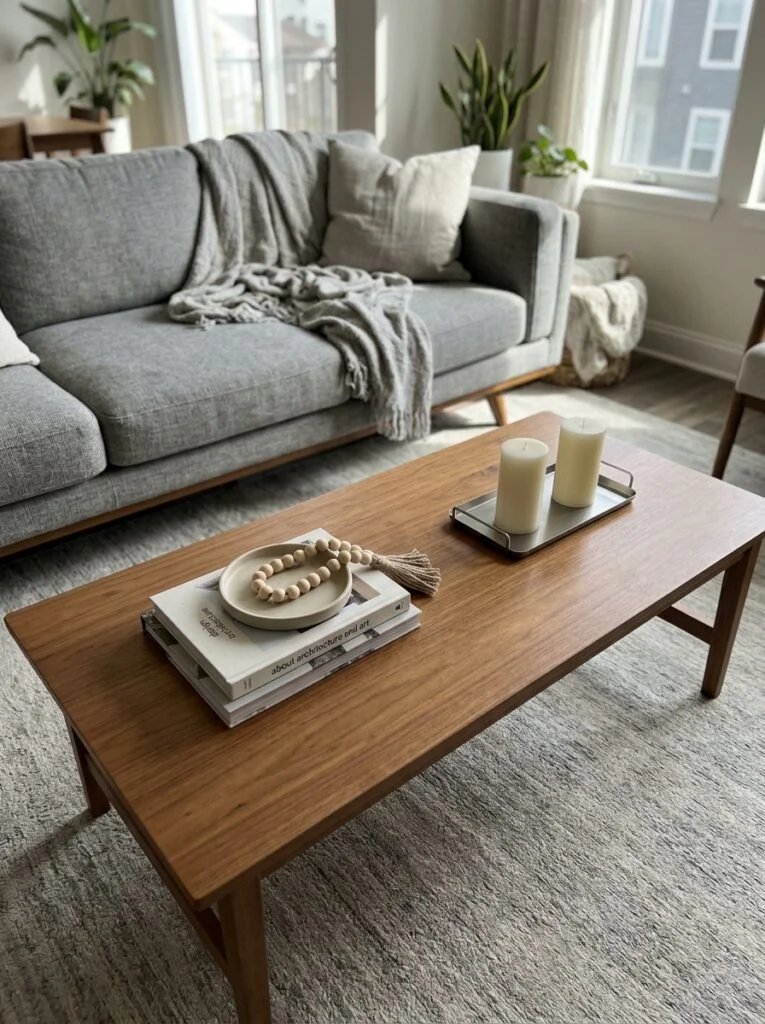
If you remember only one styling rule from this article, make it this one. Group your coffee table decor in odd numbers, ideally clusters of three, and give each cluster its own little zone on the table.
Odd numbers naturally look more balanced and visually interesting than even numbers. Design pros lean on this rule constantly because it just works. Instead of lining items up evenly across the table like a buffet line, try creating one or two small groupings with a bit of open space around them.
For example, a classic combination might be a stack of two or three books, a small decorative object on top of the stack, and a candle or vase set slightly apart. That’s your first zone. If your table is large enough for a second zone, keep it simple: a tray with just one or two items on it, rather than five.
The key is leaving open space between these groupings. That negative space is doing just as much work as the decor itself. It gives your eyes somewhere to rest, and it’s often the missing ingredient in coffee tables that feel overcrowded.
Play With Height, Texture, and Shape
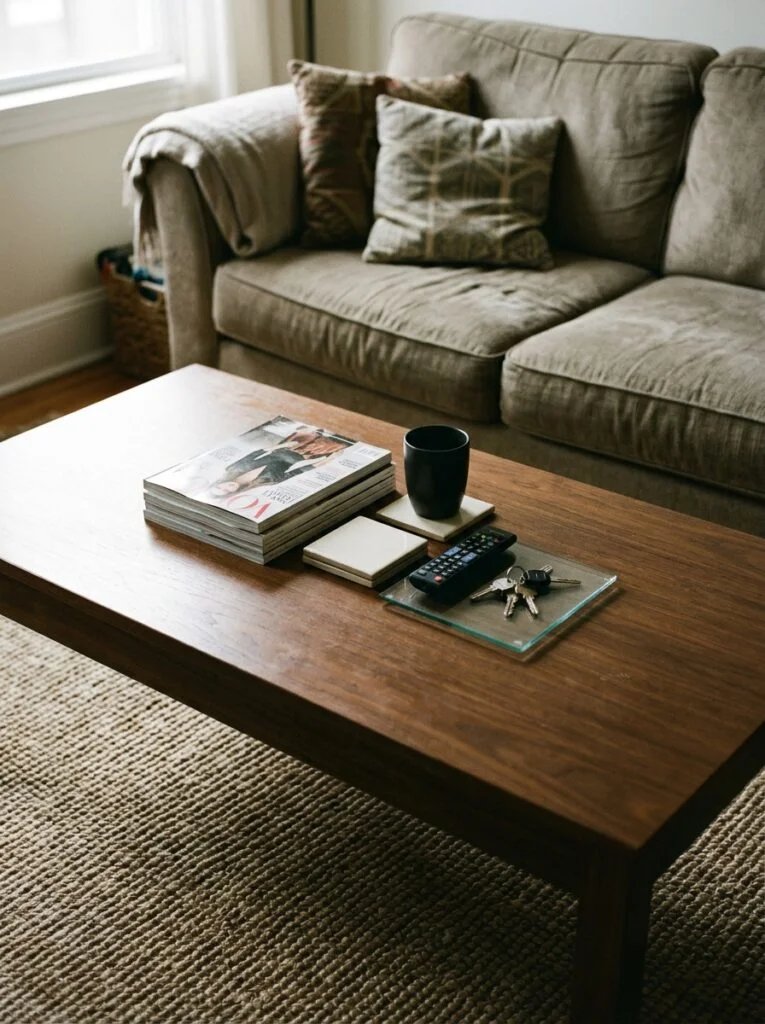
Once you’ve got your groupings figured out, the next thing to check is variety. A coffee table filled with items that are all the same height and shape can look flat and boring, while too much variety without any planning looks chaotic. The goal is a middle ground.
A well-styled table usually includes a mix of the following:
- One taller item, like a vase or a small stack of books, to create height
- One flatter or lower item, like a tray or a low dish, to ground the arrangement
- One item with texture or shape contrast, like a ceramic bowl, a woven basket, or a sculptural object
This kind of variation gives the eye something interesting to look at without overwhelming it. It’s the difference between a table that feels curated and one that feels random.
Texture matters more than people expect. A smooth glass vase next to a rough linen-bound book next to a matte ceramic bowl creates depth and interest, even if the color palette stays fairly neutral. Sticking to two or three materials total, like wood, ceramic, and glass, keeps things cohesive instead of busy.
Items You Should Remove From Your Coffee Table Today

Sometimes the fastest way to fix a cluttered coffee table isn’t adding anything new. It’s taking things away. Here are some common offenders worth clearing off immediately.
Remote controls and chargers. These are functional items, not decor, and they instantly make a table feel like a catch-all rather than a styled surface. A drawer, basket, or small hidden storage box nearby solves this without sacrificing convenience.
Mail and paperwork. If your coffee table has become the unofficial inbox for your household, it’s time to redirect that traffic to a designated spot elsewhere, like a small tray by the door or a drawer in a console table.
Too many candles. One or two candles look intentional. Five scattered across the table looks like a display shelf at a home goods store.
Duplicate categories of objects. If you have three different bowls, three different books stacked separately, or three vases all doing the same job, pick your favorite of each and store or donate the rest.
Anything without a clear purpose or story. If an object is just sitting there because it’s always been there, ask whether it’s earning its spot. Decor should either serve a function or genuinely add visual interest. If it does neither, it’s clutter.
How to Style Your Coffee Table Step by Step
If you want a simple process to follow, here’s one that works well regardless of your table’s size or shape.
Start by clearing the entire surface. This sounds drastic, but it’s the only way to really see what you’re working with and avoid the trap of just rearranging existing clutter.
Next, choose one or two functional pieces first. This might be a tray to anchor everything, or a stack of books that doubles as both decor and a small side table for drinks. Functional pieces give your styling a foundation.
After that, add your focal point. This is usually the tallest or most eye-catching item, like a vase with a few stems, a small plant, or a piece of sculptural decor. Place it slightly off-center rather than dead in the middle for a more natural, designed look.
Then bring in one or two supporting pieces that complement the focal point without competing with it. A small dish, a candle, or a single decorative object usually does the trick.
Finally, step back and look at the negative space. If it feels tight or busy, remove one item. It’s almost always easier to simplify than to guess right the first time, and most cluttered tables are fixed by subtraction rather than addition.
Other Common Coffee Table Styling Mistakes
Beyond the main clutter issue, a few other habits tend to work against a clean, styled look.
Matching everything too perfectly can feel sterile, like a furniture showroom rather than a lived-in home. A little bit of imperfection and personality goes a long way.
Ignoring scale is another common issue. A tiny candle on a massive table looks lost, while an oversized vase on a small table can feel like it’s taking over. Try to match the size of your decor to the size of your table.
Forgetting the coffee table’s actual job is easy to do. It still needs to hold a drink, a plate, or a laptop sometimes. If every inch is covered in decor, it stops being functional, which usually leads to people pushing things aside and creating clutter anyway.
Styling Tips for Different Coffee Table Shapes
Round tables tend to look best with a single centered grouping, since there’s no obvious “front” or “back” the way there is with a rectangular table. Keep your items closer together in the middle rather than spreading them toward the edges.
Rectangular tables have more room to work with, which makes the two-zone approach especially useful. One end can hold a taller grouping, while the other end stays simpler with just a tray or a single object.
Small or narrow tables benefit the most from restraint. One tray with two or three small items is often all you need. Trying to force multiple zones onto a small surface is one of the fastest ways to end up right back in cluttered territory.
Frequently Asked Questions
How many items should be on a coffee table?
There’s no strict number, but most well-styled tables use somewhere between three and seven items total, grouped into one or two zones with open space in between.
Is it better to use a tray on a coffee table?
Trays are helpful because they visually contain smaller items and create an obvious “zone” on the table. They’re especially useful on larger tables or tables that tend to collect clutter easily.
What’s the easiest fix for a cluttered coffee table?
Removing items rather than adding them. Most cluttered tables have too much going on, and simply clearing out anything without a clear purpose usually solves the problem.
Should books be stacked or spread out on a coffee table?
Stacking two or three books together, ideally topped with a small decorative object, tends to look more intentional than spreading individual books flat across the table.
How do I keep my coffee table from getting cluttered again?
Create a habit of a quick nightly reset, and give functional items like remotes and chargers a home elsewhere, such as a drawer or basket, so they never end up back on the table.
Final Thoughts
A cluttered coffee table is one of those small details that quietly shapes how an entire living room feels. The fix isn’t about spending more money or buying more decor. It’s about being more intentional with what you already have, grouping items thoughtfully, leaving room to breathe, and being willing to remove things that aren’t earning their spot.
Once you start styling with restraint instead of abundance, you’ll notice your whole living room starts to feel calmer, more put together, and a lot more like the kind of space you actually want to relax in.
2 comments