
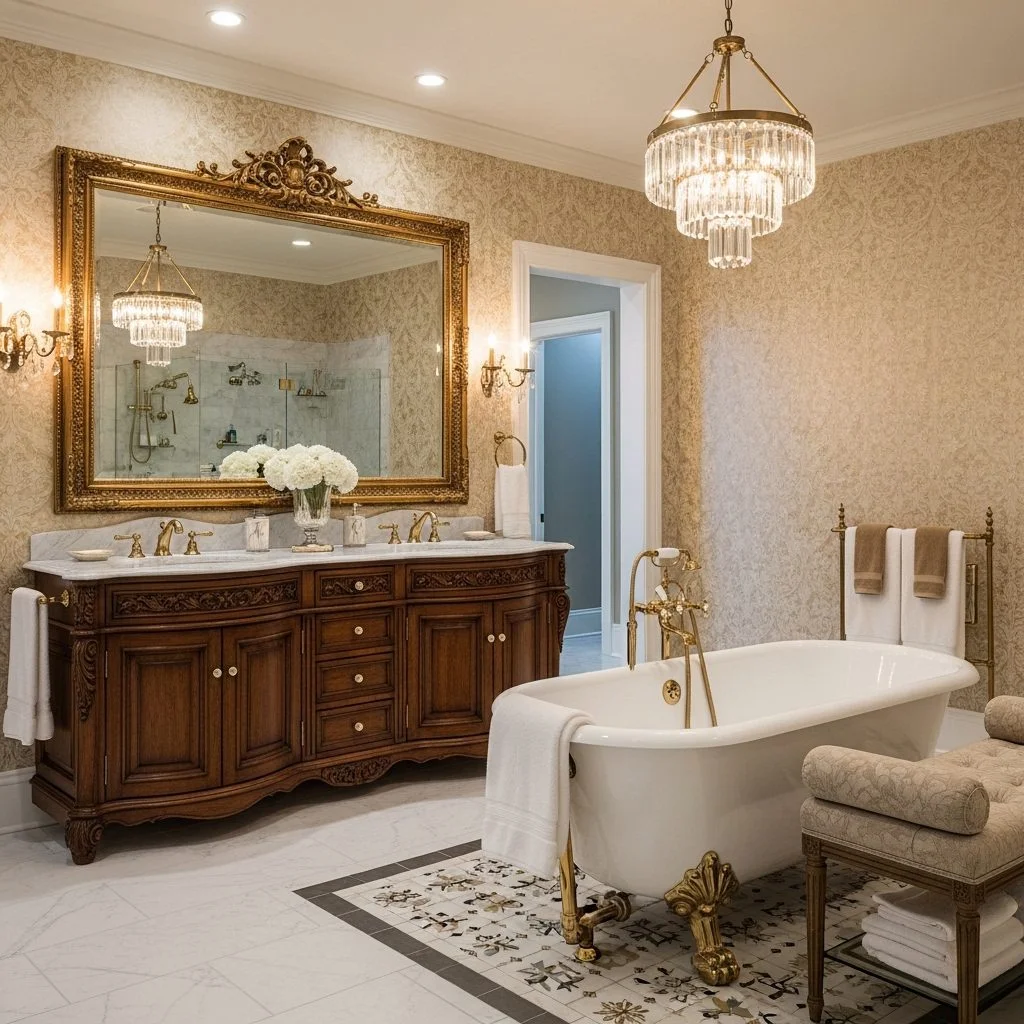
Before: a builder-grade bathroom with a chrome faucet, a white vanity, and a plastic soap dish. After: you spent a month and a few hundred dollars. The mirror, the sconces, the towel bar, the pulls, the soap pump, and the tray are all brushed gold. Everything is new, everything matches, and the room still looks like a display in a home-improvement store.
That reaction is not about price. Expensive-looking bathrooms are rarely matched sets. They are edited rooms: a few chosen finishes repeated on purpose, objects sized to the space, one surface allowed to be the star, and a lot of empty room around it. The mistake is trying to buy “luxe” as a bundle.
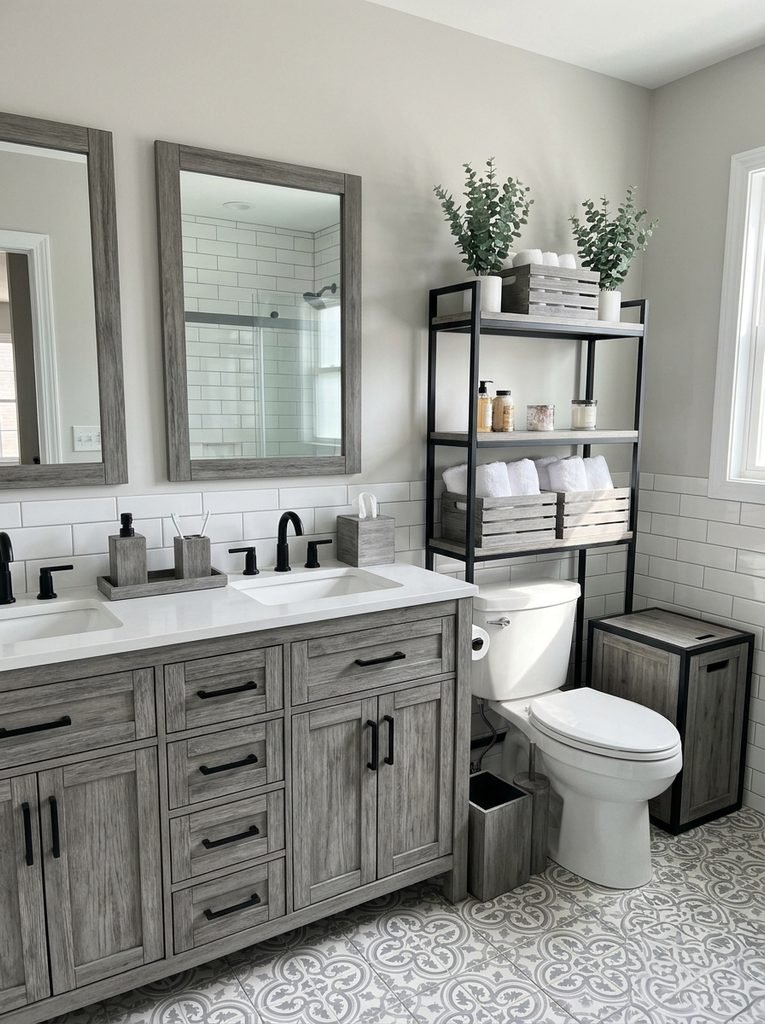
Why a Bathroom Full of New Things Still Looks Cheap
Three habits cause most of it. The first is matching every metal to the exact same finish, which flattens the room because nothing contrasts with anything. The second is buying accessories at the wrong size, such as a 3-inch soap pump on a 36-inch vanity. The third is giving every surface the same amount of decoration, so the eye has nowhere to rest.
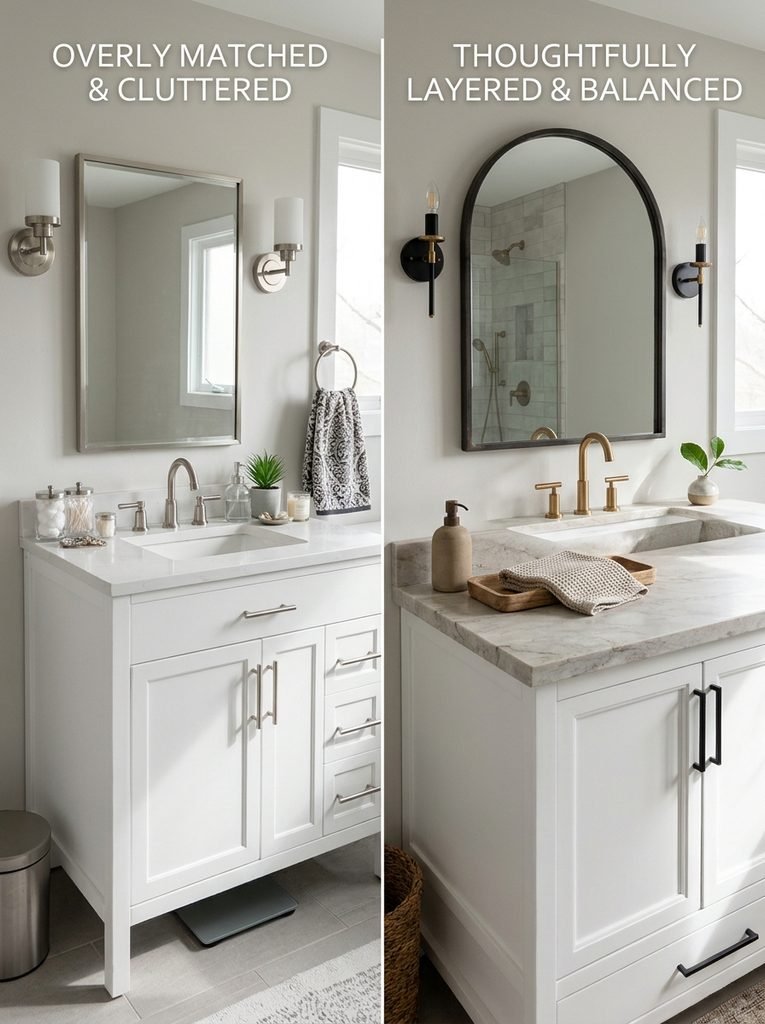
Retail sets cause this because they are sold to be easy, not to look designed. A real designer’s bathroom has a hierarchy: one thing you notice first, two or three supporting details, and a calm background. The sections below show how to build that hierarchy with the pieces you can actually buy.
Before you buy anything, do a ten-minute audit. List every visible metal, every material (tile, wood, glass, fabric), and every object on a surface. Most “cheap” bathrooms show the same problem on paper: five metals or one, nine objects on a counter, and no single standout feature. Once you see the numbers, the fixes in the sections below are mostly subtraction. For cost and labor on the bigger projects, see our guide to bathroom upgrades sorted by what they cost.
Mix Metals on Purpose, With a Ratio
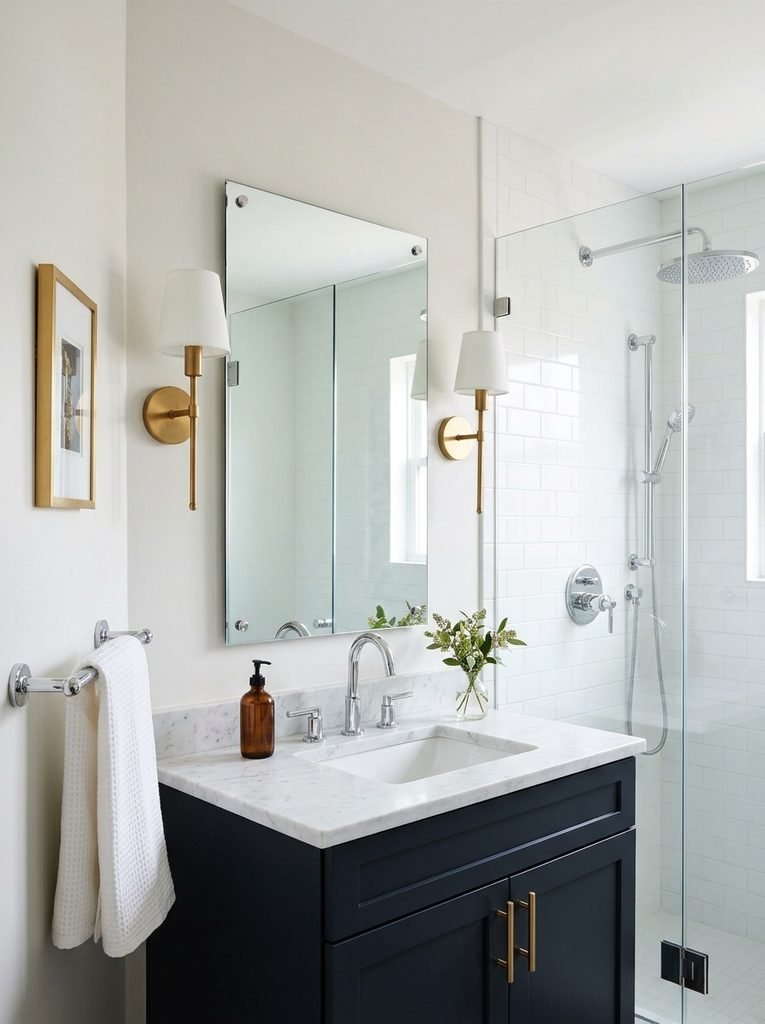
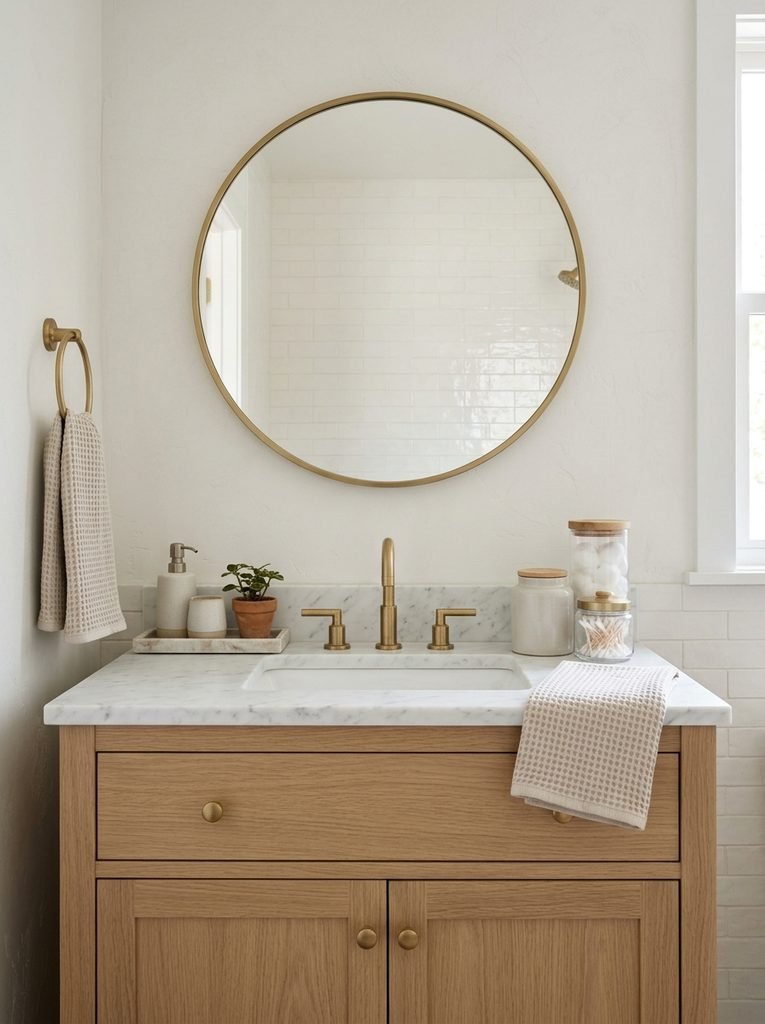
Pick one dominant metal and one accent. A workable ratio is roughly three parts dominant to one part accent. If the faucet and shower trim are chrome and you do not want to replace them, make chrome the dominant finish and repeat it on the towel bar and the mirror’s mounting hardware. Then add brass or black in three smaller places, such as cabinet pulls, a lamp base, and a picture frame.
Match the sheen as well as the color. Brushed brass next to polished brass looks like an error, not a choice. Also check where the finish comes from. Unlacquered brass darkens over months in a humid room, which looks rich to some people and neglected to others. Plated and PVD finishes stay closer to their original color. If you do want to swap a faucet to match, a basic single-hole model starts around $90 to $150, while a widespread set in a premium finish can cost two to three times that. Replace the faucet first, because it is the metal your eye returns to every time you wash your hands.
The shower is part of the same story. A wide rainfall showerhead in the dominant finish ties the wet zone to the rest of the room, and it is the metal you see most in photographs.
Sconces count as metal too. Choose fixtures in the accent finish, and keep the shades simple, glass or white fabric. For bulb color and mounting height, our post on the bathroom lighting mistake that makes everyone look tired covers what matters.
Size Every Object to the Room
Scale is the cheapest fix and the one most people skip. A typical 36-inch vanity top leaves only about 8 inches on each side of the basin. A tray 18 inches wide will swallow it. Use a tray around 8 by 12 inches, and put no more than three things on it, in odd numbers: a soap pump, a small vessel, and a candle or plant.
Mirror size works the same way. Choose a mirror a few inches narrower than the vanity, and at least 24 inches tall. A round mirror about 30 inches across suits a single sink and softens all the right angles around it.
Jars and containers should vary in height. Group a tall one, a medium one, and a small one, with the tall piece at the back. A useful rule of thumb: keep the tallest object about one-third the height of the mirror, so the reflection frames it instead of being crowded by it. Choose glass or ceramic with a lid in wood, marble, or metal. Plastic bottles with printed labels are the single fastest way to make a styled counter look cheap, so decant them.
Pick One Hero Surface and Keep the Rest Quiet
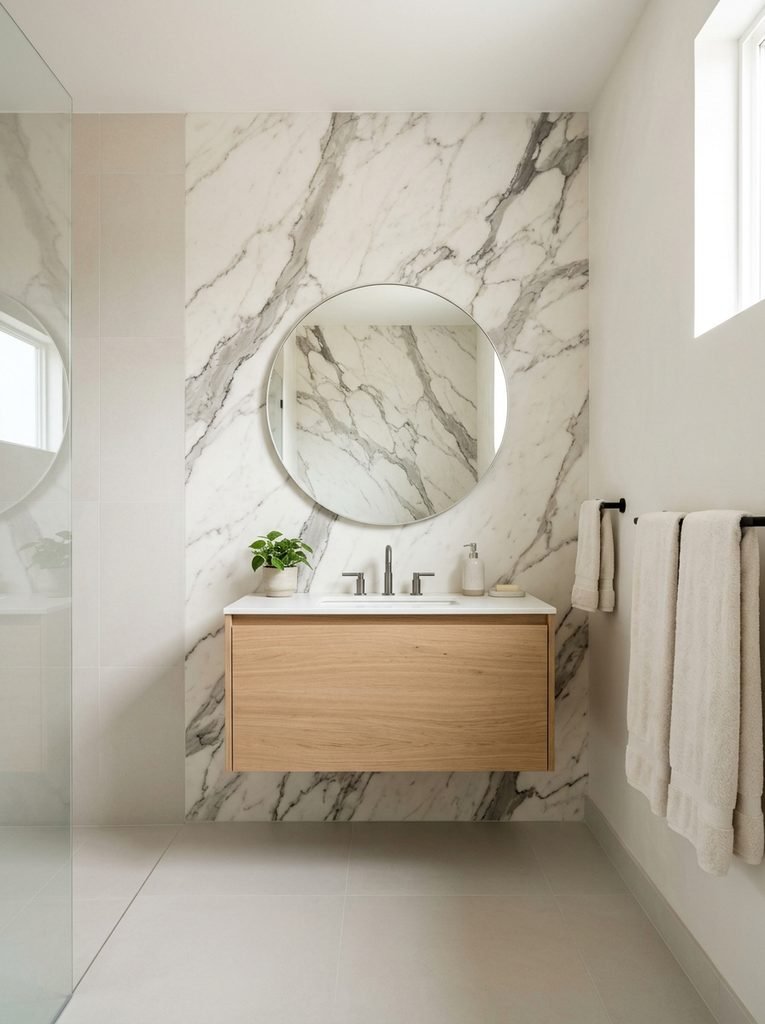
Every good bathroom has one thing you see first. It might be a marble-look wall, a stack of vertical tile, or a single feature wall. Choose one, and make everything else a calmer backdrop.
Marble-look porcelain gives you the veining without the upkeep. Real marble etches when acidic products touch it, which dulls the polished finish, and it wants resealing about once a year. Porcelain is far harder to damage. Look for large slabs with random veining rather than a repeating pattern, since repeats expose the trick. Budget roughly $5 to $15 per square foot for good porcelain, versus well above that for real marble, and remember that setting large slabs costs more labor than small tile.
f tile is the hero, mind the joints. Rectified tile can sit with grout lines about 1/16 to 1/8 inch wide, which reads as seamless. Use a grout color within one shade of the tile, and line up the grout lines between wall and floor where they meet. Stop a feature wall at a natural line, like the ceiling or the top of the window frame, rather than at a random height.
Around the hero, hold the palette to three tones. The trap is undertone. White towels with a blue cast look gray next to warm cream tile, and cream towels look dirty next to cool white. Hold the towel against the tile in daylight before you buy a set. Also keep the wall color within the same family. A white vanity against a gray-white wall will look slightly dirty if the two undertones disagree, even when both are technically neutral.
Leave Empty Space on Purpose
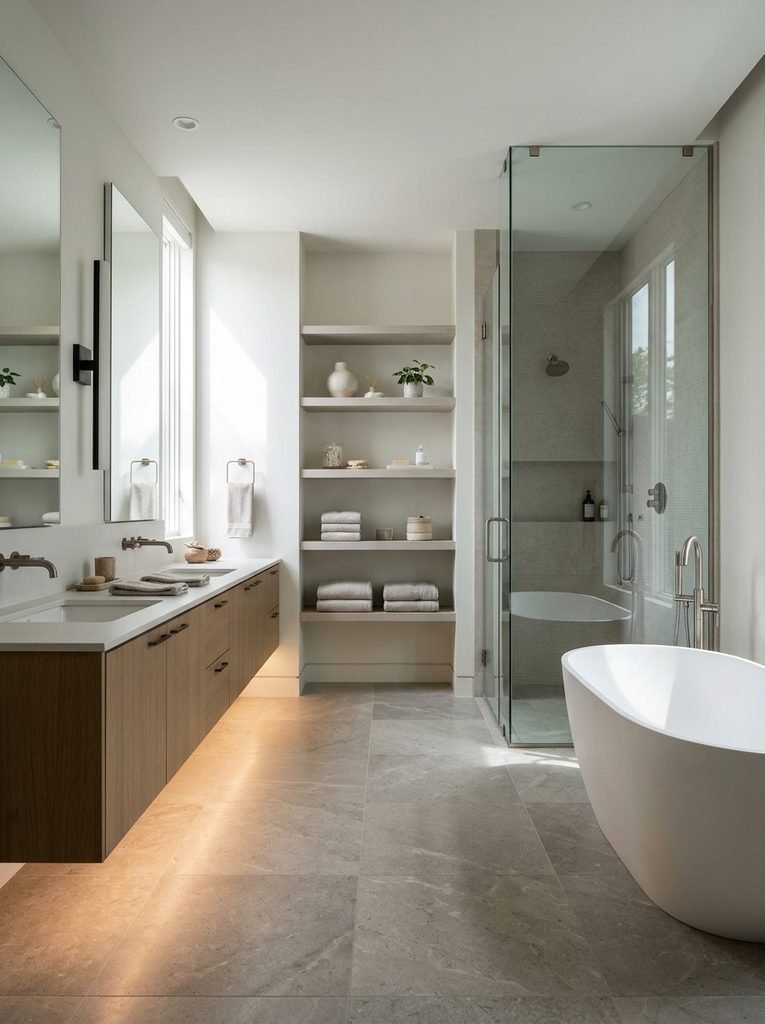
Empty space reads as money because it means the room had room to spare. A wall-hung vanity shows floor under the cabinet, so keep that strip clear and let a low LED glow underneath do its job. Open shelves look expensive when about a third of each shelf stays empty. Space brackets so a stack of towels fits with a hand’s width of clearance above it, and keep the top shelf for lighter, decorative objects. A shelf that is packed from end to end reads as storage, and storage reads as clutter.
Frameless glass follows the same logic. Without a metal frame or a curtain, the shower stops cutting the room into pieces, and you see all the way to the back wall. A freestanding tub also needs breathing room. Plan for at least 6 inches of clear space behind and beside it so you can clean, and about 30 inches in front if the room allows. A tub pushed hard against one wall looks like a built-in that lost its surround. Floating it a few inches off the wall, with the faucet on a floor stand, gives the shadow gap that makes it look like furniture.
Layer Fabric and Wood Instead of Adding More Objects
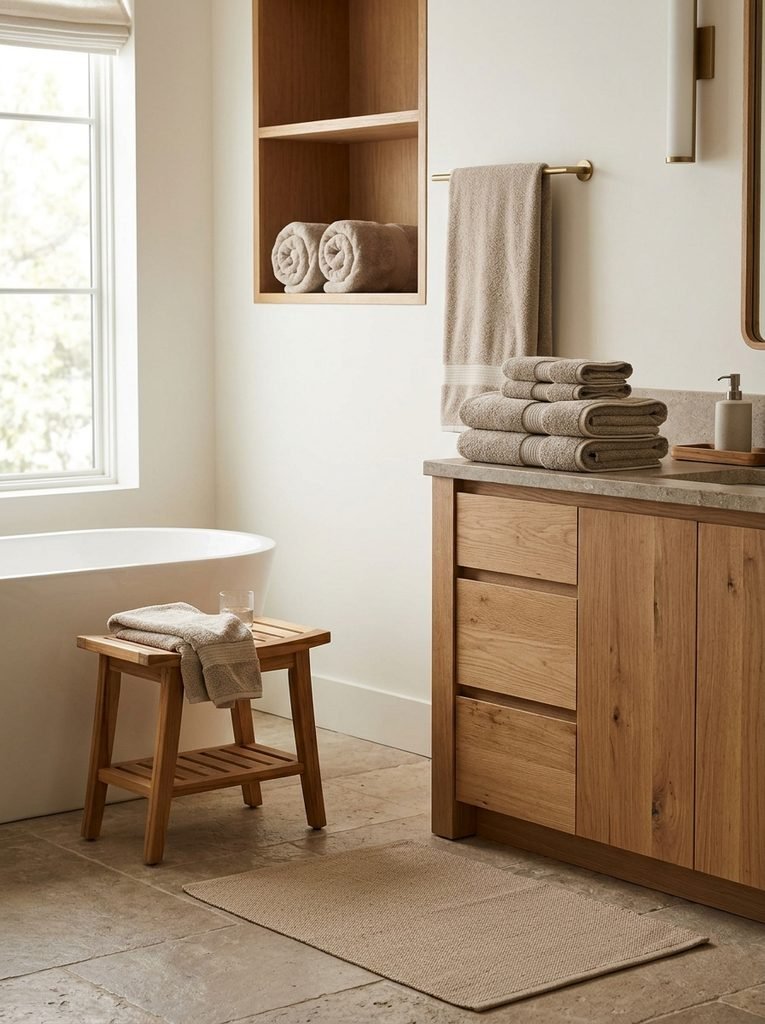
When a room needs warmth, add texture, not stuff. Start with towels. A heavier towel, around 600 GSM, in one color family looks like a hotel set. Roll two bath towels on a shelf and hang one on the bar. Stack hand towels on the counter. Do not display all of them at once, because a wall of towels looks like a store. Keep the rest in a closed cabinet, and swap the set every week so the visible ones always look fresh. Folded edges facing out, with no tags showing, finish the effect.
A cotton rug in the same tone as the tile, about 2 by 3 feet, goes in front of the vanity. Use a non-slip pad under it and wash it weekly, because a damp rug is the quickest way to make a nice bathroom smell stale.
Wood is the other warm material. One teak stool, a wooden tray, or a bath caddy is enough. Teak holds up in humidity, and an oiled oak shelf will too, as long as you seal the underside. A small stool beside the tub also gives you a place to put a towel and a drink. Expect to pay about $50 to $120 for a teak stool, and bring it out to dry in the sun a few times a year so mildew does not take hold in the slats.
Finish With Light, One Plant, and One Real Detail
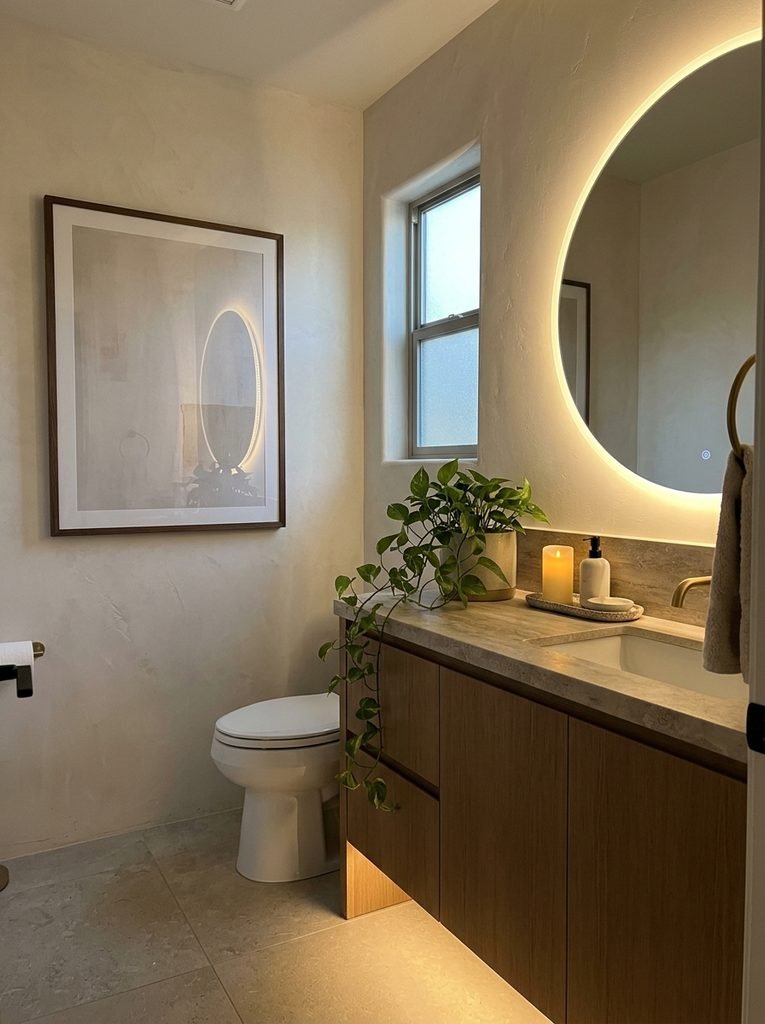
The last layer is what people feel more than see. A soft glow from an LED-lit mirror or an under-vanity strip gives the room a calm ending point after dark.
Add one plant, not five. Pothos and ZZ plants cope with low light, and a real plant looks better than a faux one that has gone dusty. Hang one piece of art in an acrylic or sealed frame, away from the shower spray. Pick a size that fills about two-thirds of the wall space above the toilet or the free wall beside the vanity, and hang it with the center around 57 inches from the floor. A single large print looks more expensive than a gallery of small ones, which can look like a dentist’s office.
For candles, treat the shelf like a mini kitchen. The National Fire Protection Association advises keeping candles at least 12 inches from anything that can burn and suggests flameless versions as an alternative. In a bathroom, that means not next to a towel stack or a shower curtain. A flameless candle on a tray gives the same look with none of the risk.
The Two-Minute Photo Edit
Stand in the doorway and take one photo. Look at each surface and remove a single item from every one that has more than three. Then look again at the metals. Repeat the photo in a week, when the room has gone back to real life, because that is the version people see. If you can name the dominant finish and the accent in five seconds, the room is edited. If you cannot, it is still a set.
Frequently Asked Questions
Why does my bathroom look cheap even after I replaced everything?
Usually the pieces are the right quality but the wrong scale or too matched. Check three things: accessories under 6 inches on a 36-inch vanity, more than two metal finishes, and more than three objects per surface. Removing a few items and adding contrast in one finish often fixes it without buying anything new.
Can I mix chrome and brass in the same bathroom?
Yes, if one finish clearly leads. Keep the plumbing fixtures in the dominant metal and introduce the second in about a quarter of the visible hardware, such as pulls and a lamp. Match the sheen, since polished beside brushed looks accidental, and repeat each metal at least twice so it reads as a choice.
Is marble-look porcelain a good substitute for real marble?
For most bathrooms, yes. Porcelain resists etching from acidic cleaners and skincare, and it needs no yearly sealing. Choose large slabs with varied veining to avoid obvious repeats. Real marble suits a low-traffic powder room where you accept a gradual patina, since even a splash of citrus cleaner can leave a dull mark.
How many items belong on a bathroom vanity?
Three to five on the whole counter is a good limit, grouped in one or two clusters. A soap pump, one small vessel, and one candle or plant on a single tray is a complete look. Anything else belongs in a drawer, and daily-use items like toothbrushes get a closed cup or a cabinet.
Should bathroom towels match the tile color?
They should share an undertone, not match exactly. Cream towels suit warm beige tile, while crisp white suits cool gray. Hold a towel against the tile in daylight before buying. A slightly lighter or deeper shade of the same family looks intentional, and a clashing undertone makes both items look dingy.
1 comment