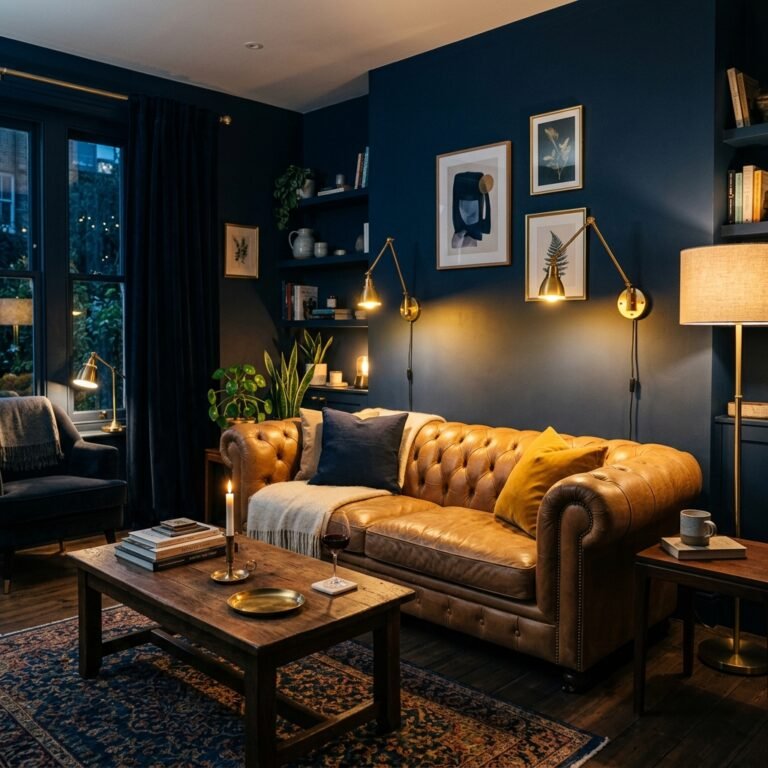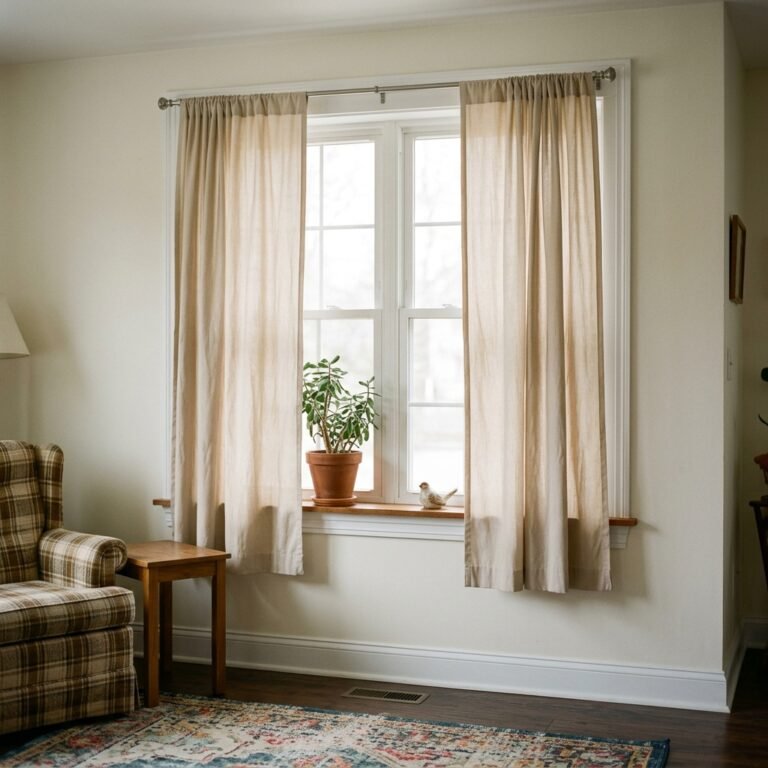
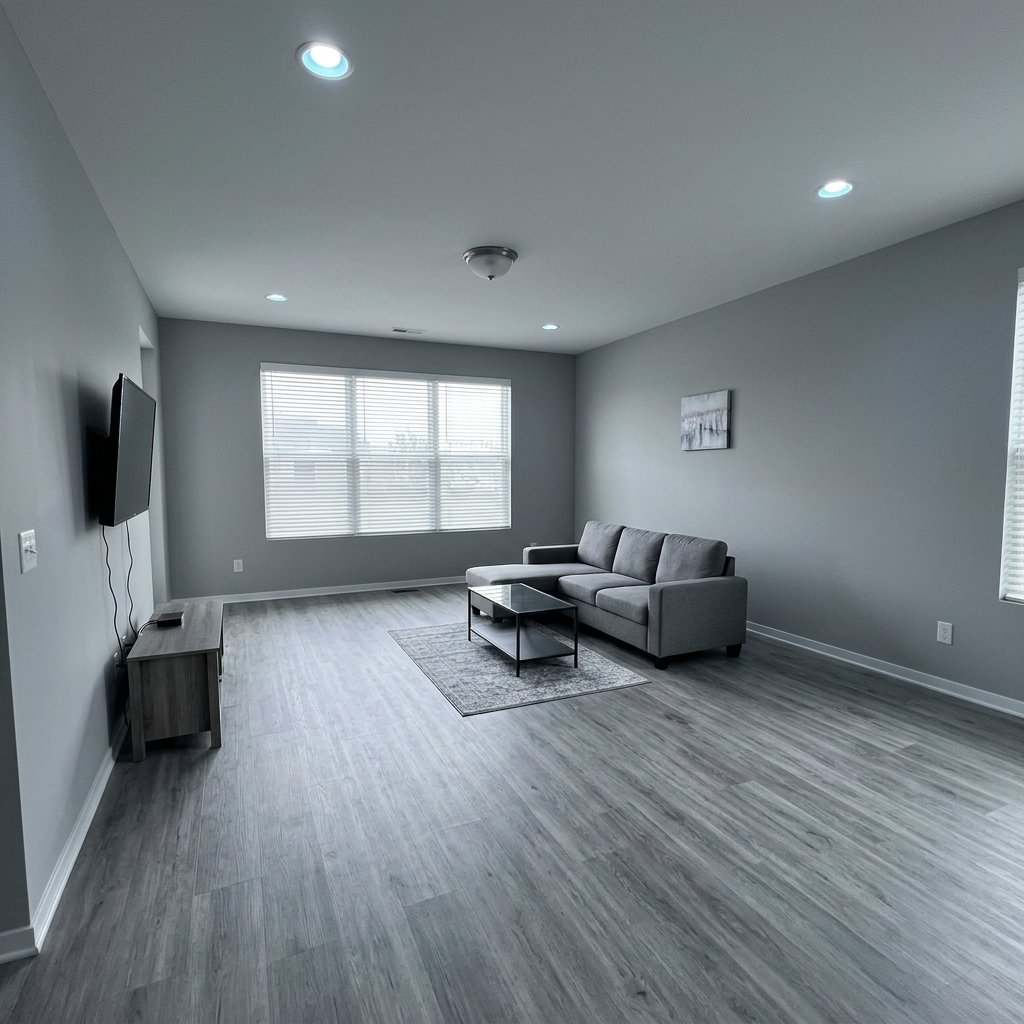
You turn the key, flip the switch by the door, and six recessed lights snap on in a neat grid. The walls are flat white. The floor is gray vinyl plank. A catalog sofa faces a 65-inch TV across a room that is clean, square, and correct.
It also looks like a listing photo. Three weeks in, you still catch yourself talking a little quieter in there.
That is the builder-grade mistake: treating the walls, floor, and ceiling lights as fixed facts and decorating on top of them. In a minimal room there are few objects to distract you, so those defaults do most of the talking. Builders chose them for speed and cost, not for how a Tuesday evening feels.
The good news is that most of the cold comes from a handful of surfaces you can change for a few hundred dollars, and several of the changes are renter-safe. Here is why the box feels cold, how to audit yours in twenty minutes, and which fixes pay off first.
Why a New-Build Box Feels Cold Even When Every Piece Is Pretty
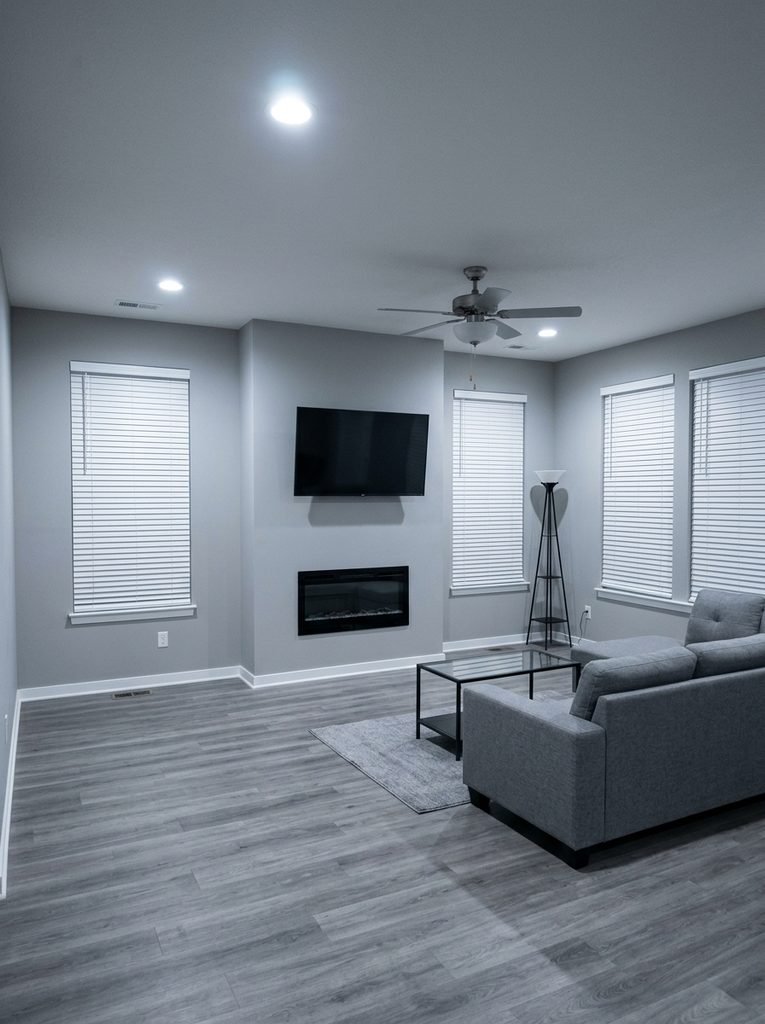
A room feels warm when light, depth, and uneven edges give your eye something soft to land on. A builder-grade box often supplies none of the three, because each default was picked to be quick to install. Look at what you were handed:
- One flat white on everything. Walls, and often the ceiling, share a single sprayed color, so no plane separates from the next.
- Cool bulbs. Many builders fit lights labeled 4000K or 5000K, which looks crisp in sales photos and clinical at 8 p.m.
- Thin trim. Window casing around 2-1/4 inches wide, on windows set nearly flush, leaves almost no shadow line.
- Glossy plank flooring. Vinyl plank bounces overhead light straight back up at you.
- One switch. Every light is either fully on or fully off.
Furnish a busy room like this and you will hardly notice. Furnish a minimal one and these five defaults become the whole visual story. That is why a second throw blanket never fixes it.
The Twenty-Minute Evening Walk-Through
Do this at 7 p.m., with the blinds closed and every light on. It costs nothing and shows you which fixes matter in your room.
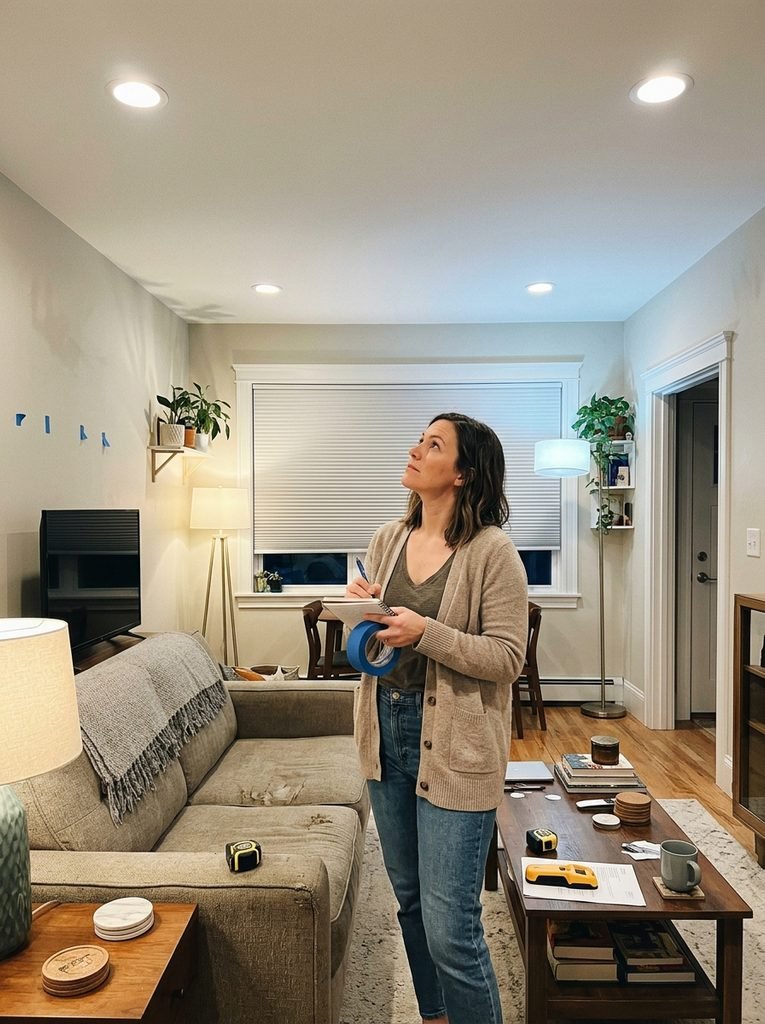
- Count switches against fixtures. Write down how many lights each switch controls. One switch for six cans means no way to dim just the seating area.
- Read the bulbs. The color temperature is printed on the bulb base or the box. If you see 4000K or 5000K, that is your first purchase.
- Hunt for shadow lines. Scan the walls for every place a surface steps out by an inch or more. Most boxes have three: baseboards, door casings, and window sills.
- Mark the studs. Use a stud finder and painter’s tape on the wall behind the TV. Slat panels and ledges need to hit them.
- Write the can’t-change list. If you rent, check what your lease says about paint and screw holes before you plan anything.
Older houses with real plaster and deep trim have a different cold problem, usually too little texture or too many objects. For that, start with our guide to minimalist living room ideas that stay warm.
What Each Fix Costs and Which Ones a Renter Can Keep
These are rough US ranges and they shift by region. Start at the top, because the cheapest fixes also change the room the most.
| Fix | Rough cost | Renter-safe? | Time |
|---|---|---|---|
| Warm bulbs in existing cans | $40 to $90 for six | Yes | 20 minutes |
| Plug-in wall sconces with cord cover | $60 to $160 a pair | Yes | 1 hour |
| LED-rated dimmer | $20 to $45 DIY | Ask your landlord | 30 minutes |
| Wider window casing | $40 to $90 per window | Needs permission | One weekend |
| Wood slat panels | $40 to $100 per 8-foot panel | Only if screw holes are allowed | One weekend |
| Limewash or plaster-effect paint | $60 to $120 a gallon, plus primer | Only if repainting is allowed | One weekend |
| Vinyl-safe pad and wool-blend rug | $300 to $800 | Yes | One afternoon |
Anything that needs permission is reversible with spackle and a touch-up quart, which is a fair thing to offer your landlord in writing.
Fix the Light Before You Touch the Furniture
Start here, because every other change reads differently under better light.
If your cans take screw-in bulbs, swap all of them in one sitting. Mixing 2700K and 4000K bulbs in one room looks patchy. If your lights are flat wafer discs with no bulb at all, look for a small slider on the edge of the disc or on its junction box. Many let you pick a warmer setting without tools.
Then deal with the switch. An LED-rated dimmer is cheap, and an old incandescent dimmer will buzz or flicker with LED bulbs. Choose dim-to-warm bulbs if you can. They slide toward a candle-like 2200K as you lower them, which a fixed bulb never does. Run the cans near a third and leave the rest off.
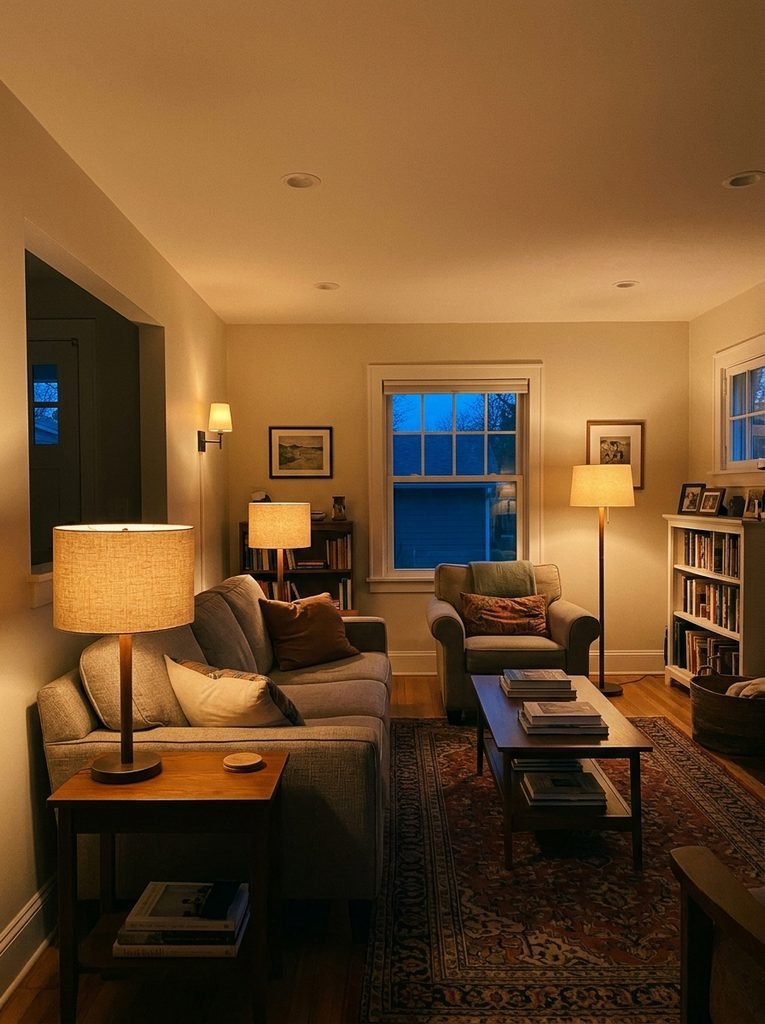
Recessed lights alone still flatten a room, because they shine straight down. Add two lamps at seat height. Pick shades whose bottom edge lands near seated eye level, around 40 inches off the floor, so you see the glow instead of the bulb. Renters can hang a plug-in sconce at the same height and hide the cord in a paintable cover.
Put the floor lamps on a smart plug or switched outlet so one tap starts the evening. Then give the new bulbs three nights before you judge them. After months of cool light your eyes have adapted, and 2700K looks yellow at first.
Add the Shadow Lines the Builder Left Out
Warmth in a minimal room is mostly depth. Pick one of these, not all of them.
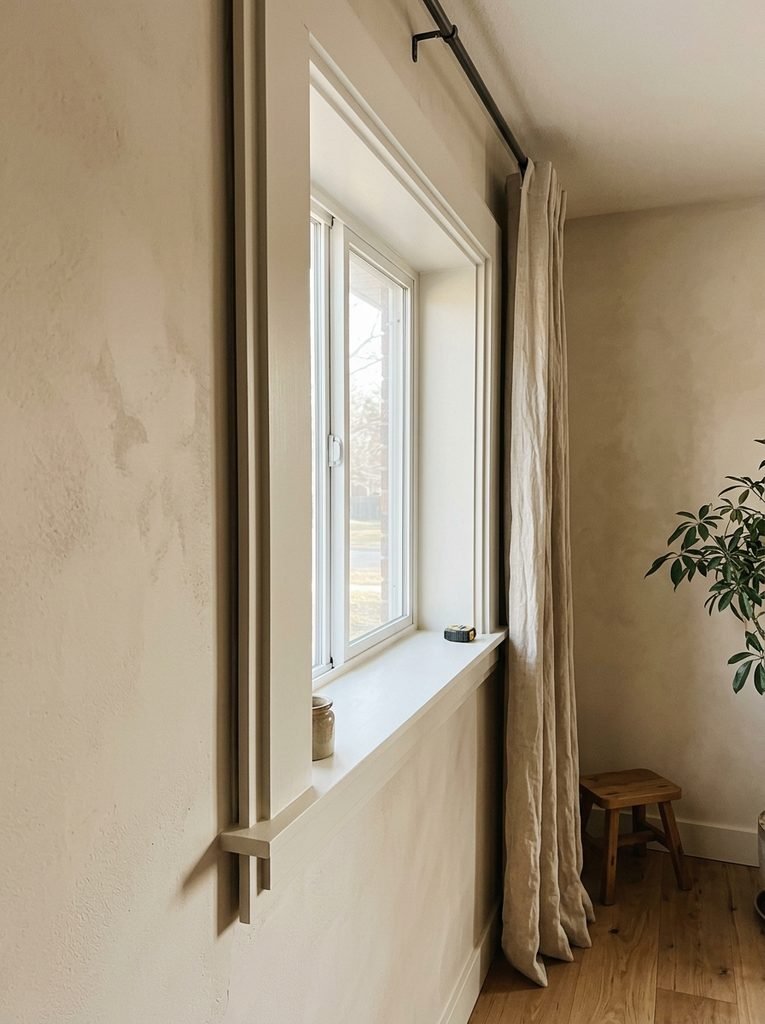
Wider window casing. Nail 1×4 primed poplar boards over the thin factory casing, and add a slim sill below with a small overhang. The new edges throw a shadow line all day. Expect $40 to $90 in lumber per window, plus caulk. Use a level and a scrap of cardboard as a spacer so the small step between old and new trim stays an even quarter inch all the way around. An uneven step reads as a mistake from across the room. Fill the nail holes, caulk every seam, and paint it before you decide it looks wrong.
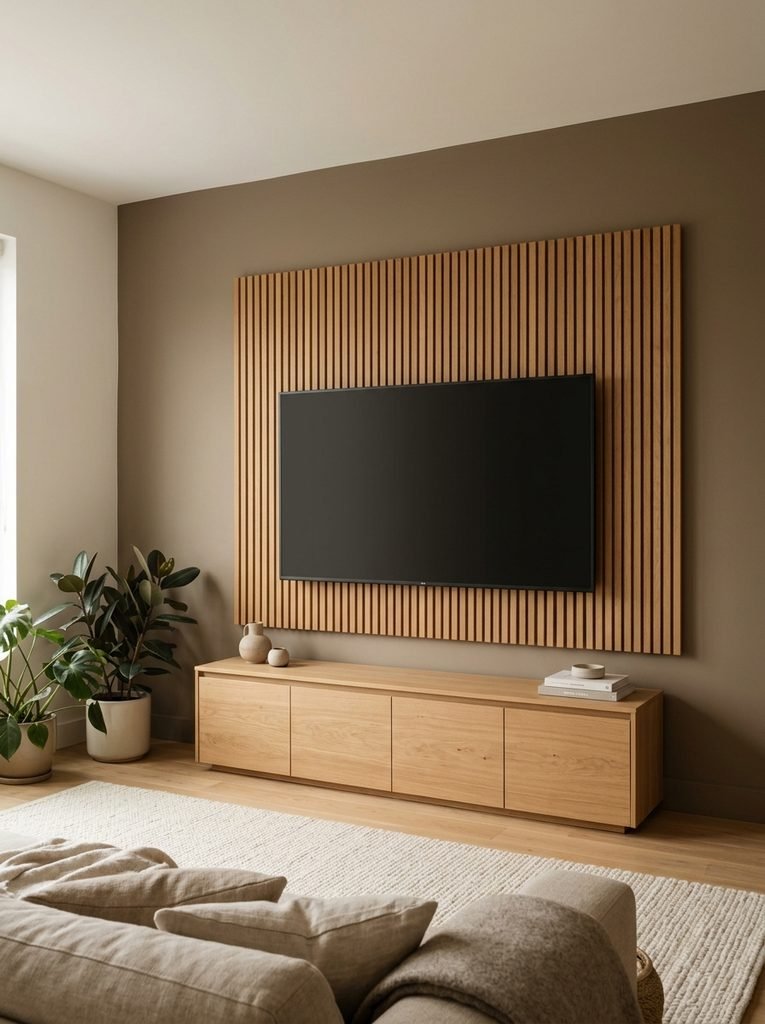
A wood slat wall. Vertical slats on a felt backing add rhythm and texture behind a TV or sofa. Panels run roughly $40 to $100 per 8-foot section, and they need to hit studs, so use the tape marks from your walk-through. Order one extra panel, because cuts around outlets eat material and dye lots vary between orders.
Limewash or plaster-effect paint. The cloudy, uneven finish catches light at an angle in a way flat paint cannot. Budget roughly $60 to $120 a gallon, and follow the maker’s primer step on smooth new drywall. Test on a 2-by-2-foot board first, because limewash dries lighter than it looks wet.
A picture ledge. A ledge about 4 inches deep casts a thin shadow under whatever sits on it. It needs only two or three screws, which suits renters who can patch small holes.
Give Vinyl Plank a Softer Landing
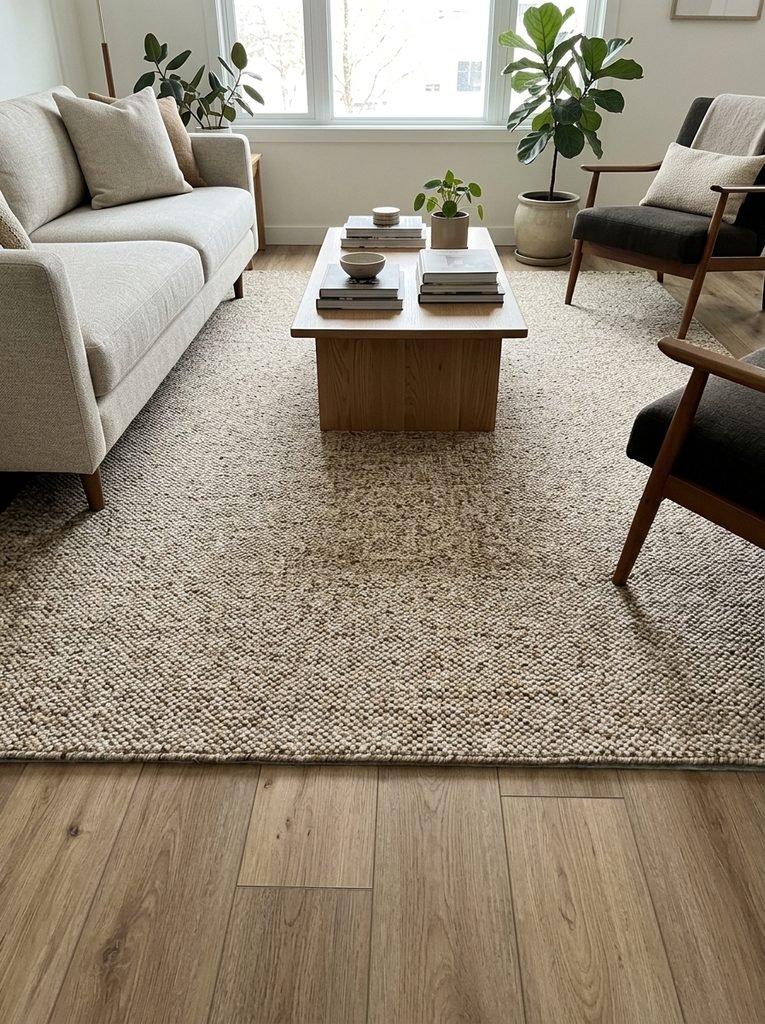
Size the rug so at least the front legs of the sofa and chairs rest on it. Our guide to rug placement ideas that suit different layouts covers the common arrangements, so here the focus is the floor itself.
Choose a low-pile wool blend in a sand-and-brown tweed rather than a solid. Tweed hides the scuffs and crumbs that glossy vinyl shows, and the matte fiber breaks up the reflection of the lights.
Check the pad before you buy the rug. Rubber and PVC backings can leave yellow-brown stains on vinyl plank after a few months. Look for a pad labeled safe for vinyl, usually felt bonded to natural rubber, and cut it about an inch smaller than the rug on every side so the edges lie flat.
Soften the Black Rectangle on the TV Wall
A 65-inch TV is about 57 inches wide. On a flat white wall it becomes the strongest contrast in the room, and your eye returns to it even when it is off.
Lower the contrast instead of hiding the set. Paint the TV wall one or two steps deeper than the others, in a warm mushroom or clay-beige, so the screen sits against a color closer to its own darkness. Mount the center of the screen near seated eye level, roughly 42 to 48 inches off the floor, and run power through an in-wall-rated kit so no cords cross the wall.
Below it, use a low console with closed doors rather than open shelves, so remotes and routers vanish. If you added a slat panel, center it behind the TV and let it run a foot or two wider on each side.
Paint in the Right Order and Air the Room Out
Order matters. Change the bulbs first, since paint looks different under warm light. Then paint, then trim, then bring in the rug and furniture. Cut in along the ceiling first with an angled brush and roll before that edge dries, since flat builder walls show lap marks quickly. Builder paint is often a thin flat coat that soaks up the first layer of anything new, so plan on primer plus two coats and lightly sand any glossy patches.
Paint also puts chemicals in your air. The U.S. Environmental Protection Agency lists paints among the household products that release volatile organic compounds, and it advises extra ventilation and plenty of fresh air while you use them. In practice, that means low-VOC paint, a window open with a box fan blowing outward, and sleeping elsewhere the first night if you can.
Overcorrections That Make a Box Look Staged
Warm everywhere. Running every bulb at its lowest dim-to-warm setting turns the room amber and makes reading a strain. Keep one 2700K lamp for the sofa corner where you read.
Faux wood on one wall. Peel-and-stick wood-grain sheets repeat their pattern, and once you spot the repeat every couple of feet you cannot unsee it. Real slats or paint hold up better.
Three wood tones. A slat panel, stained casing, and a coffee table in different browns fight each other. Hold to two, and let one of them be the rug.
A lone textured wall. One limewashed wall with nothing echoing it looks like a patch. Repeat its tone in a lamp base, a ceramic, or a throw.
The Same Doorway, Two Weekends Later
Walk back in at 7 p.m. and flip the same switch. Two cans glow at a third of their strength, a lamp pools light beside the sofa, and the TV wall has gone from white to a soft clay. Nothing you bought is rare or expensive.
You are talking at your normal volume again.
Frequently Asked Questions
Can I change the color temperature of recessed lights without an electrician?
Usually yes. If your lights take screw-in bulbs, swap every bulb in the room for a warmer one in a single sitting. If they are flat wafer discs with no bulb, look for a small slider on the disc edge or junction box that selects settings such as 2700K or 3000K. Only changes to the wiring itself call for a licensed electrician.
Do rugs damage luxury vinyl plank flooring?
Some can. Rubber and PVC backings may leave yellow-brown stains on vinyl plank over several months, especially in sunny spots. Choose a pad labeled safe for vinyl, usually felt bonded to natural rubber, and cut it about an inch smaller than the rug on every side so the edges lie flat.
How much does it cost to upgrade builder-grade window trim?
Doing it yourself usually costs about $40 to $90 per window in primed poplar, caulk, and nails. Hiring a carpenter commonly runs $150 to $400 per window, depending on your region. A 1×4 board is three-quarters of an inch thick, so it stands proud of the wall and casts the shadow line you want.
How long should I wait before using a room after painting it?
Most paint feels dry within hours, but fumes last longer than the dry time suggests. Keep a box fan exhausting from an open window for a day or two, choose low-VOC paint, and sleep elsewhere the first night if possible. Check the can for recoat and cure times, since thick coats and humid weather stretch both.
Will limewash stick to new drywall?
It can, but not directly. Smooth new drywall lacks the tooth limewash grips, so most makers call for their own mineral primer first. Sample on a 2-by-2-foot board, because limewash dries noticeably lighter than it looks wet, and the brushwork you leave becomes the final texture.