
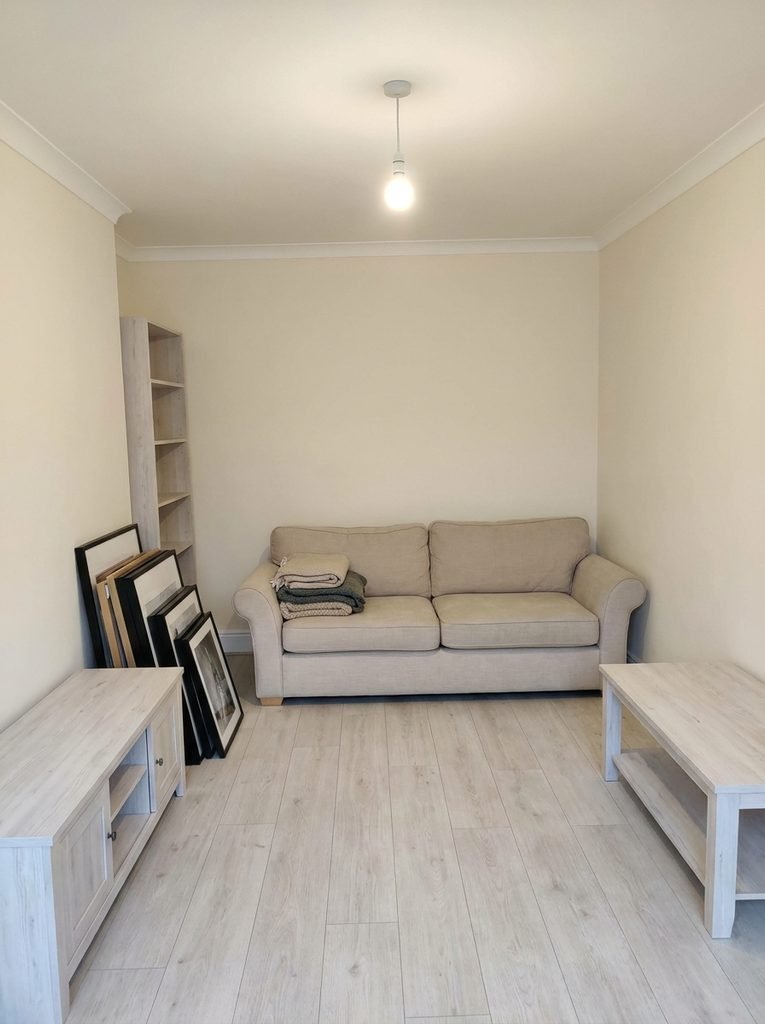
You finished the room on a Sunday. The sofa sits on tapered oak legs. The coffee table is glass. The TV console floats off the wall, the rug is pale oatmeal, and the one print has a frame as thin as a pencil. Every piece came straight out of a “small living room” guide. Then a friend walks in, stops in the doorway, and asks if you just moved.
Nothing in the room is wrong, which makes it more annoying. The room looks unfinished because everything in it is light, slim, and see-through. Nothing has any weight. Below, you will learn how to spot that problem in your own room, where to add weight without losing the clean modern look, and which parts of the “keep it airy” advice deserve to stay.
What an Unfinished Room Actually Looks Like
The symptoms are easy to miss because they feel like personal taste. Your eye slides across the room and never lands anywhere. The sofa seems to hover a few inches above the floor. Guests perch on the front edge of the cushions instead of leaning back.
Meanwhile the TV takes over by default. A 55-inch screen is roughly 48 inches wide and 28 inches tall, and switched off it is a black rectangle. In a pale room with no other dark shape, it becomes the heaviest object you own. Every seat points at it like a compass needle.
Then there is the sound. Clap once in the middle of the room. If you hear a sharp, ringing slap, you have a lot of hard, bare surfaces and very little soft mass to absorb them. In a 10-by-12-foot room, that echo is part of why the space feels like a showroom and not a home.
Why the Light-Everything Advice Backfires
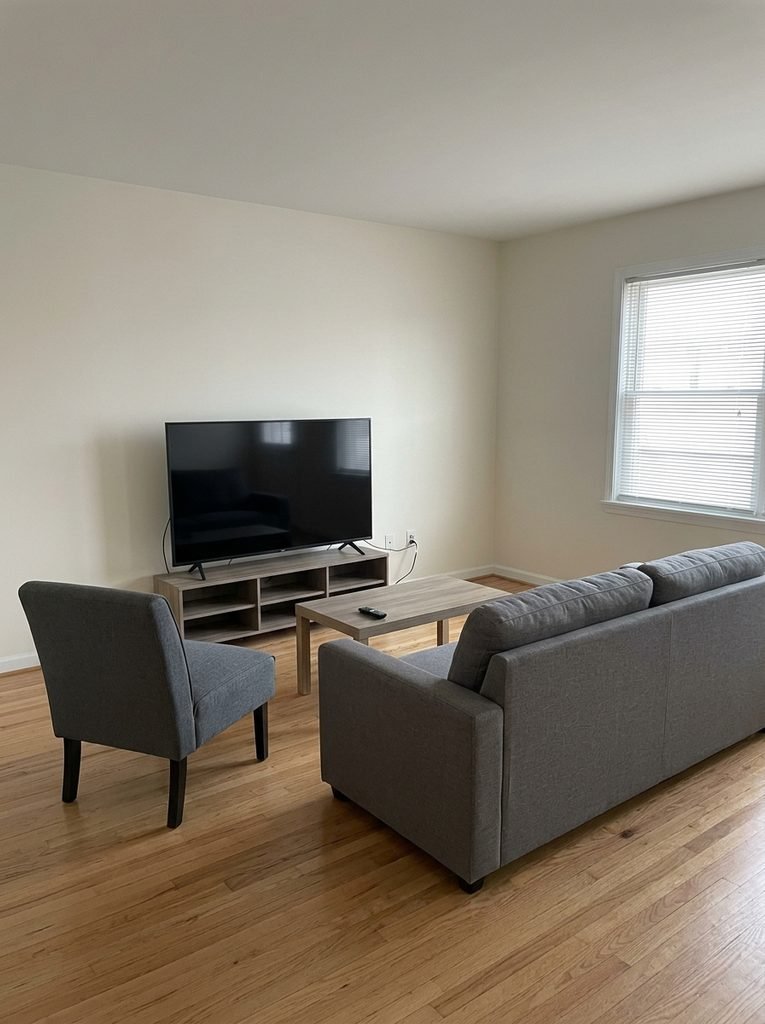
Each popular small-room tip is sound on its own. Legs show more floor. Glass disappears. A floating console frees up the baseboard. A pale rug reflects light. A thin frame keeps the wall quiet.
The trouble starts when you stack all five. Designers call the missing ingredient visual weight, meaning how heavy an object looks, no matter what it weighs on a scale. A room needs a few heavy-looking things so the light things can read as light. Take away every counterweight and the lightness stops looking intentional and starts looking empty.
Designers quoted in Livingetc’s guide to visual weight make the same point from the other direction. They say furniture on legs and see-through materials work best next to something solid and substantial, and that a piece with a strong base only works when lighter pieces surround it. Your room likely has the light half of that equation covered. It needs the solid half.
Run the Squint Test Before You Buy Anything
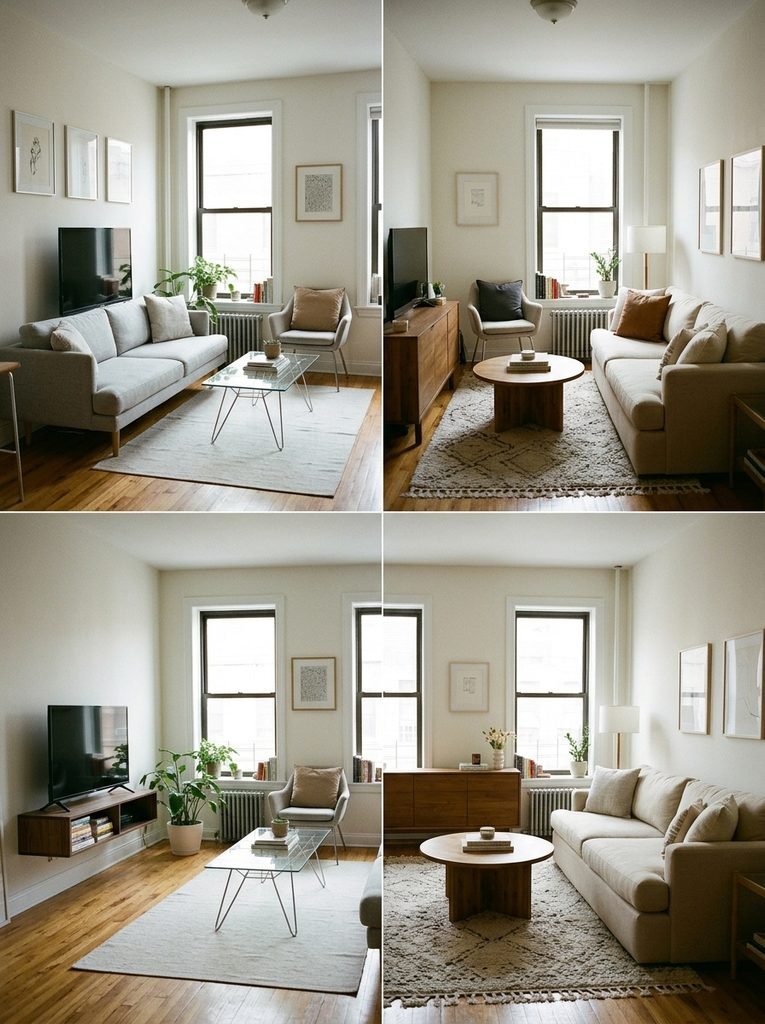
Stand in the doorway, where you first see the room. Squint until the details blur. Now find the darkest, heaviest blob.
If it is the TV, you have your answer. If nothing stands out and the whole room melts into one pale smear, that is also your answer. Take a phone photo and switch it to black and white. That makes the weight map even easier to read.
You want two or three distinct masses at different heights, and not all in the same corner. A dark rug low down, a solid piece at mid-height, and one dark shape on the wall usually do it. The TV then becomes one mass among several instead of the lone anchor.
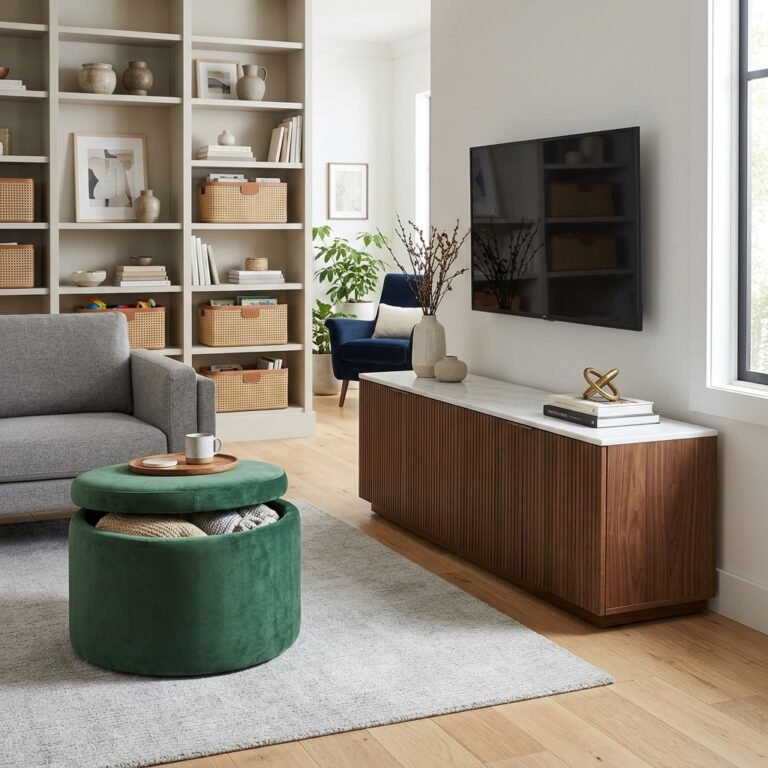
If your console floats, check how it hangs. A 48-inch walnut console weighs roughly 40 to 60 pounds empty, and the TV, books, and a router add more. Screw it into studs, which sit about 16 inches apart in most walls, and use a rail or cleat rated for the load. Drywall anchors alone are the most common installation mistake I see with floating furniture.
Give the Floor One Dark Anchor
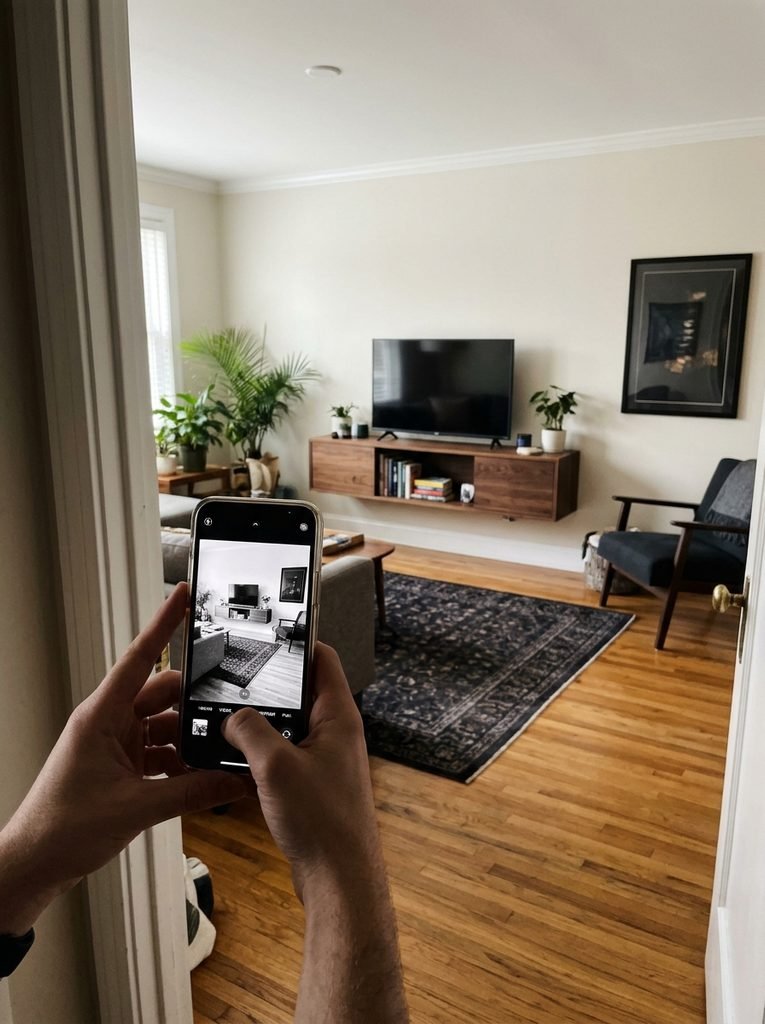
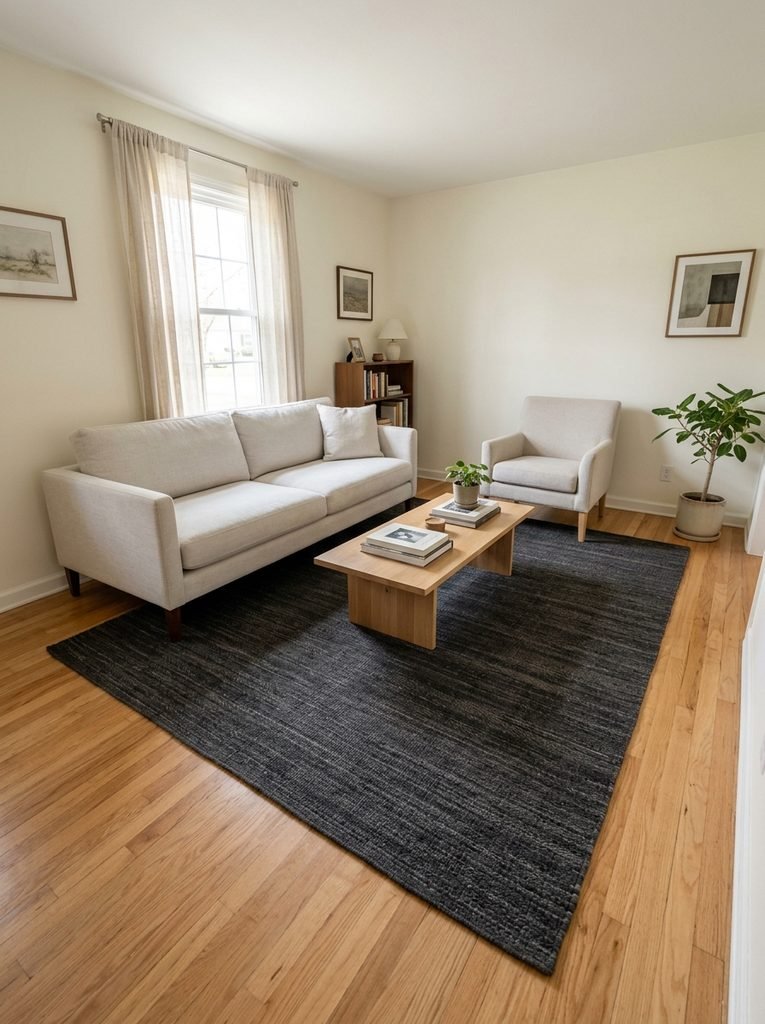
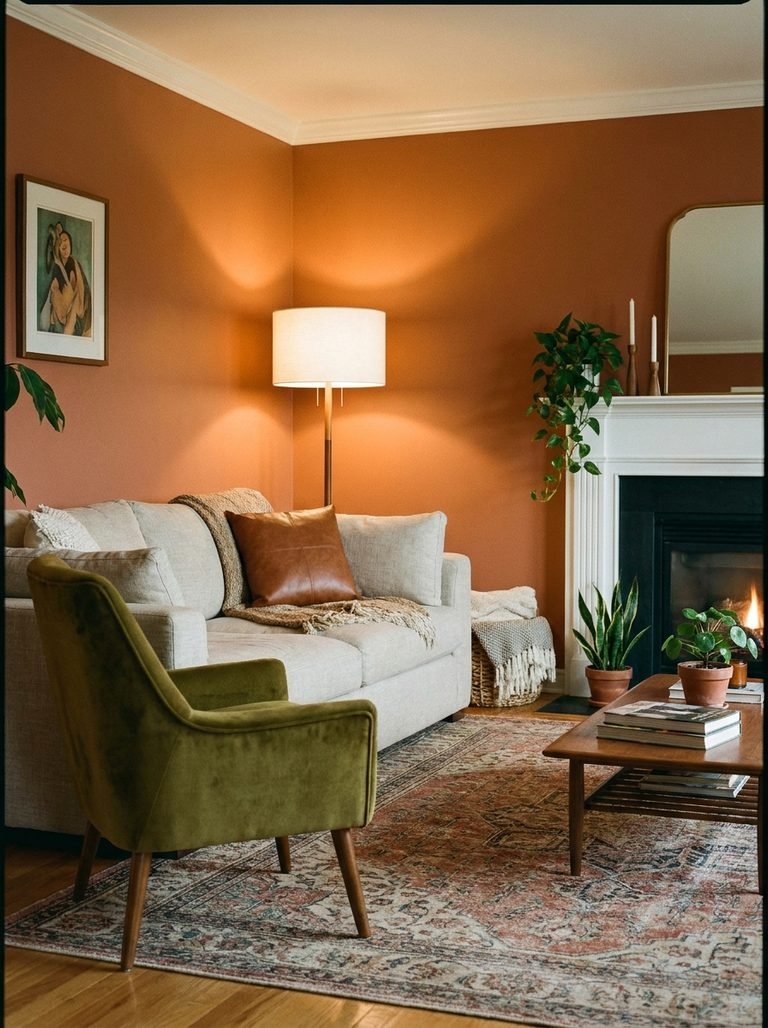
Start low, because weight near the floor reads as stable. The easiest place to add it is the rug. Choose a mid-to-dark tone such as charcoal, deep olive, or walnut brown, and keep the sofa pale. The contrast frames the sofa, so it looks placed on purpose instead of floating.
Many small-room guides warn against dark rugs. The warning makes sense for walls, because dark walls close in. A dark rug sits underfoot, so it reads as ground. Skip pure black, though. It shows every pale lint ball and pet hair within a day.
In an 11-by-13-foot room, an 8-by-10 rug leaves about 18 inches of bare floor around the edges, which looks tidy. Put at least the front legs of the sofa and chairs on it. A wool-blend flat-weave in that size typically runs $250 to $600.
Add a pad. A quarter-inch felt-and-rubber pad costs roughly $60 to $120 for 8 by 10. It stops slipping, adds cushion, and absorbs sound, so it helps with the echo too.
Swap One Airy Piece for a Solid One
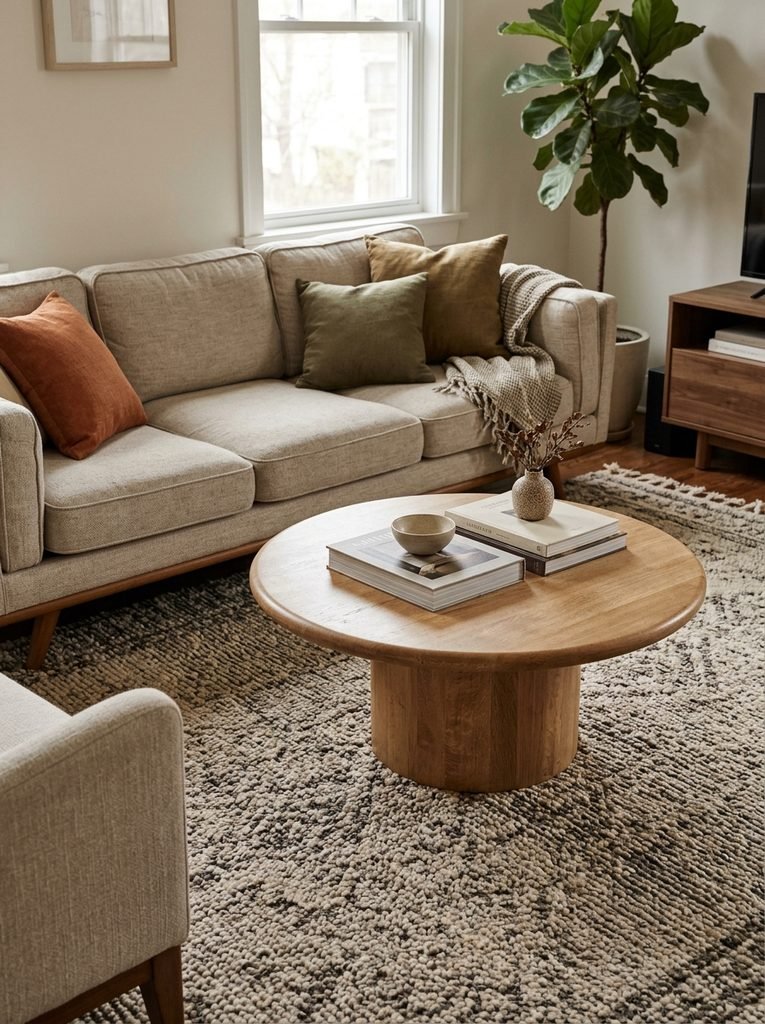
Pick a single swap, not three. The coffee table is the best candidate. Replace the glass top with a solid round table in wood, stone, or a stone-look composite, about 30 to 34 inches across. Keep its height within an inch or two of the sofa seat, which is usually 17 to 18 inches. Round edges keep it easy to walk around in a tight room.
Glass is not banned. It just needs company. Glass shows fingerprints, picks up chips at the corners, and offers nothing for the eye to rest on. If your rug and wall already carry weight, a glass table can stay.
The other options are a sofa with a solid plinth base instead of legs, or a console with closed doors instead of open shelving. A closed front also hides the router and cables that make a floating console look busy. Our guide to living room storage furniture that looks like decor covers what to look for in that kind of piece.
Hang One Heavy Thing on the Wall
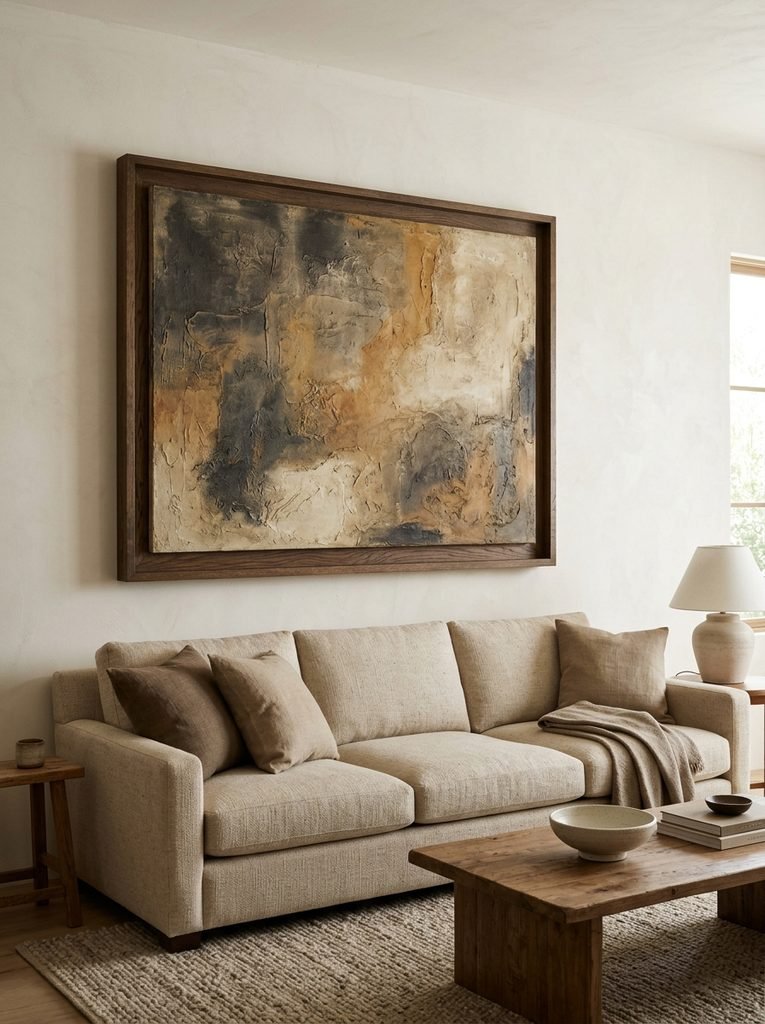
A thin black frame with a wide white mat is about as light as wall art gets. Keep one of those if you like it, but give the main wall one piece with real mass. Choose a large canvas or print in a frame at least 1.5 inches deep, in dark oak or matte black.
Size matters more than subject. For an 80-inch sofa, aim for artwork about two-thirds to three-quarters of the sofa’s width, so roughly 52 to 60 inches wide, either one piece or a tight pair. Hang it 6 to 10 inches above the sofa back so the two read as one group.
If art is not your style, use the wall itself. Paint the back panel of a bookcase a mid-tone, or add a textured plaster or limewash finish on the sofa wall. A single textured surface gives the eye something to hold without adding objects.
Let the Lamps Carry Some Weight
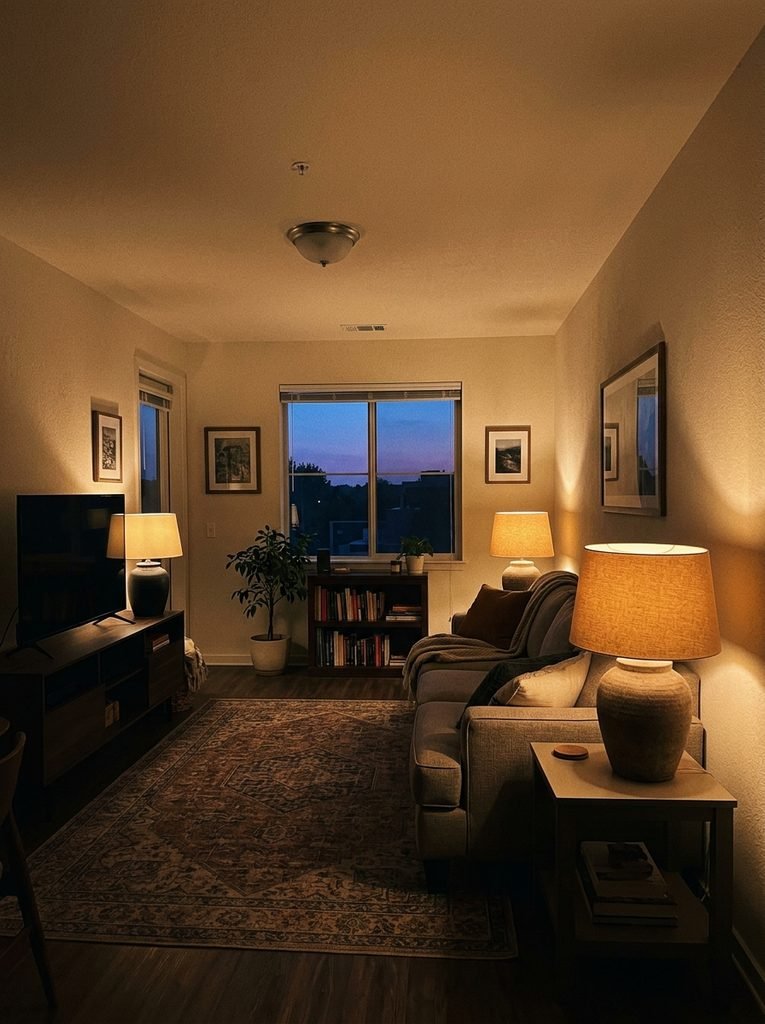
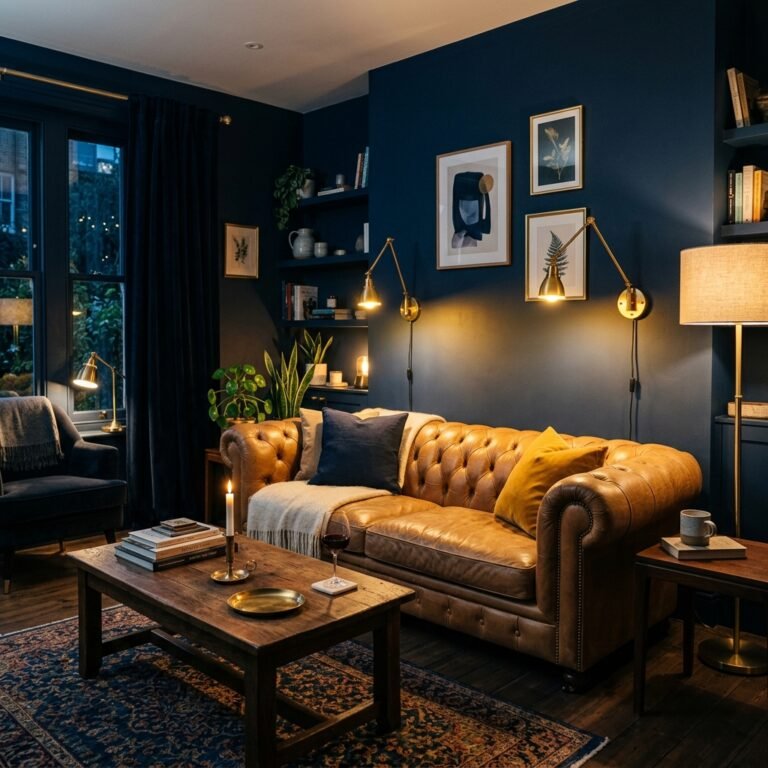
A ceiling fixture plus a skinny metal floor lamp gives you light but no mass. Swap in a lamp with a real body: a ceramic or stone base around 14 to 18 inches tall, topped with a drum shade of similar width. Place it in the corner farthest from the TV so it counters the screen’s weight.
Use two lamp-height light sources at minimum, one on each side of the room. Bulbs rated 2700K and about 800 lumens each give a warm, even glow. A dimmer on the ceiling light lets you switch it off entirely in the evening.
This matters most at dusk. A pale room with only overhead light goes flat and gray after sunset. Lamps create pools of light and shadow, and that pattern of bright and dim spots gives the room depth.
Fix the Echo While You Are at It
Run the clap test again after each change. Hard surfaces bounce sound: bare walls, glass, a mirror, a wood floor. Soft mass soaks it up. The good news is that most of the visual-weight fixes above also deliver soft mass, so you solve both problems at once.
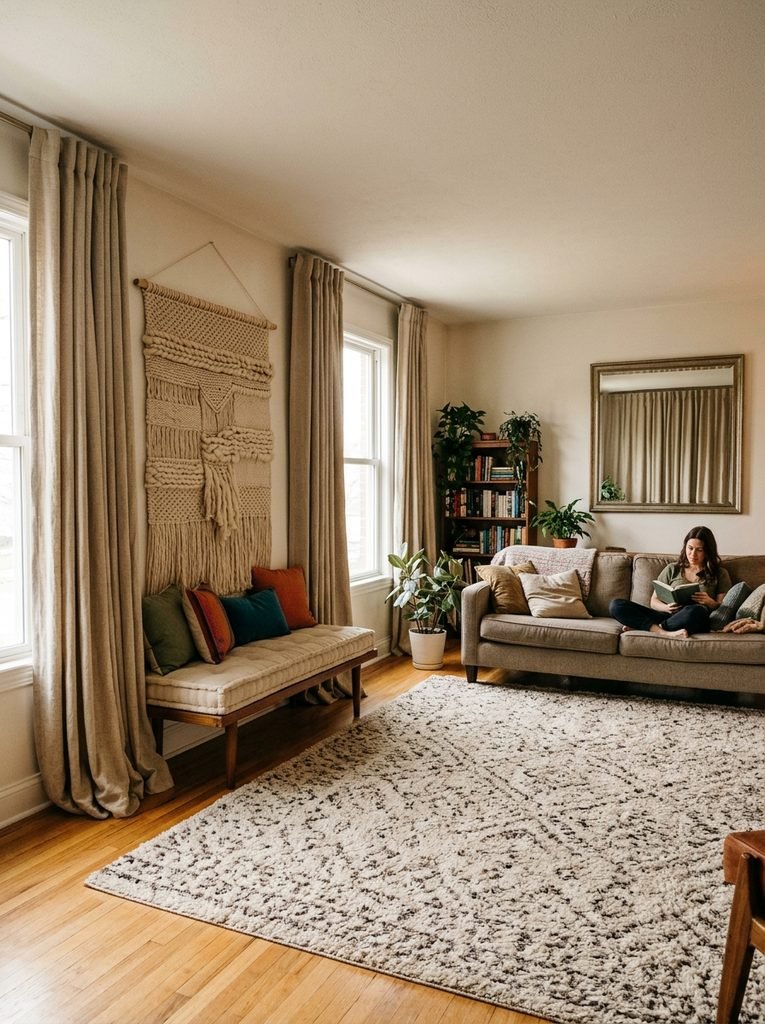
The rug and pad handle the floor. For the windows, lined curtains in a heavier cotton or linen blend absorb far more than thin sheers. For the biggest bare wall, add something upholstered or woven, such as a fabric-wrapped panel, a large woven hanging, or a bench with a thick cushion.
You do not need to remove the mirror. Just avoid hanging it opposite another bare wall, where it and the wall trade the same sound back and forth. Put it across from a window with curtains, and the drapery does double duty.
What to Keep Exactly as It Is
Do not undo the parts that work. The slim legs stay. The light walls stay. The big mirror and the tidy surfaces stay. You are adding two or three counterweights, not turning a bright room dark.
A rough guide: about a third of the room’s big surfaces should be mid-tone or darker, such as the rug, one wall element, and a table. The rest can stay pale. If you squint again and see a light room with a few clear anchors, you have the balance right.
Plants help here too. A snake plant in a dark ceramic pot beside the sofa adds a small, vertical mass that costs under $60, and it softens the straight lines of a modern layout.
A Realistic Budget and a Saturday Order of Operations
Expect roughly these ranges: rug $250 to $600, pad $60 to $120, a solid coffee table $150 to $450, a large framed piece $120 to $350, and one good lamp $80 to $250. The full set lands somewhere between $600 and $1,700. If that is too much at once, start with the pad and the lamp, which cost the least and change the room fastest.
On Saturday morning, run the squint test and take the black-and-white photo. Buy or move the rug first, because floor weight shifts everything above it. Add the lamp next. Then swap the coffee table, and hang the art last, once you can see what the room still needs.
Photograph the room after each step. The changes are subtle enough that you will forget how bad it looked an hour earlier.
Before You Return Anything
If the room still feels off after the rug and lamp, hold off on sending the glass table back. Squint again first. Often the room needs one more dark shape on the wall, not a new piece of furniture. Fix the weight, then judge the furniture.
Frequently Asked Questions
How do I know if my small living room needs more visual weight?
Squint at the room from the doorway. If the TV is the only dark shape and everything else blurs into one pale smear, the room needs weight. Another sign is guests perching on sofa edges. Add weight at the lowest point first, since a mid-to-dark rug under the seating usually shifts the balance more than any accessory.
Is a glass coffee table a bad idea in a modern small living room?
No, as long as something else in the room is solid. Glass keeps sightlines open, but it shows fingerprints and chips at the corners. If your rug, sofa, and wall already carry weight, glass works well. If the room feels floaty, swap to a solid round table, 30 to 34 inches across.
What size TV works best in a small modern living room?
For a 4K screen, a 55-inch TV suits seating about 5.5 to 7.5 feet away, which covers most rooms under 13 feet long. Anything bigger turns the black rectangle into the dominant shape on the wall. A 55-inch set is about 48 inches wide, so a console 54 to 60 inches wide keeps the proportions tidy.
Will a dark rug make my small living room look smaller?
Usually not, if the walls and sofa stay light. A rug sits on the floor, so it reads as ground and not as a wall closing in. Choose charcoal, olive, or walnut brown instead of black, which shows lint. Keep a pale sofa above it so the contrast looks deliberate.
How can I make a modern small living room less echoey?
Add soft mass at the hardest points: a quarter-inch felt-and-rubber rug pad, lined curtains, and one upholstered or woven piece on the largest bare wall. Clap before and after each change. A ringing echo should soften into a short, muffled sound after two or three of these additions.
1 comment