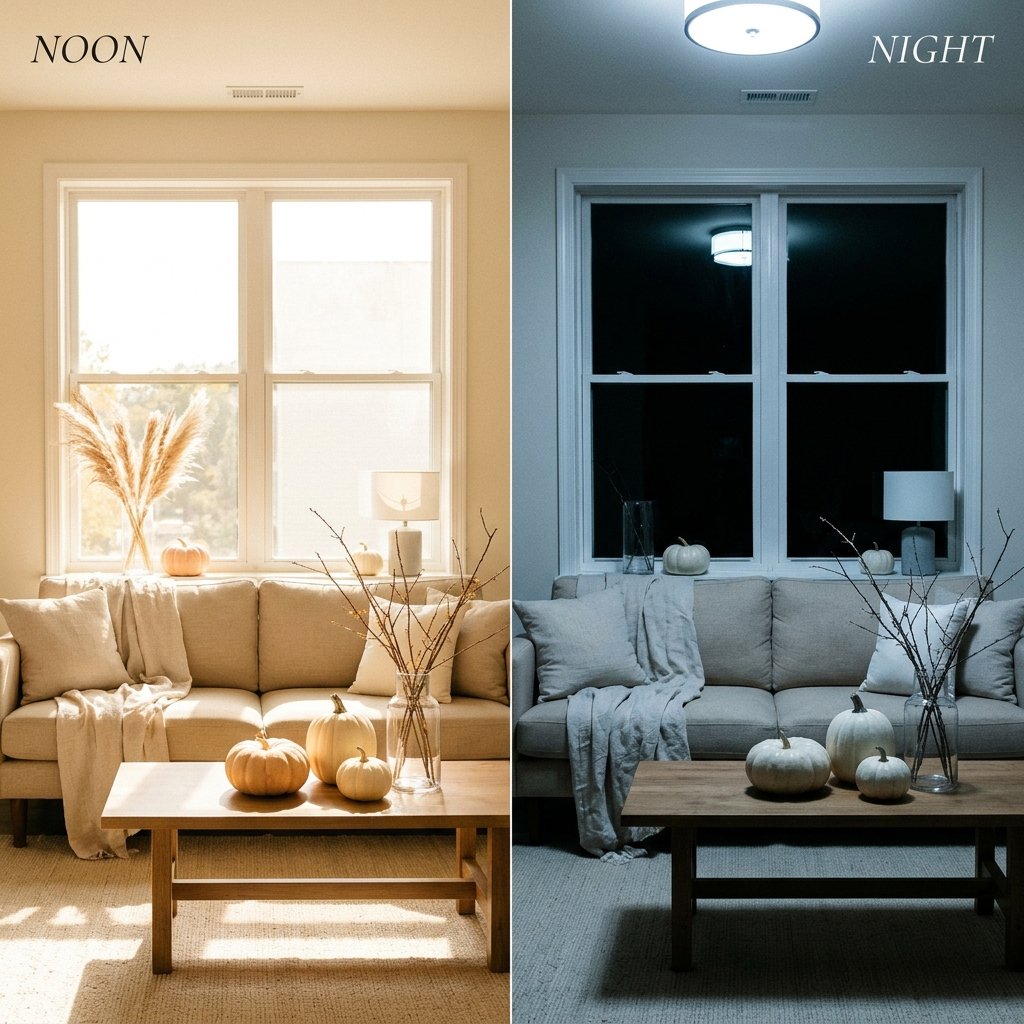
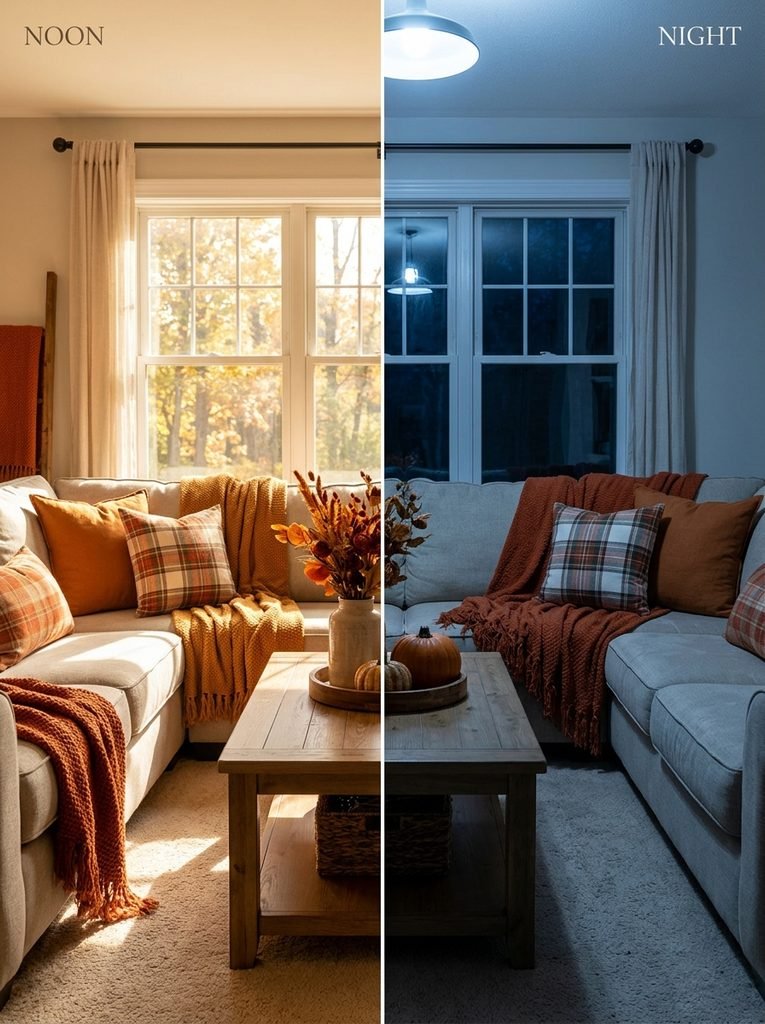
It’s 5:10 p.m. in late October. You flip the switch by the door, and the living room you styled last weekend goes strangely flat. The cream pumpkins look like props. The knit throw reads gray. The whole room feels a few degrees cooler than it did at lunch, and nothing in it has moved.
You didn’t buy the wrong things. You styled for the wrong hour.
Most fall decorating happens in daylight, when a window does the heavy lifting. Then the clocks go back, and you spend five or six hours every evening in that room under electric light. That is the version that has to feel cozy. Below, you’ll find why the noon look falls apart after dark and what to change, starting with the cheapest fixes.
Why Daylight Hides the Problem
Window light is soft, wide, and bounces off every surface. It makes a rust pillow glow and gives a linen throw visible depth. You judge your decor in that light because a Saturday afternoon is when you finally have time to decorate.
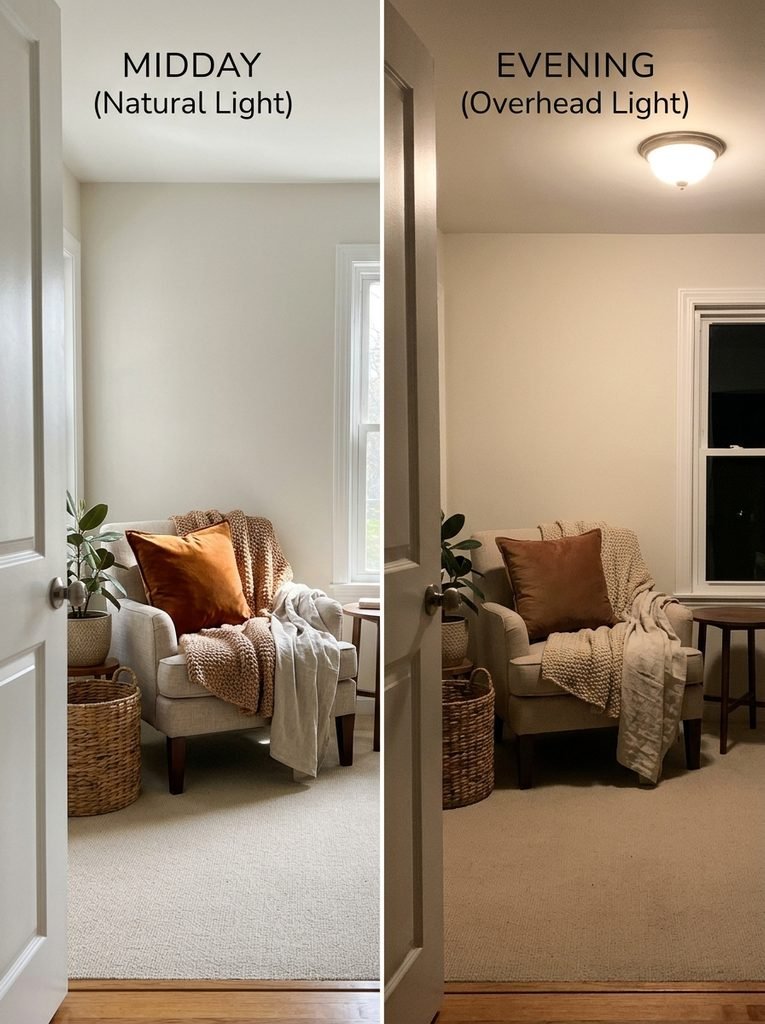
Evening is different. In many northern cities, sunset lands around 4:30 p.m. by mid-November, and one ceiling fixture takes over. It lights everything from above. Shadows fall straight down, textures flatten, and the warm colors you picked go muddy.
Here is a two-minute test. An hour after sunset, turn on the lights you normally use and photograph each seating area from the doorway. Put those photos next to midday shots of the same spots. The gap between them is your real to-do list.
Notice what disappears first. It’s almost always texture. Chunky knits, bouclé, and woven baskets depend on side light to cast tiny shadows, and straight overhead light erases them. That’s how a room full of soft things can still feel hard.
What One Ceiling Light Does to Everything You Bought
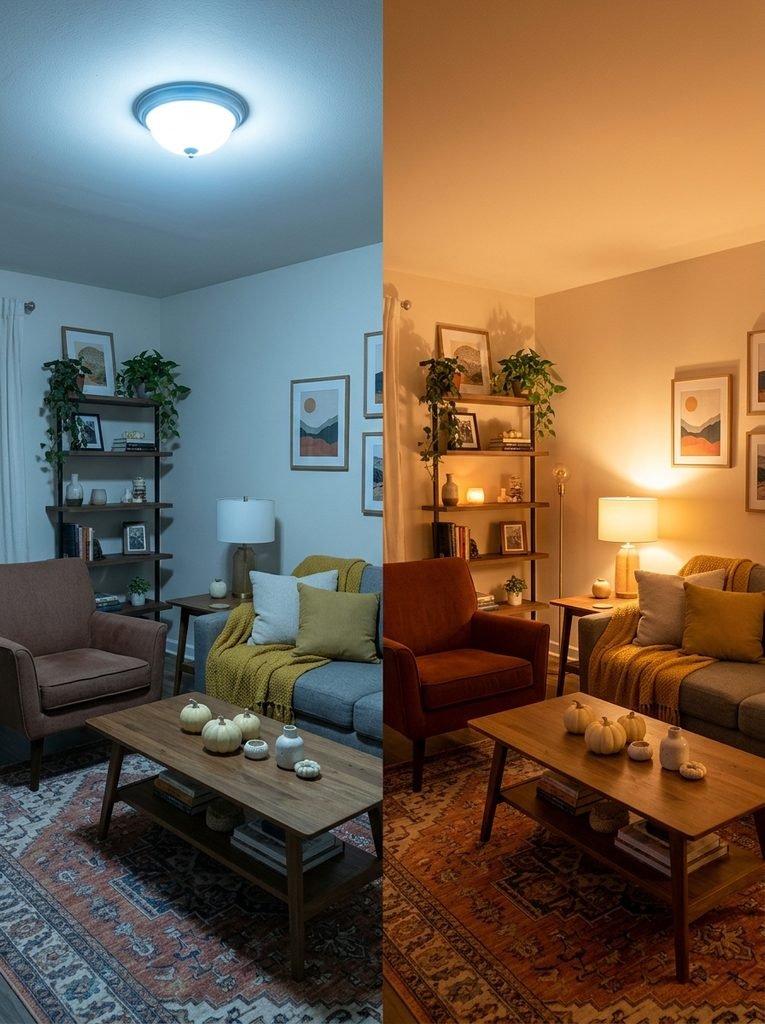
Ceiling fixtures are usually chosen for tasks, not evenings. According to the Department of Energy’s lighting guide, cooler, higher-Kelvin light gives more contrast for visual work, while the 2700 to 3000 K range counts as warm and flatters skin tones and clothing in living spaces. Many fixtures end up with bulbs labeled “cool white” or “daylight,” which sit well above that range.
Under that bluish light, rust loses its richness, mustard turns greenish, and cream pumpkins look chalky. Check the Kelvin number printed on the bulb or box. If it says 4000 K or higher in a room you use at night, that’s your first swap.
The most common installation mistake is mixing temperatures. A warm lamp beside a cool ceiling fixture makes the lamp look orange and dingy by comparison. Pick one temperature for the whole room and match it in every lamp.
Build Pools of Light Below Eye Level
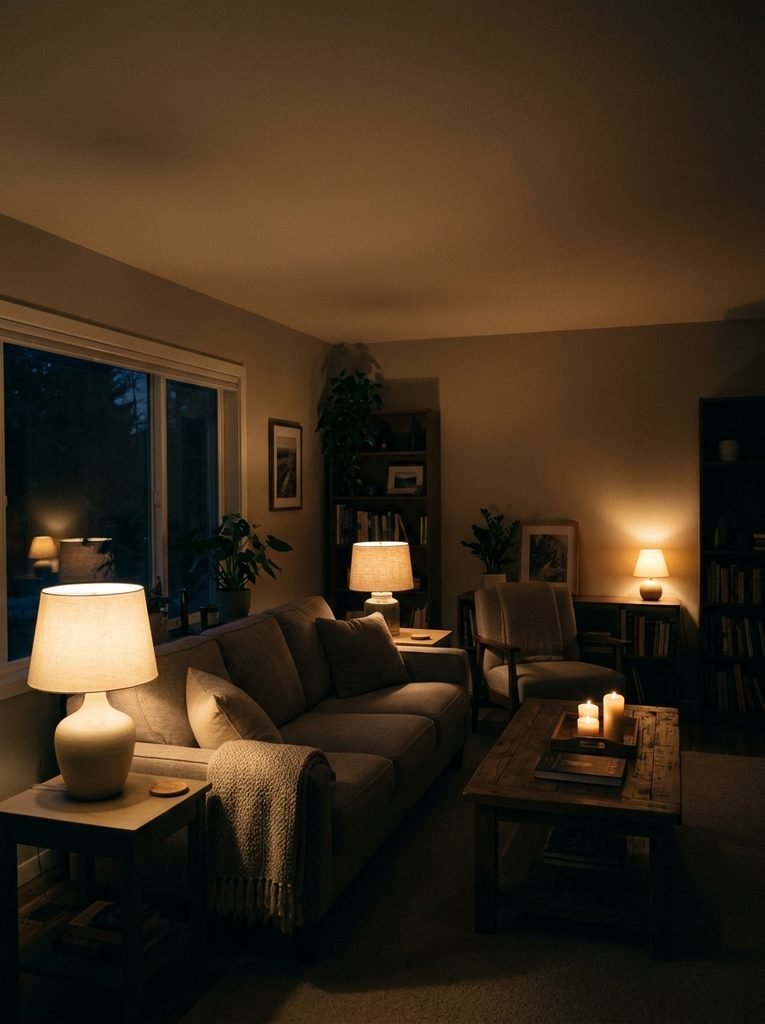
Cozy rooms are lit like a campsite: several small, low glows instead of one big overhead one. Use these numbers as a starting point for a living room of about 12 by 15 feet.
- Count: three to five light sources, none of them on the ceiling.
- Height: the bottom of each lamp shade should sit near eye level when you’re seated, roughly 40 inches off the floor. You see the glow, not the bulb.
- Bulbs: 2700 K, between 450 and 800 lumens per lamp. That matches the old 40 to 60 watt range.
- Placement: one lamp at each end of the sofa, one low light behind a chair or on a console.
- Control: a plug-in dimmer, usually under $25, lets you drop the room to 30 or 40 percent after dinner. Check that your bulb is labeled dimmable. A standard LED on a dimmer buzzes and flickers.
Shade color matters more than people expect. A cream or linen shade spreads light outward and warms it slightly. A black or dark shade pushes light only up and down, which leaves the sofa itself in shadow. If a lamp looks stingy, change the shade before you change the lamp.
No outlet where you need one? Rentals are full of these corners. A plug-in wall sconce with a cord cover keeps the wire tidy, and a rechargeable table lamp, roughly $30 to $60, can sit on a shelf or side table with no cord at all.
Candles belong in this layer too. Group two or three on a tray at coffee table height, and keep them at least a foot from anything that can burn. Yes, that includes the new throw you just draped over the sofa arm. For shelves and mantels, flameless candles with a flickering amber bulb give the same effect without the watching.
Swap Thin Textiles for Ones With Weight
A printed polyester pillow looks fine in a product photo. At 7 p.m., when you sink into the sofa, it feels like a hotel lobby cushion. Cozy is a touch sensation first, and weight is what your hands notice.
Pick up a throw in the store. A good knit weighs around three pounds and drapes straight down. If you can see through the weave, or it floats when you shake it out, skip it. Then put it where your arm lands: over the sofa arm, not folded on the back where nobody reaches.
For pillows, stuff a cover one size under the insert, such as a 20-inch cover on a 22-inch insert. The extra fullness reads as plush even on a budget pillow. Two squares and one 12-by-20 lumbar is plenty for a three-seat sofa.
Underfoot, the front legs of the sofa should sit on the rug, which usually means a 5-by-8 at minimum. Add a faux sheepskin, roughly $40 to $80, by the chair you actually read in. Bare hardwood at 8 p.m. is a big part of why a room feels cold. A chunky pouf helps too, because it gives cold feet somewhere warm to land.
Windows count as textiles too. Lined curtains hung 4 to 6 inches above the frame and just touching the floor cut that bare-glass chill after dark, and the extra height makes the room feel taller. In the bedroom, a flannel or brushed-cotton sheet set under your usual duvet changes how the bed feels more than any new pillow will.
For a room-by-room list built around the sofa area, our guide to cozy fall living room ideas goes deeper.
Put the Showpieces Where the Lamplight Lands
Pumpkins on a sunny windowsill are lovely at noon and invisible at 6 p.m. Move the display to surfaces within about three feet of a lamp: the coffee table, a console, the end of a mantel. A lamp beside a grouping also throws shadows up the wall, which adds depth you can’t buy.
Group in threes at different heights, such as a tall vase, a mid-size pumpkin, and a low bowl. Cream ceramic pumpkins are the better pick above a working fireplace, because real ones soften faster in that heat.
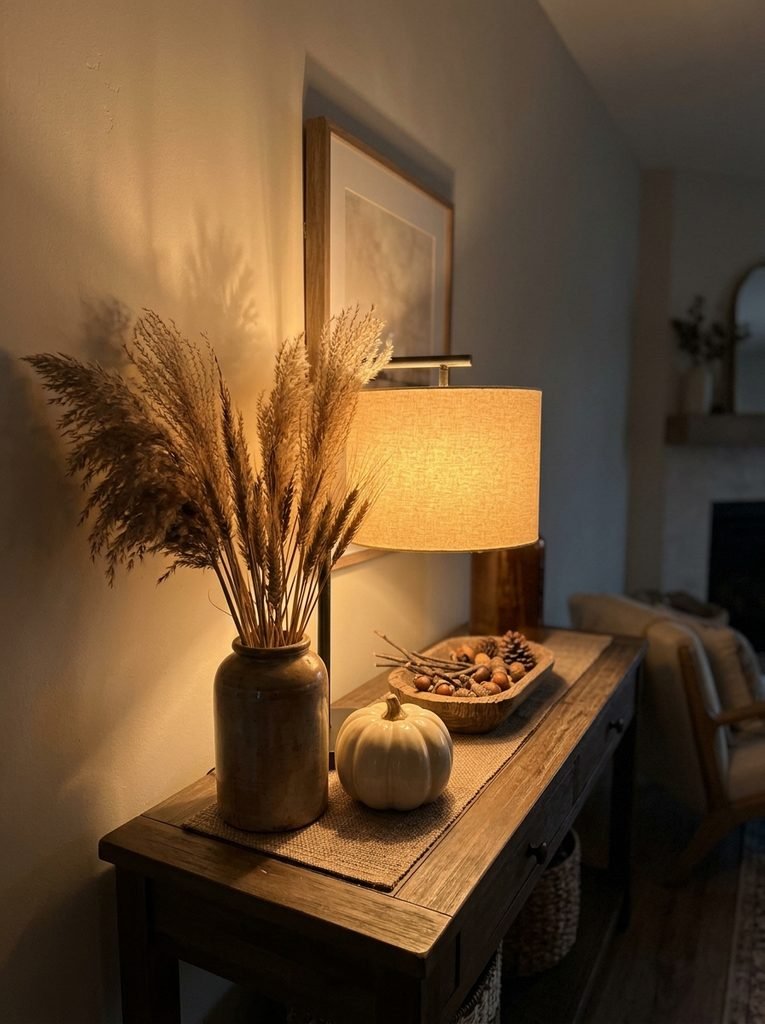
Dried stems earn their keep here. A 12- to 14-inch vase of wheat or pampas beside a lamp casts feathery shadows on the wall, which looks far richer than the same stems under a ceiling light. Acorns, small branches, and wooden bowls work the same way when they sit on a tray in that glow.
If a fireplace is your focal point, our fall mantel decor ideas cover how to style the shelf itself in more detail.
Edit the Palette for Evening Light
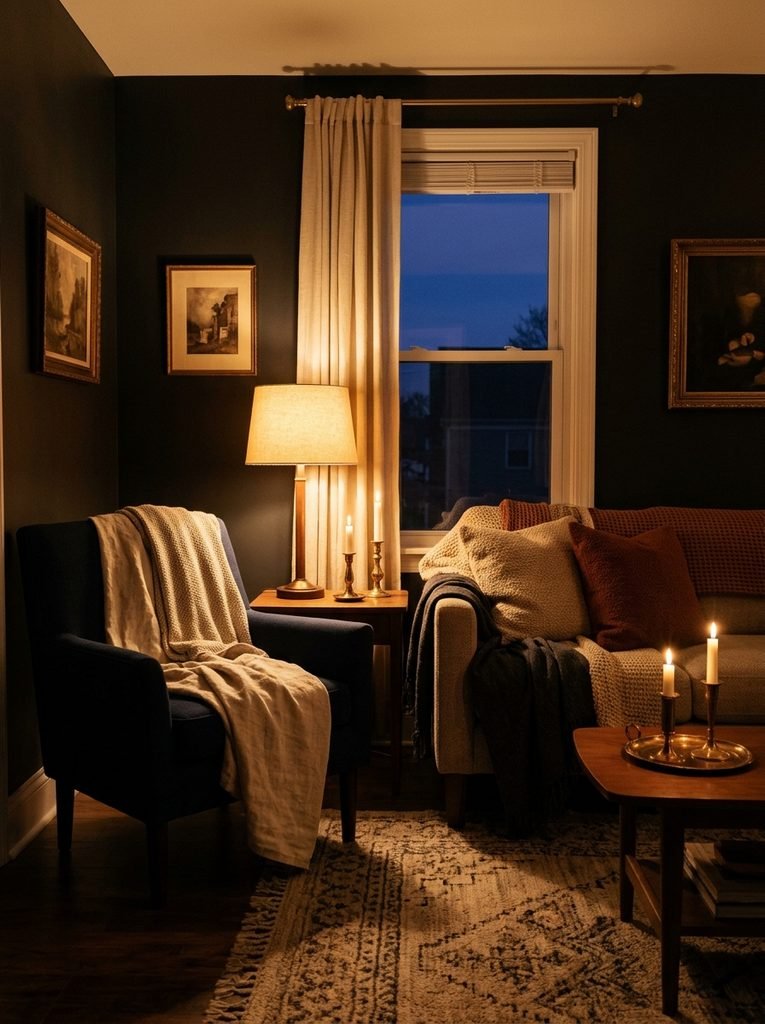
Warm bulbs change colors, so shop with them in mind. Under a 2700 K lamp, terracotta leans brown, mustard can turn olive, and white goes butter yellow. Rust with a red undertone, deep green, oatmeal, and charcoal hold up better.
Brass and copper pick up lamp glow and give the room small sparks of light. A few thrifted candle holders or a tray do more after dark than a whole shelf of matte pieces.
Dark, moody corners need a lamp within three feet, or they swallow light and read as a hole in the room. Pair navy or deep green with one pale linen piece so the eye has somewhere to rest.
If you prefer a pale palette, texture has to do the work color usually does. Layer oatmeal, ivory, and sand in different weaves so the room reads soft instead of blank. Before buying anything, hold the fabric under your lamp at night, and keep the receipt.
Light the Personal Pieces on Purpose
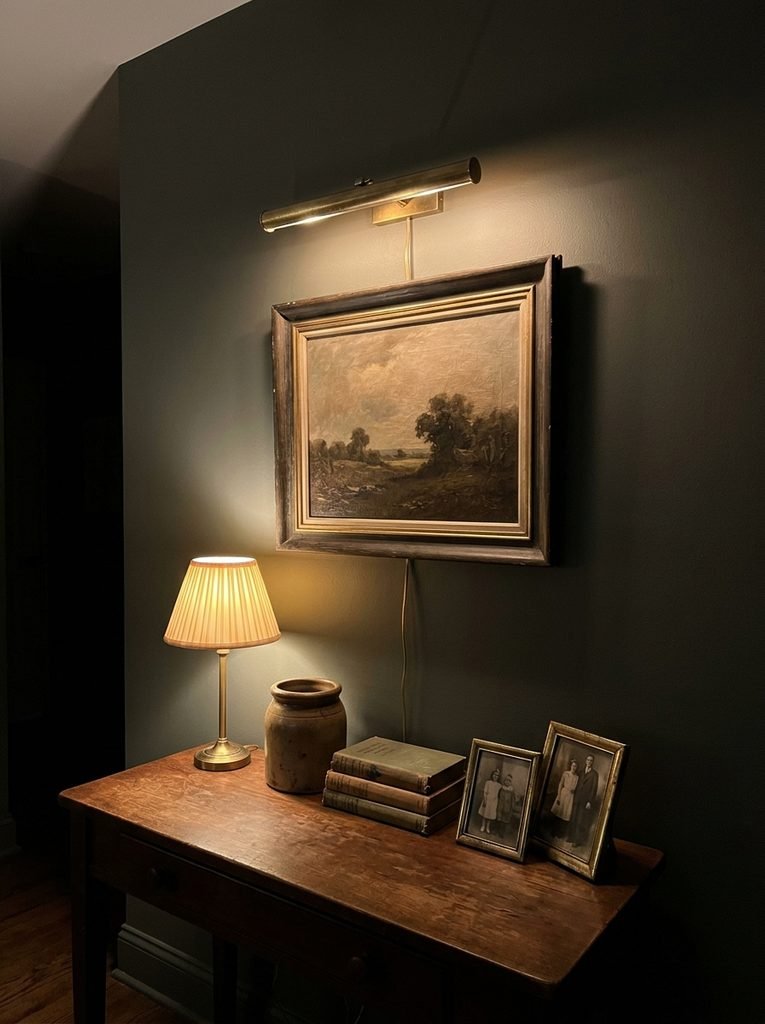
Art, thrifted finds, and framed photos usually go up by daylight and sit in the dark at night. Hang art so its center sits about 57 inches from the floor, then aim a lamp so light grazes the surface instead of hitting it head-on. A plug-in picture light, roughly $25 to $45, handles a single large print.
Vintage pieces and family photos benefit most. Worn brass frames, old books, and a ceramic crock pick up amber light in a way new items rarely do. Cluster them near a lamp, and leave some shelf empty so each piece has room to catch the glow.
Fix the Spots You Only See After Dark
Some parts of your home are only used once the sun is down, and they rarely get styled for it.
Start at the front door. A wreath looks great at 2 p.m. At 6:30 it’s a dark circle on a dark door. Swap the porch bulb for a warm one, or add a small battery spotlight on an outdoor timer, usually under $15.
Inside, put a small lamp on the console by the door so the first thing you see on arrival is a glow, not a switch plate. A basket under the bench keeps shoes out of that picture.
In the kitchen, a plug-in LED strip under the upper cabinets, roughly $25 to $40, makes a bowl of mini pumpkins on the counter look intentional instead of lost.
For a reading chair, place a floor lamp just behind one shoulder with the shade bottom a little above your head. The light falls on the page, not in your eyes, and the corner stays glowing when you’re not in it.
One Rental Living Room, Before and After
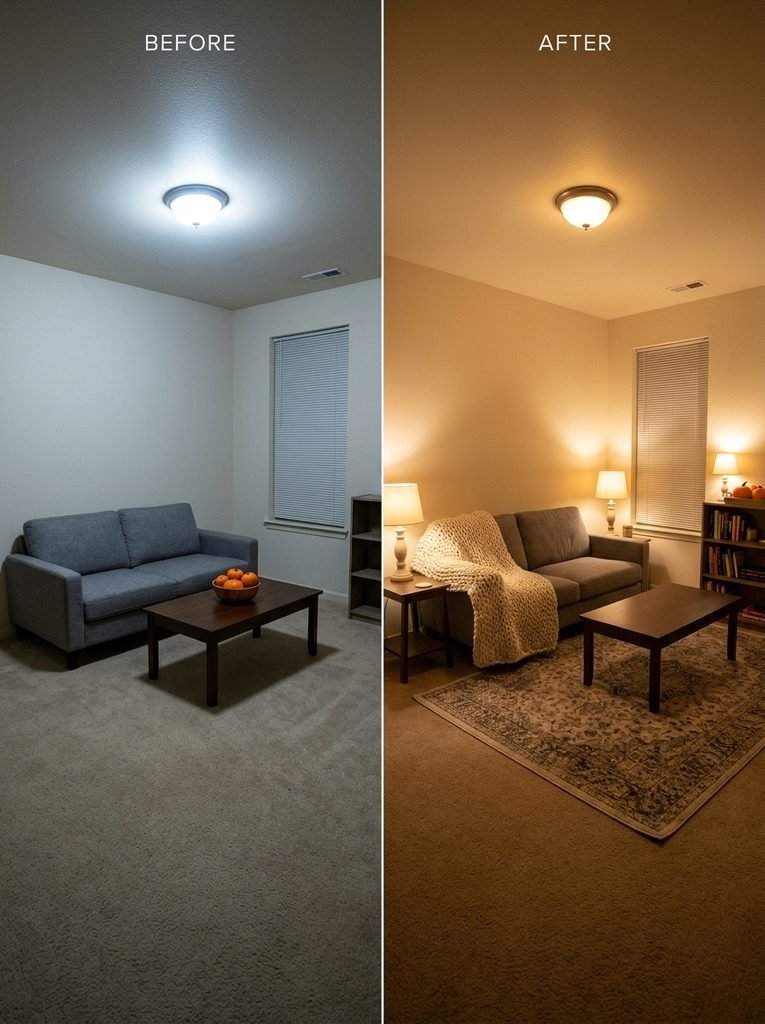
Picture a 12-by-14-foot rental living room with a single ceiling fixture and a five-year-old gray sofa. In the “before” version, the fixture holds a 5000 K bulb, the only decor is a bowl of orange pumpkins on the coffee table, and the room feels like a waiting area after dark.
For the “after,” nothing gets repainted and the sofa stays. The ceiling bulb becomes 2700 K. Two lamps with cream shades flank the sofa, a third sits on a bookshelf, and a plug-in dimmer holds the glow at about 40 percent. A heavy knit throw hangs over the arm, a 5-by-8 rug now meets the sofa’s front legs, and the pumpkins move to a tray beside the shelf lamp. The cost is a few hundred dollars, most of it the rug, and the room reads as a different place.
Spend the First Few Dollars in This Order
You don’t need a full restyle. Begin with bulbs: a multipack of 2700 K LEDs usually costs $10 to $20. Next, add a dimmer or timer plug for under $25. Then buy one heavy throw for the spot where you sit most, and a faux sheepskin if your floors are bare. Only after that is it worth buying another pumpkin.
Try the Dusk Test Tonight
Wait for the light outside to fade. Switch off the ceiling fixture, turn on three lamps, and photograph the same seating area you shot earlier. If the second photo looks warmer than the first, you’ve found the missing piece, and you didn’t have to buy a single pumpkin.
Frequently Asked Questions
Why does my living room feel cold even though I decorated for fall?
Feeling cold is often about surfaces and light, not thermostat settings. Bare floors, thin curtains, and bluish bulbs all read as chilly. Add a rug under the sofa’s front legs, lined curtains, and 2700 K bulbs before buying more decor. A faux sheepskin by your favorite chair, roughly $40 to $80, helps cold feet right away.
How many lamps does a living room need for fall evenings?
Plan on three to five light sources for a room about 12 by 15 feet, with none overhead. Put one at each end of the sofa, one by your reading chair, and one low accent on a console or shelf. A smaller room can manage with three if two sit at different heights.
Are flameless candles worth buying for fall decor?
Yes, especially for mantels, shelves, and anywhere fabric sits close. Choose ones with a warm amber bulb instead of a white one, plus a built-in timer. A set of three runs roughly $20 to $35. Keep real candles for a coffee table tray, with at least a foot of clearance on every side.
What fall decor works in a room with no afternoon sun?
Anything that looks good under lamplight: textured throws, dried stems, brass, and ceramics. Skip pieces that depend on the sun, like glass lanterns on a windowsill. Keep a lamp within three feet of your main display, and lean toward olive, rust, or navy, because pale colors can look gray in a dim room.
Does every lamp work with a dimmer?
No. The bulb and the dimmer both have to be rated for dimming. Check that the bulb package says dimmable, and match the dimmer’s minimum load to the bulb. LED bulbs often draw under 10 watts, so older dimmers can flicker or hum. A dimmer made for LEDs is the safer buy.