The Balcony Decor Mistake That Makes Apartments Look Unfinished
My friend Nadia moved into a one bedroom last spring and did everything right inside. Warm lamps instead of the ceiling light. A rug that was actually big enough. Books she has really read. The place looked good, and she knew it looked good, and yet she kept saying the same thing every time I came over: “It still feels like I just moved in.”
She blamed the living room. She talked about repainting. She started a Pinterest board for shelving.
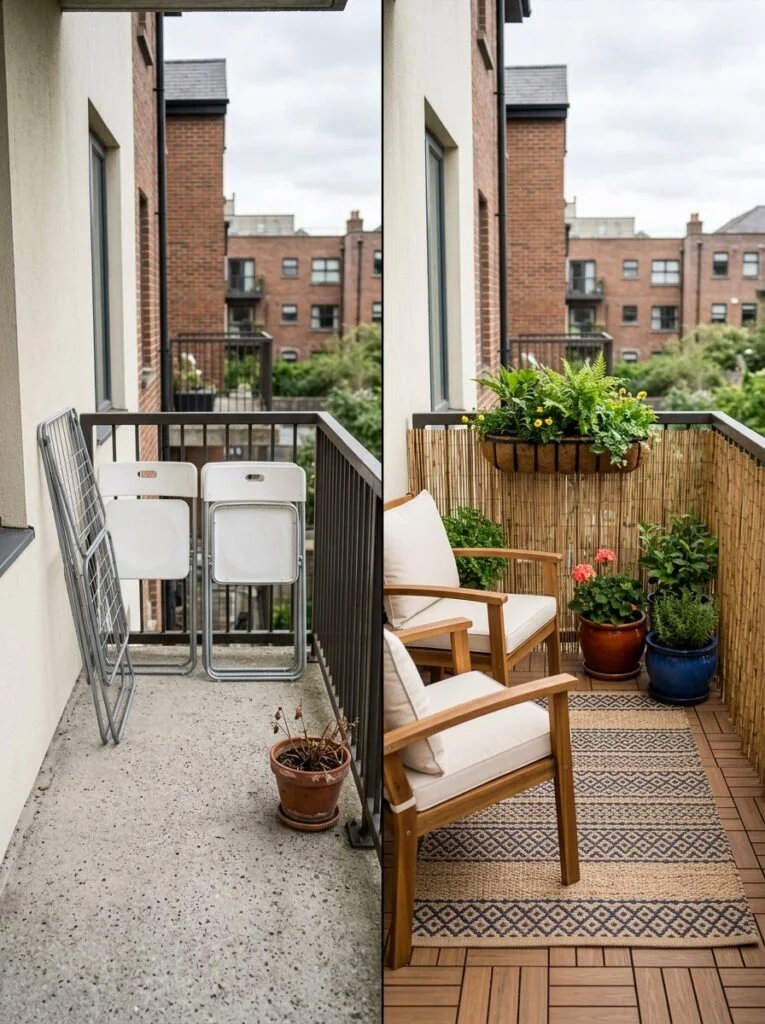
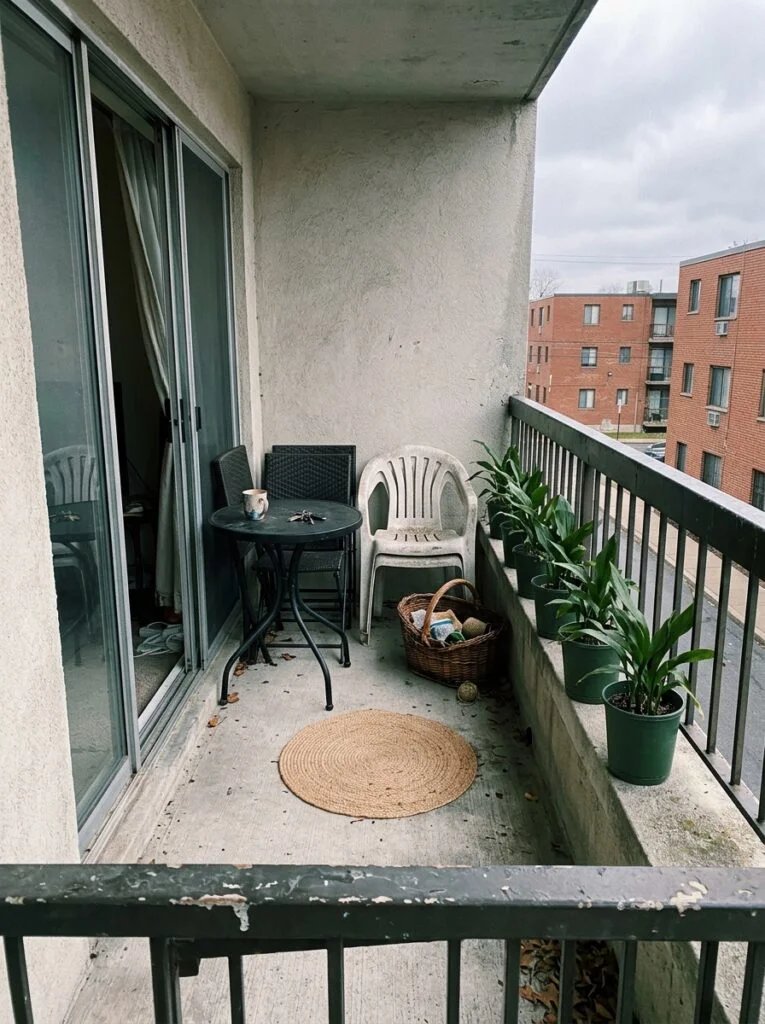
Then one evening we were sitting on her sofa with tea, and I finally looked past her, through the glass sliding door, at the balcony. Grey speckled concrete. A folded clothes drying rack leaning in the corner. Two white plastic chairs pushed flat against the railing. One sad pot with something brown in it.
That was it. That was the whole problem.
I’m not being dramatic here, and I’m not exaggerating for a headline. I did the exact same thing in my first apartment for almost two years. The balcony sat there like a construction site attached to a finished home, and I could never work out why my living room refused to feel done.
So What Was the Actual Problem?
Nadia had furnished her balcony. She had never finished it.
There’s a real difference between those two words, and it’s the difference that trips up almost everyone with a small outdoor space. Furnishing means putting objects out there. Chairs, a pot, maybe a little table from a sale bin. Finishing means treating the surfaces the way you’d treat any other room in your home.
Her floor was still whatever the builder poured. Her railing was still bare metal bars. Everything she owned was shoved against the perimeter, which left a strip of naked concrete running right down the middle.
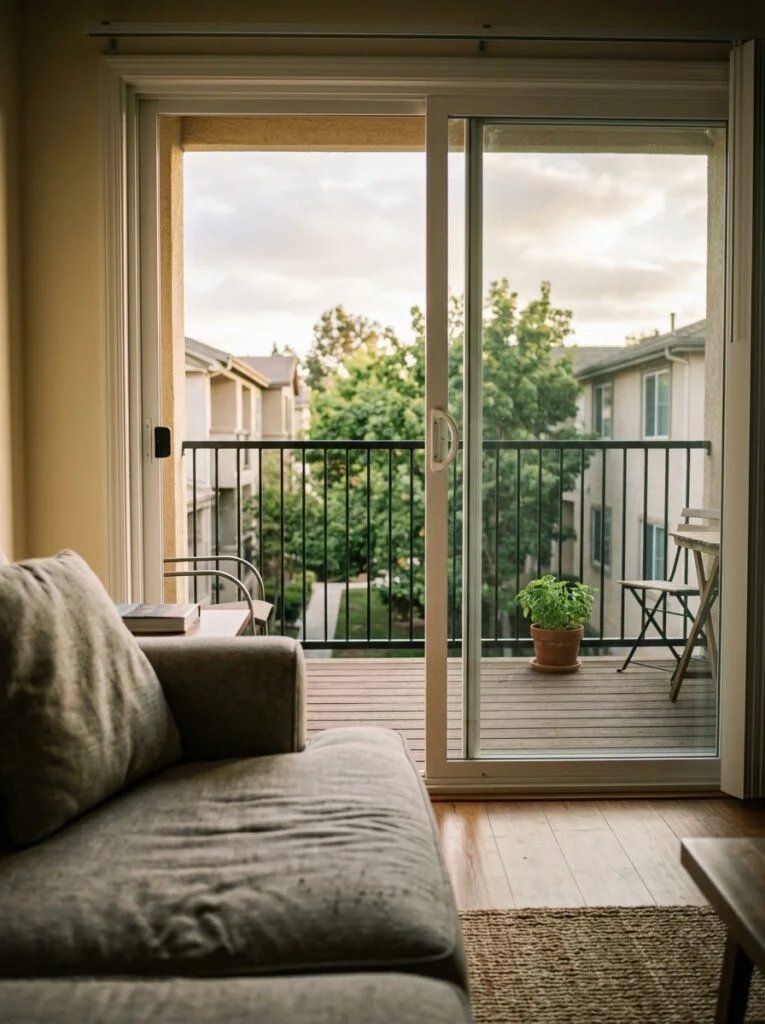
Here’s why that quietly damages the inside of the apartment too. A sliding glass door is basically a giant frame. Whatever sits behind it gets read as part of the room, the same way a window with an ugly view drags down a bedroom. Your eye travels across the finished living room floor, hits the door track, and lands on raw concrete. The brain files that as “unfinished,” and it doesn’t stop at the door. It applies that verdict to the whole space.
Bare concrete reads as leftover building material. It’s the same instinct that makes unpainted drywall feel wrong even when the furniture in front of it is lovely.
A Five Second Test You Can Do From Your Couch
Before buying anything, sit exactly where you normally sit. Not standing in the doorway. Sitting, in your usual spot, with your usual view.
Now answer these:
- What’s the single largest thing you can see out there? If the honest answer is “floor,” you’ve found your problem.
- Can you name one color on that balcony that also exists in the room you’re sitting in? If not, the two spaces are strangers.
- Is there anything at eye level, or does everything out there stop below knee height?
- Is the middle of the balcony empty while the edges are crowded?
Two or more of those pointing the wrong way, and your issue isn’t the furniture you bought. It’s the finish you skipped.
Why the Floor Does So Much of the Heavy Lifting
The floor is the biggest uninterrupted surface out there, usually by a huge margin. It sets the tone before anything else gets a chance to. You can put a beautiful chair on bare concrete and the concrete still wins.
Cover it and the whole thing changes in about fifteen minutes. Your options, roughly in order of effort:
An outdoor rug. Cheapest big win available. Flatweave polypropylene is the one you want, because you can hose it off and it dries instead of turning into a sponge. Size matters more than pattern. A rug that’s too small looks worse than no rug at all, because it turns into a floating bath mat. On a five by eight balcony, reach for something like a four by six and let a few inches of floor show around the edges.
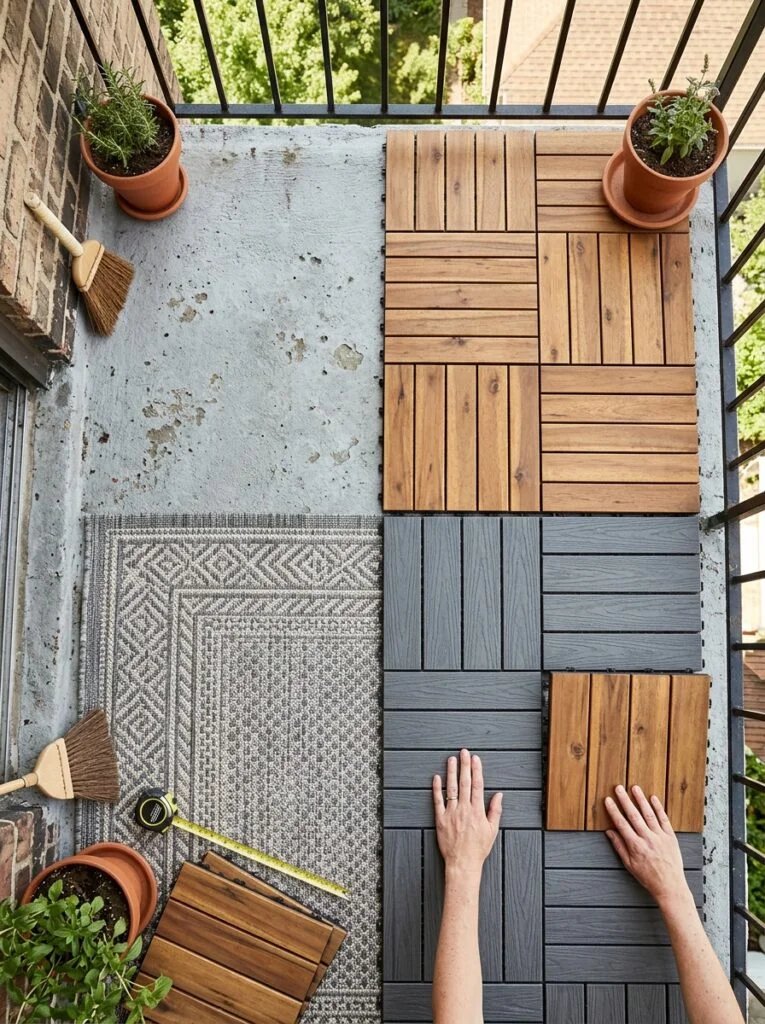
Interlocking deck tiles. These click together over concrete without glue or screws, come in wood look or composite, and lift straight out when you move. For renters they’re close to perfect. Lift a few and sweep underneath once a season so water and grit don’t sit there.
Painting or staining the concrete. Great result, but only if you own the place or have written permission. Not a casual weekend decision in a rental.
Layering both. Deck tiles as the base, a smaller rug on top where you actually sit. This is what usually looks the most intentional in photos, and it’s not expensive if the rug is small.
Two practical things people learn the hard way. Don’t cover the floor drain, and leave a small gap at the edges so water has somewhere to go. And if your balcony gets rained on directly, pick materials that dry fast rather than materials that look nice dry.
While we’re on the subject of ignored square footage, a balcony is usually the most expensive unused space in an apartment, since you’re paying rent on it either way. It’s the same quiet waste that happens with the corner of a small home nobody ever uses, except this one is behind glass where you have to look at it every single day.
The Railing Is the Other Half of the Story
Once the floor is handled, the bare railing becomes the loudest remaining thing. Metal bars read as fencing. Fencing belongs around a parking lot, not around your morning coffee.
A few ways to soften it:
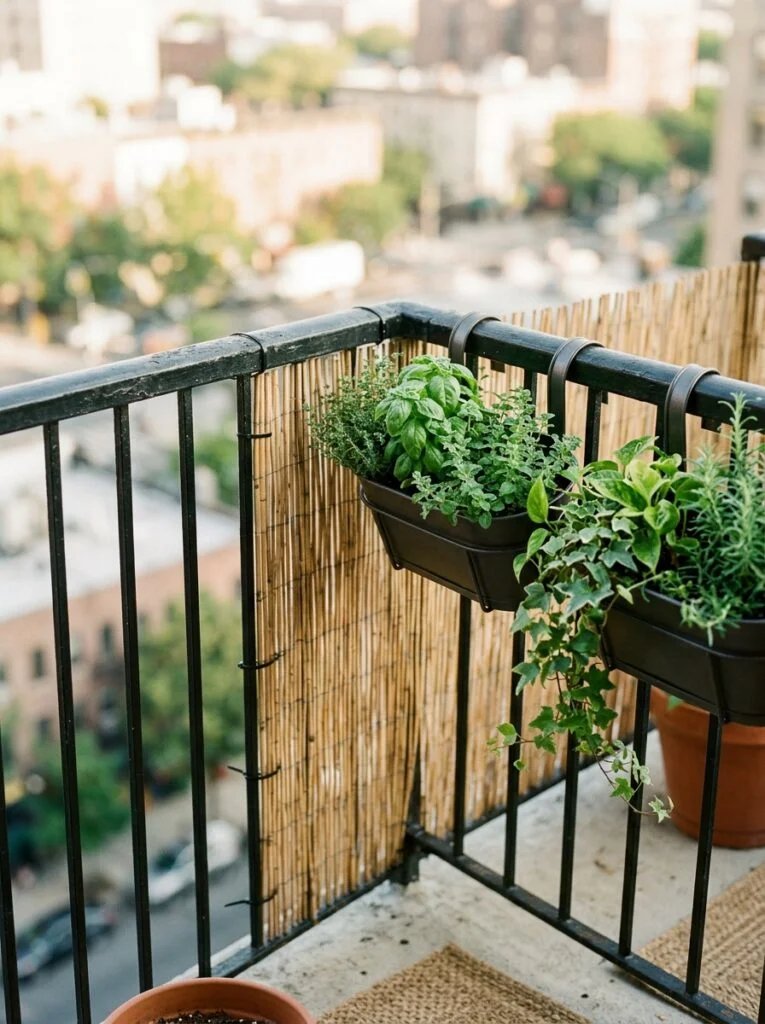
- Reed, bamboo, or willow screening, zip tied along the inside of the rail. Cheap, warm looking, and it hides whatever the neighbors have going on below.
- Balcony privacy fabric, which is basically a hemmed panel with grommets. Easier to clean than reed and it survives wind better.
- Railing planters that hook over the top bar. Herbs and trailing greenery instantly stop the space from feeling like a cage.
- A narrow rail shelf or bar top, which gives you somewhere to set a mug without needing a full table.
- A trellis or vertical planter on the solid side wall, if you have one.
Please check your building rules before you attach anything. Wind is stronger a few floors up than most people expect, and anything hanging on the outside face of a railing can end up on someone’s head. Many buildings only allow inward facing planters for exactly that reason. Ask your property manager and get the answer in writing. It takes one email and saves an argument later.
Three Real Balconies and What Fixed Them
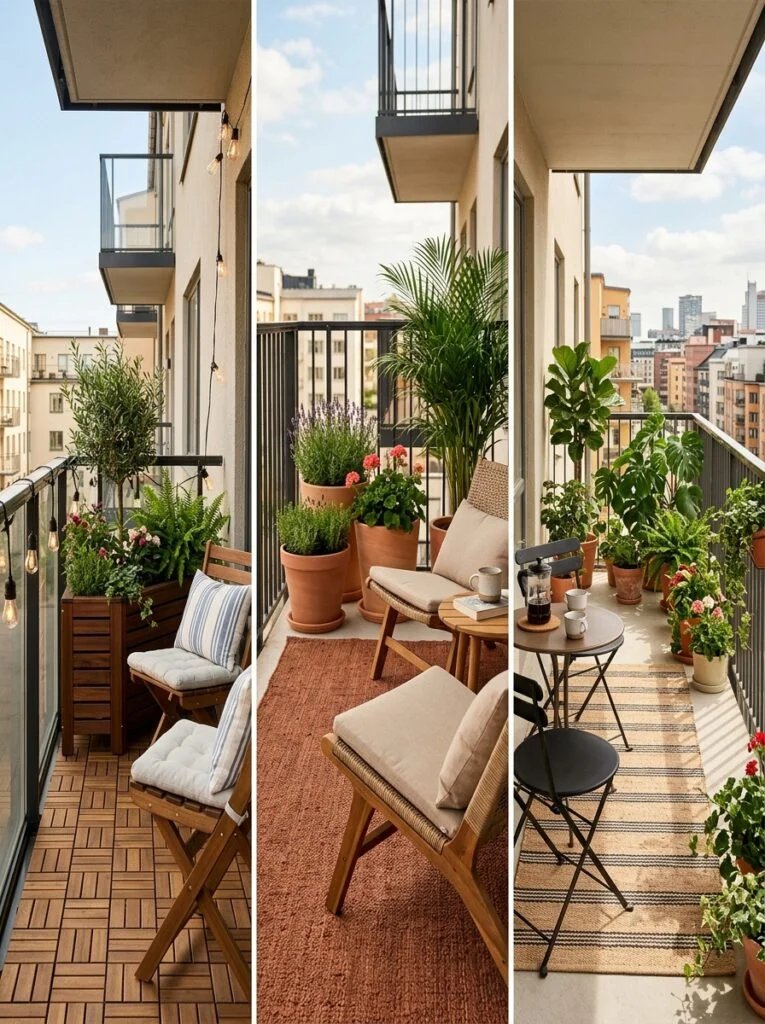
The three by six sliver. This was Nadia’s. The drying rack moved to a corner of the bedroom, wood look deck tiles went down over the concrete, the plastic chairs were replaced with two folding wooden ones, and a single tall planter went in the far corner. One string of warm solar lights along the top of the rail. Total spend was a couple hundred dollars, most of it the tiles. She texted me a photo the next week with the caption “why did I wait a year.”
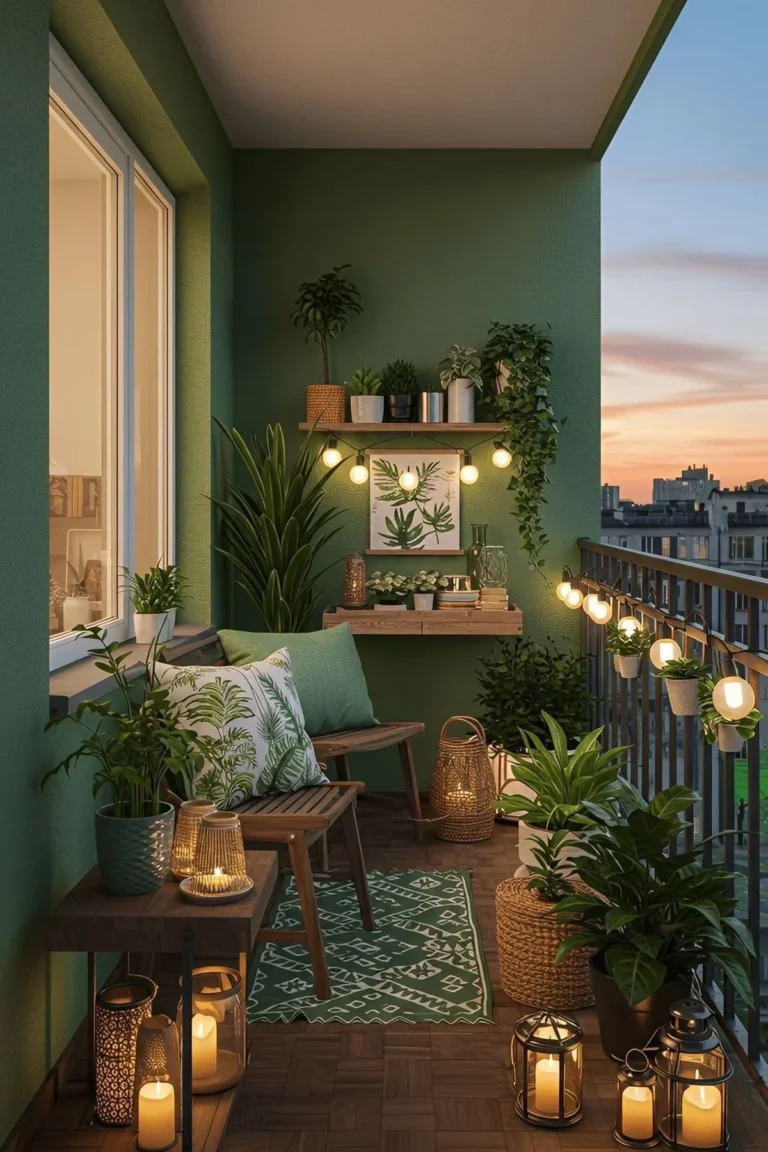
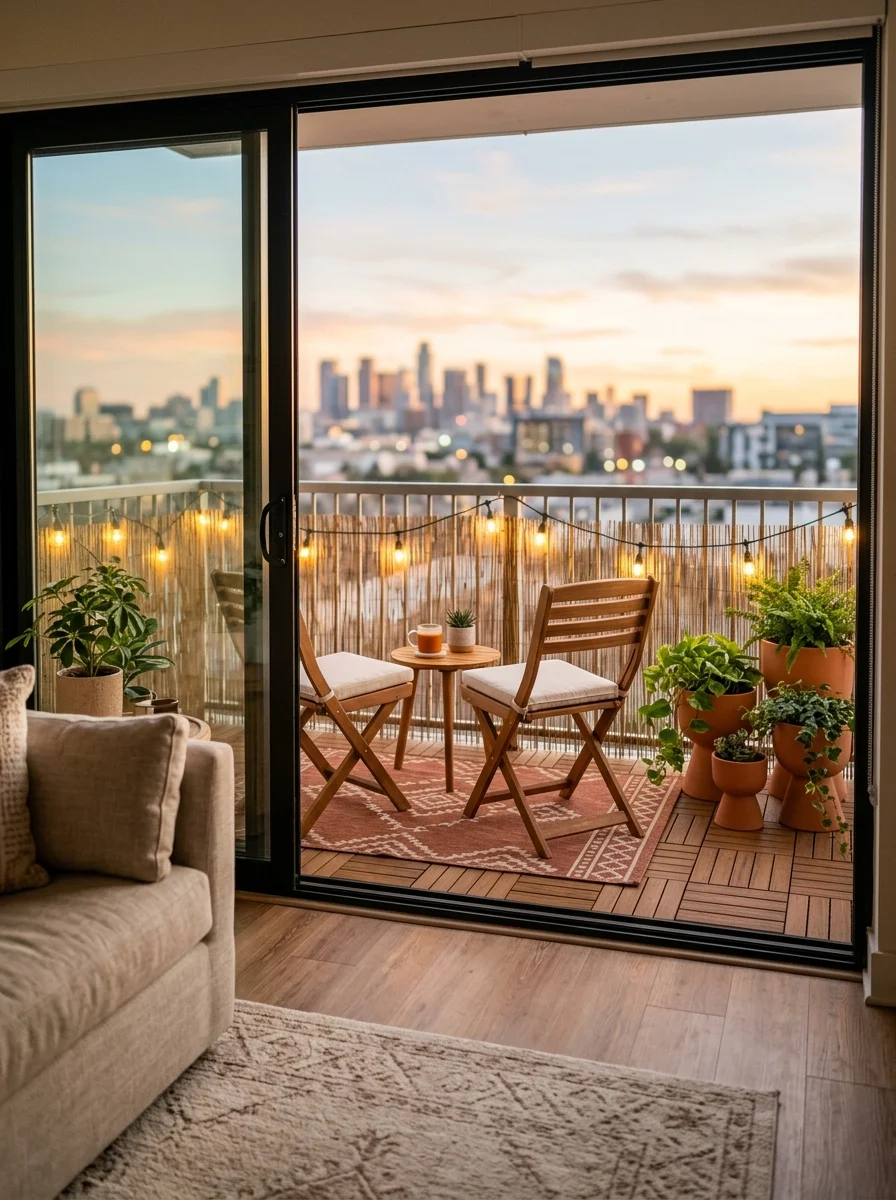
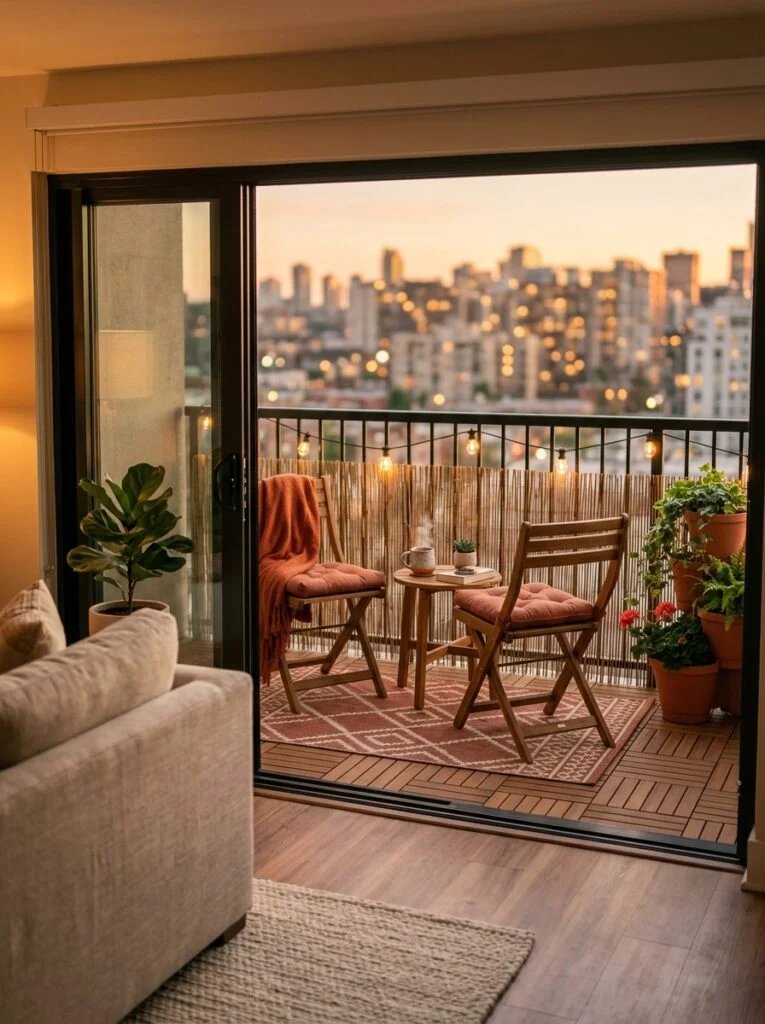
The standard five by nine with a slider. A friend of my sister’s had this one, and she’d already bought decent furniture. The fix was almost entirely about connection. An outdoor rug in a rust color pulled straight from her living room cushions. Both chairs pulled six inches off the railing and angled slightly toward each other instead of lined up like a waiting room. Three terracotta pots at three different heights. A lantern on the floor beside one chair.
The long narrow wraparound. These look generous and behave badly, because a long thin strip has no natural center. The answer was to stop treating it as one space. A coffee zone at the door end with a runner rug and two chairs, a plant zone at the far end, and the same terracotta repeated all the way down so it still read as one continuous space rather than two random collections.
Small Moves That Make the Space Look Deliberate
- Pull every piece of furniture a few inches off the railing. Furniture flat against a wall or rail always looks like it’s waiting to be moved.
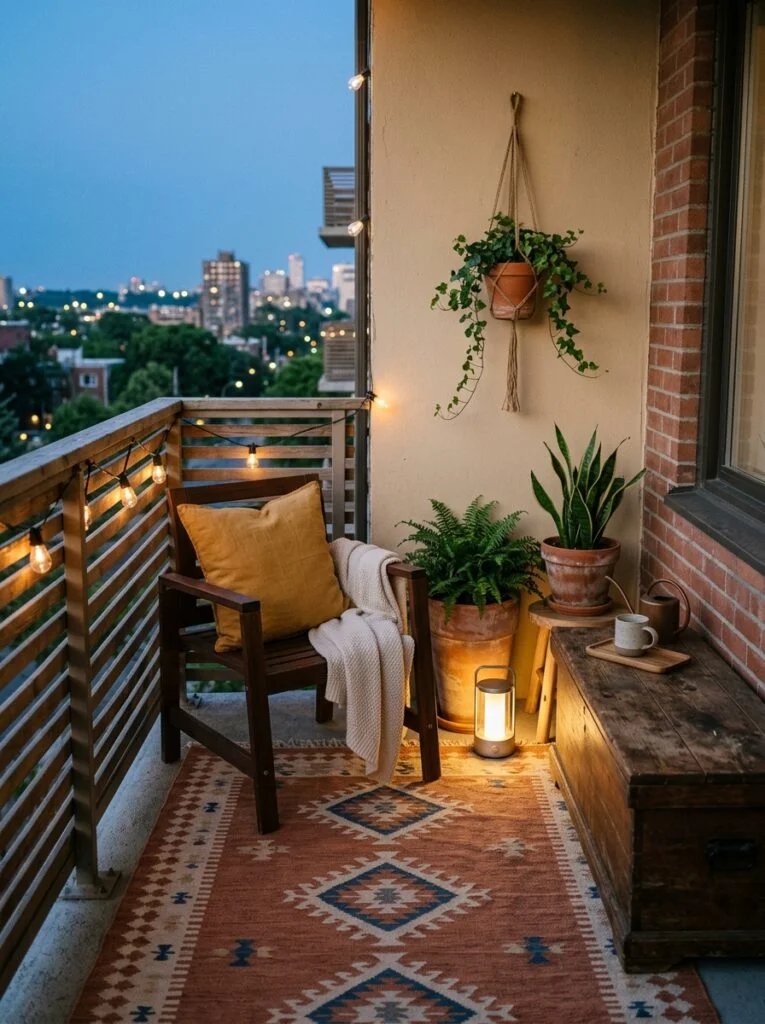
- Group plants in odd numbers and at three different heights. Floor level, something raised on a stool or crate, and one hanging or wall mounted.
- Repeat one material at least three times. Terracotta, black metal, natural wood, whatever. Repetition is what reads as a decision instead of an accident.
- Borrow one color from the room the balcony connects to. This single move does more for continuity than anything else on this list.
- Choose warm light. Cool white bulbs make a small outdoor space feel like a stairwell. Solar string lights or a rechargeable lantern are both fine, and neither needs an outdoor outlet.
- Give the ugly necessities a home. Mop, drying rack, cleaning supplies, tools. A lidded outdoor storage bench holds them and doubles as seating.
- Add one soft thing. A single outdoor cushion or an all weather throw makes the space feel used rather than staged.
- Sweep and wipe the railing before you judge anything. A surprising amount of “unfinished” is just dust and cobwebs.
Mistakes That Quietly Undo the Good Work
- The undersized rug. Worth repeating because it’s the most common one. If the front legs of your chairs can’t sit on it, size up.
- Too much furniture. A three piece bistro set crammed into a space that wanted one comfortable chair and a footstool. Sitting room beats seating count.
- Identical plants in identical pots. Same height, same terracotta, evenly spaced. It looks like a garden center display shelf.
- Temporary plastic chairs that live there for three years. We all do it. Nobody means to.
- Bringing indoor things outside. Indoor wicker baskets swell, MDF stools puff up at the corners, indoor rugs hold water and start to smell. It looks fine for a month and rough by the end of the season.
- Ignoring the walls and ceiling. The overhead surface and the shared side wall are part of the room. A single outdoor safe wall piece or a hanging planter changes the proportions completely.
- Blocking the door swing or the drain. Both are the kind of thing you only notice when it’s raining and you’re carrying a laundry basket.
- Decorating for a photo instead of a habit. If you never drink coffee out there, don’t build a coffee corner. Build whatever you’ll actually walk out and use.
Balcony Questions People Ask Me Most
I rent. How much can I really change? More than you’d think, as long as nothing needs screws or adhesive. Deck tiles, outdoor rugs, freestanding planters, zip tied screening, tension mounted shelving, solar lights, and a storage bench all come out cleanly. Take a photo of the balcony on day one so there’s no debate about the state you found it in.
Everything I put out there fades or falls apart. What holds up? Polypropylene for anything woven, powder coated aluminum for metal, and teak or acacia for wood if you’re willing to oil it occasionally. Cushions last dramatically longer when they live in a storage bin between uses rather than sitting out through every rainstorm.
Is my balcony too small to be worth decorating? Almost certainly not. Even a three by four ledge works with a covered floor, one chair, and one good plant. On a space that tight, skip the table if it blocks the door, and hang a small folding rail tray instead.
Real plants or fake ones? Real is worth trying first, since sun and rain are tough on artificial greenery unless it’s specifically UV rated. Pick two or three plants suited to how much sun your balcony actually gets and how cold your winters run, and ask a local nursery rather than trusting a general list. A tiny herb pot you use for cooking earns its space faster than anything decorative.
Do string lights look cheap? Only when there’s too much going on. One run of warm white lights along the rail or overhead looks calm. Multicolor, flashing, or three competing sets is where it goes wrong.
What order should I buy things in? Floor first, then seating you’ll actually sit in, then something vertical, then light. Buying in that order stops you from owning four cute accessories and a bare concrete slab.
If You Only Change One Thing
Cover the floor.
That’s it. That’s the move that takes a balcony from “storage ledge with chairs on it” to “small room I chose to have.” Everything else on this list is refinement, and refinement only pays off once the base is handled.
Then go sit back down on your couch and look out through the glass again. Nadia’s exact words when she did that were that her living room suddenly looked bigger, which it wasn’t. It just finally ended somewhere instead of trailing off into unfinished concrete.
That’s the part nobody tells you about balconies. Fixing them isn’t really about the balcony.