
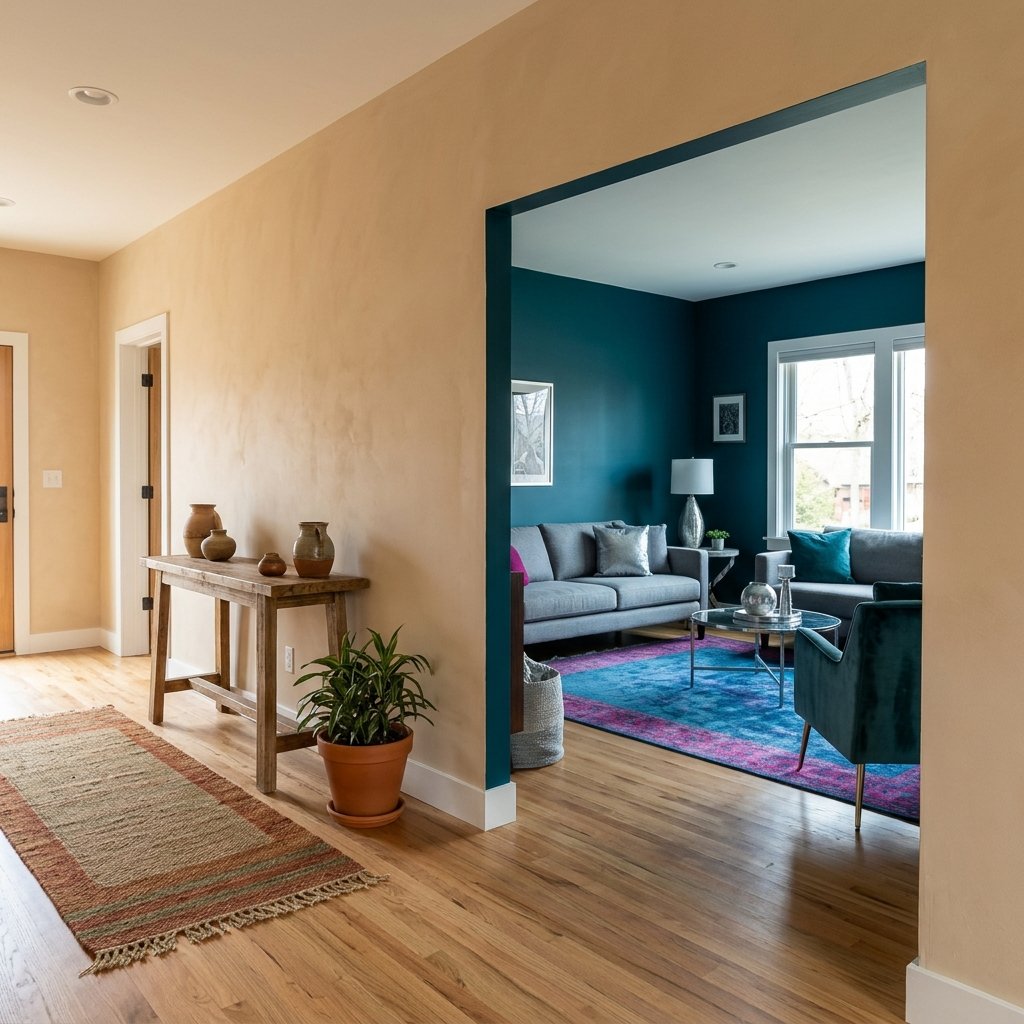
Saturday evening, you roll the last coat of warm greige onto the living room wall and step back. It looks right. Sunday morning you carry your coffee into the kitchen, turn around, and the room looks different from there. The greige now sits beside cool white cabinets, and the two rooms seem to belong to different houses.
Neither color is wrong. The mistake was choosing the living room as if it stood alone. You see it from the hallway, from a kitchen stool, and from the front door. This guide shows you how to build a living room color palette from what the room sits next to, so the colors still look related from every spot you stand.
Why a Room That Looks Right Alone Still Looks Wrong
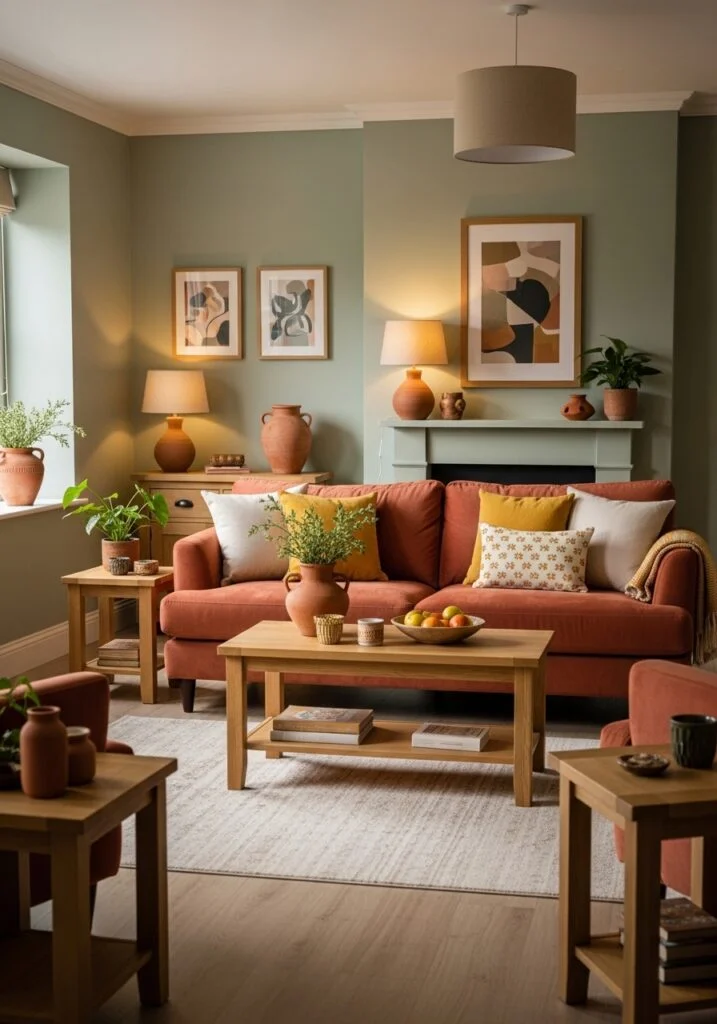
Paint chips and room photos train you to judge one space at a time. Your eye does not. From the middle of the sofa you may see 15 to 20 feet in two directions: through a doorway into the kitchen, down a hall, across to a dining table. Every color in that view gets compared with its neighbors, planned or not.
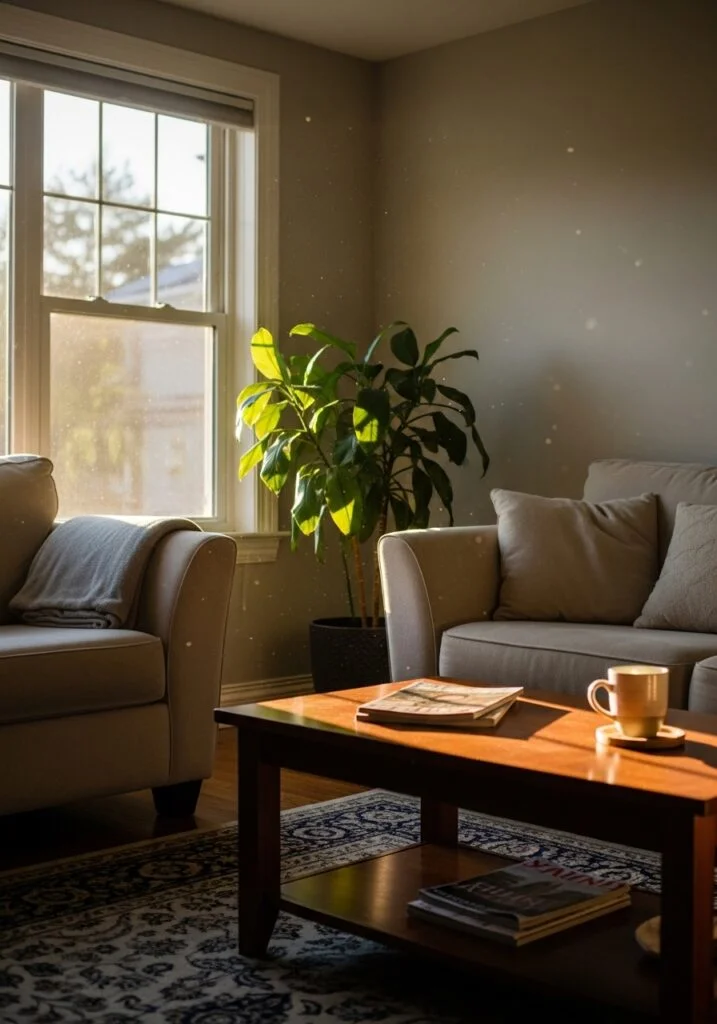
Comparison exposes undertones. A warm greige looks neutral on its own. Next to a cabinet white with a blue-gray lean, it suddenly looks yellow-pink. Neither color moved. The neighbor changed how you read it.
You also inherit other people’s choices. A previous owner picked the kitchen paint, a builder picked the flooring, and they were rarely chosen together. Your job is not to repaint the house. It is to choose a living room palette that makes the existing neighbors look deliberate.
Map Everything You Can See From the Sofa
Before you open a paint can, stand in three places: the center of the sofa, the main entry, and the spot in the kitchen or hall where you pause most. From each one, list every wall color, floor, cabinet, and trim finish visible at once. A labeled phone sketch works fine.
Most people find five to seven separate colors and two or three flooring types. Mark each as “staying” or “could change.” Floors, cabinets, and counters nearly always stay. Walls nearly always can change. That list of staying items is your real design brief.
Then count the wall colors in a single view. Three is a useful ceiling. Four starts to read as patchwork, even when every shade is pleasant on its own.
Choose One Anchor From What Will Outlast the Paint
Benjamin Moore’s color team advises building a scheme around one anchor color taken from something you already love, such as a fabric, artwork, or a room that works. For a connected living room, pick that anchor from the longest-lived thing in view: a rug, the floor, a sofa, or a run of cabinets. Paint is the cheapest surface to change, so it should follow the expensive ones.
Say the kitchen has white shaker cabinets and the living room has a floor you cannot touch. The anchor is not simply “white.” It is that exact white, because it sets the undertone every other color will sit beside. Write down what it leans toward: blue, yellow, green, or pink.
Read the Undertone Before You Pick Anything Else
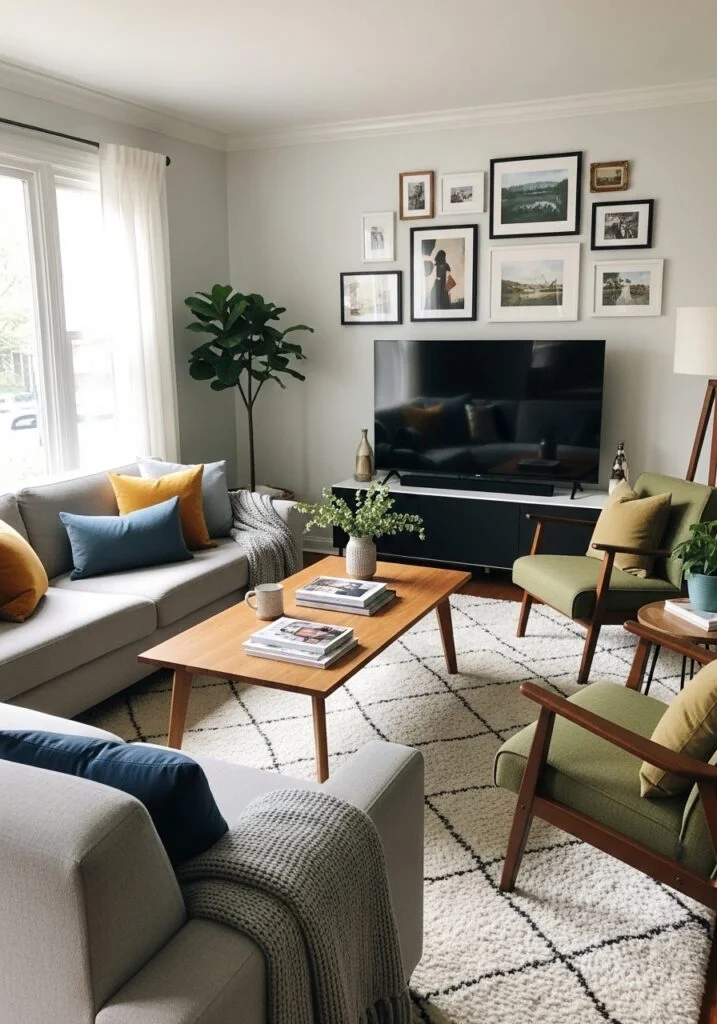
Undertone is the faint second color hiding in a neutral. The same Benjamin Moore guidance suggests an easy way to find it: hold the item beside swatches of grayed pinks, blues, and greens until one of them matches. Try it with a cabinet door, a rug corner, or a tile sample against a paint fan deck.
Do this for the anchor and for each neighbor in your sightline. If the cabinet white leans cool and the floor leans warm, you need a living room neutral that sits between them rather than one that sides with either. A slightly green or taupe-leaning greige often bridges a cool white and a warm floor better than a pink-based beige does.
Write one word beside every item: cool, warm, green, or pink. At the paint counter, you can match words instead of trusting your memory of a color.
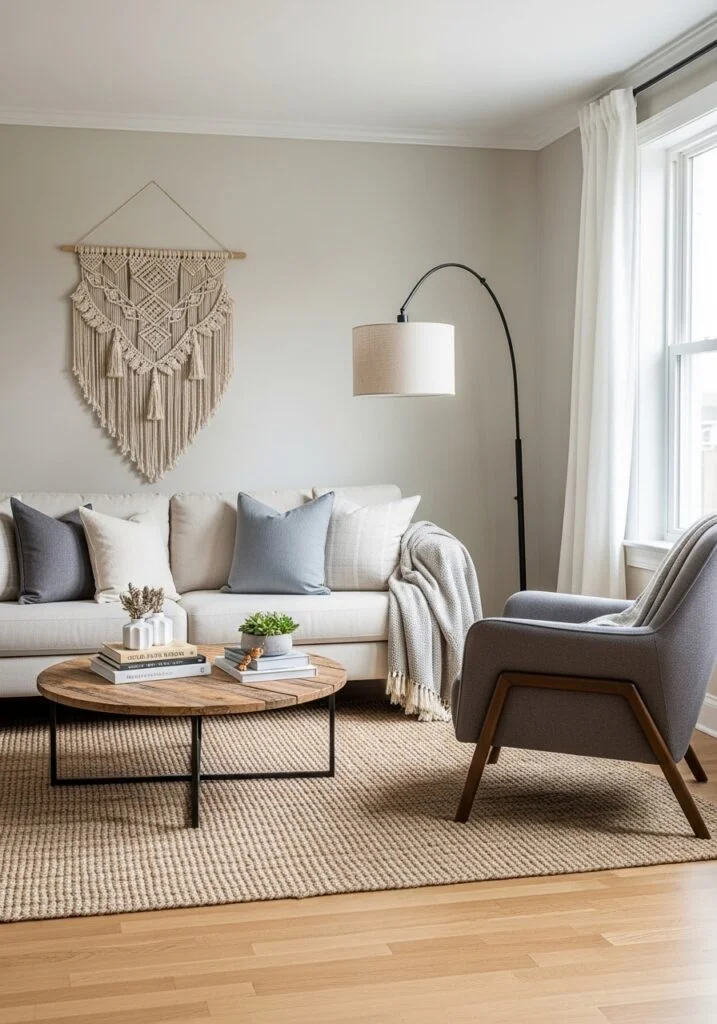
Build a Palette of Four or Five Colors, Not Ten
Benjamin Moore recommends four or five colors in total: one or two neutrals that share the anchor’s undertone, a lighter and a deeper version of the anchor, and one accent from a neighboring hue. The small count is deliberate. It is enough to cover a living room, a hall, and one kitchen wall without repeating yourself.
Here is a worked example for a cool-leaning house. The kitchen cabinets are a blue-leaning white. That white also goes on the living room ceiling and trim. The living room walls take a pale blue-gray. A slate blue, one step deeper, goes on the hall door or the back of a bookcase. The accent is a muted plum in two pillows and one framed print. Five colors, one cool undertone, and every room draws from the same set.
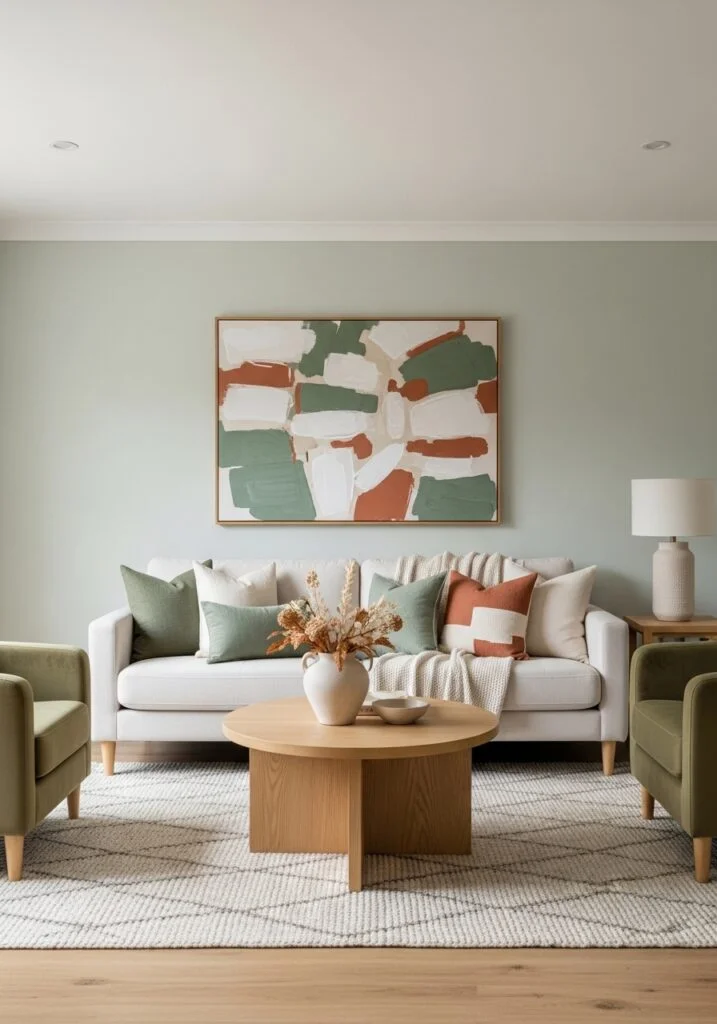
If your anchor is warm, run the same recipe with a cream, a mushroom neutral, a deeper brown-taupe, and a rust or ochre accent.
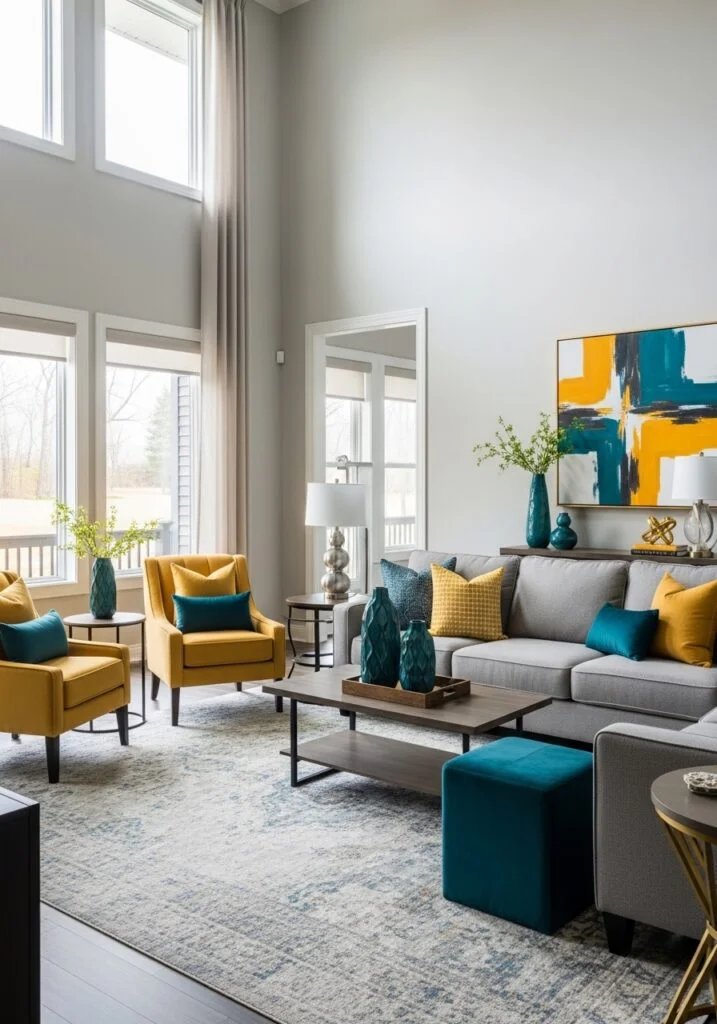
Decide Where Each Color Starts and Stops
The cleanest paint changes happen at inside corners and behind door casings, never mid-wall. A color that stops at an outside corner leaves a ragged edge that chips with every bump, and one that stops mid-wall looks like a mistake. At a hall opening with no casing, carry the living room color around the short return and stop at the inside corner on the far side.
In an open plan with no natural break, you have two options. Use one wall color through the whole connected space and let rugs and furniture mark the zones. Or step the color by one or two shades within the same family, starting at an inside corner, so the shift reads as light rather than a new color.
Keep the sheen identical across both. A flat wall beside an eggshell wall in the exact same color can read as two colors when afternoon light rakes across them.
Handle the Floor Change at the Doorway
Walls are not the only surface that changes at a doorway. When the living room has one floor and the kitchen has another, the seam belongs directly under the door line, not out in the open room. A flat threshold strip about 1 to 1-1/2 inches wide hides the gap, and it looks calmer in the darker of the two floor colors.
Check the undertones of both floors the same way you checked the paint. A golden oak beside a gray-brown plank looks like an argument at the seam. A rug in the living room whose border picks up a hint of the kitchen floor color gives the eye something to connect. An 8-by-10 rug placed so its edge ends about 12 inches short of the doorway keeps the transition visible without crowding it.
Keep Trim, Ceilings, and Doors on One White
Benjamin Moore’s own example uses a single white on the woodwork, ceilings, and doors of a hall, a bedroom, and an ensuite to hold three different wall colors together. You can copy that logic. If the living room trim is creamy and the kitchen trim is a crisp bright white, your eye catches the difference at every doorway, along a 3-1/2 to 5-inch casing line repeated around the house.
Repainting casings and baseboards in the room you are already painting costs about one quart of semi-gloss, roughly $20 to $35. Match the trim to whichever neighboring room has trim you cannot cheaply change. Do the same with ceilings, since a ceiling is the one surface you see across every open doorway.
Reuse a Color From Next Door as Your Accent
Benjamin Moore also describes rotating each color’s job from room to room. The main wall color in one room becomes the ceiling or accent in another. In practice, the slate blue from the hall door shows up again as a lampshade and a throw in the living room. The living room’s pale blue-gray returns in the kitchen as a roman shade or a runner.
Move two or three objects, not twelve. Repeat the color at three scales: something large like curtains, something medium like pillows, and something small like a vase. The eye catches that repetition within seconds, even when the rooms have different wall colors.
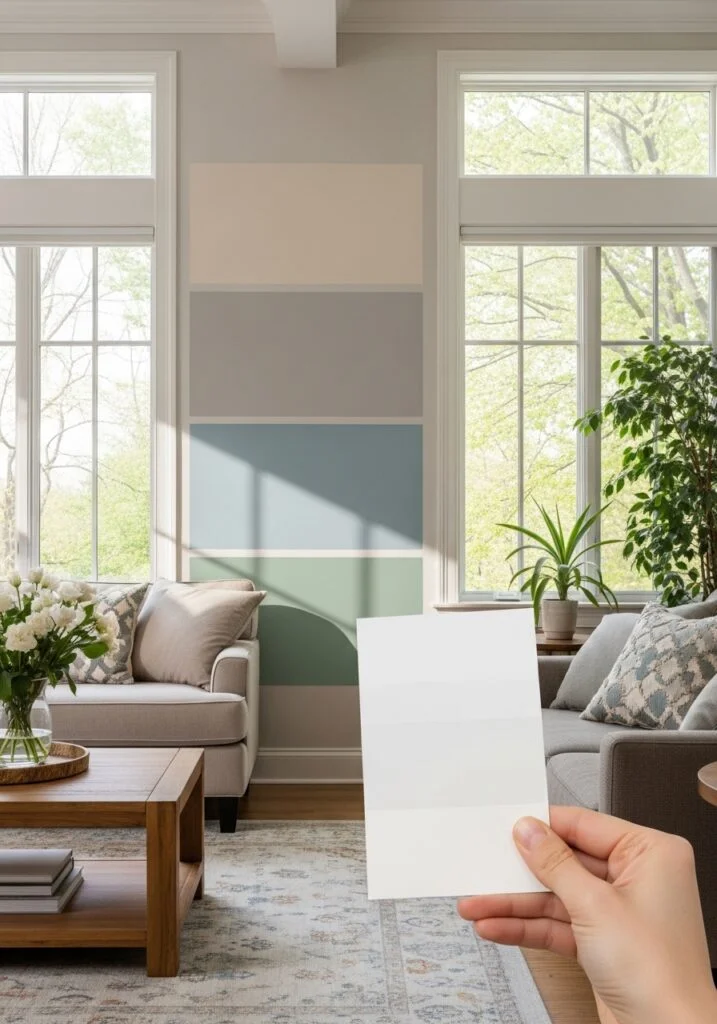
Test the Palette at the Doorways, Not Mid-Wall
Test samples where two rooms meet. Paint two coats of each candidate on a 22-by-28-inch sheet of white poster board, then tape the boards beside the doorway so your neighbor’s wall or cabinet is in the same view. Look from the sofa and from the next room.
Leave the boards up for three days. Sample pots run roughly $5 to $9 each, which is far cheaper than repainting. If you want to judge how a color behaves once the lamps come on, our guide to living room color combinations that hold up in daylight and lamplight covers bulb temperature and evening testing in detail.
What a Connected Palette Costs
A 12-by-15-foot living room with 8-foot ceilings has about 430 square feet of wall. Subtract one door and two windows and you are near 370. A gallon covers roughly 350 to 400 square feet, so two coats take two gallons.
At $45 to $90 a gallon, add a quart of trim paint, three sample pots, rollers, and tape. A realistic total is about $150 to $285 for the living room alone.
Carrying a companion color into a hall 3 feet wide and 10 feet long adds about 200 square feet of wall, roughly one more gallon for two coats. That is a small price for removing the clash. If your kitchen cabinets are the problem, see our notes on kitchen cabinet colors that last beyond one season before you pick the living room color.
When Rooms Are Allowed to Disagree
A simple test applies: if you cannot see a room from the sofa or the entry, it can follow its own rules. A den with a door, a powder room, or a bedroom at the end of a hall can hold a deep jewel color or a bold green without touching the living room palette.
The shared trim and ceiling white still do quiet work when those doors swing open. They keep a dark room from looking like a hole cut into the house.
If You Already Painted the Wrong Color
You do not have to start over. Work through these fixes in order of cost.
First, repaint the trim and ceiling in the shared white. That alone cuts the clash by a surprising amount. Second, add a bridging color in the hall or doorway return, a mid-tone that borrows an undertone from both sides. Third, move color with textiles: curtains, a rug, or pillows in the neighbor’s accent will make the two rooms look related without more paint.
Only repaint a whole room as a last step, and choose the smaller room with less wall area, usually the one with fewer windows and doors to cut around.
Tonight, sit on the sofa, list what you can see, and write one undertone word beside each item. That list will tell you more about your palette than another hour with paint chips.
Frequently Asked Questions
Can my living room and kitchen be different colors if they are open to each other?
Yes, if the colors share an undertone and the trim and ceiling stay the same white. Stop the change at an inside corner, such as where a wall meets a cabinet run or pantry return, so the line looks planned. A shift of one or two shades within one color family reads smoother than a new hue.
How many wall colors can I use across a connected first floor?
Three is a comfortable limit for colors visible from one spot, and four or five across the whole floor if they share undertones. Count from the sofa and from the front door separately, since each view differs. Repeating one color in two rooms usually adds less visual noise than introducing a fourth new one.
What color should I paint a hallway between two clashing rooms?
Pick a mid-tone that shares an undertone with each room, then keep the ceiling and trim in your shared white. Halls are seen in short glimpses, so a color one or two steps deeper than either neighbor often feels deliberate rather than muddy. Tape a sample board at each end before committing.
Do I have to repaint the whole floor plan if I only change the living room?
No. Painting only the living room works when the new color shares the undertone of its neighbors and the trim matches. Check the result from the doorway after the first coat. If one neighbor still clashes, repaint only its adjoining wall, usually 8 to 12 feet of wall rather than a full room.
Does floor color matter more than wall color when choosing a palette?
Floors come first because you rarely replace them. Flooring is the largest continuous surface in a connected plan, so a wall color that fights it shows in every view. At even $3 per square foot installed, new flooring in a 12-by-15-foot room costs about $540, versus under $200 in paint.
1 comment