
You held a three-inch paint chip under the store lights, and the emerald looked like a cut stone. Your kitchen has about 22 linear feet of cabinet doors, one window over the sink, and a ceiling fixture some builder picked in a hurry. Three inches of jewel color and roughly 100 square feet of it are not the same purchase.
That gap explains most emerald kitchens that look like a cave once the second coat dries. The color is rarely the problem. The mistake is choosing emerald as a color and never planning for how much light it absorbs. White cabinets hand light back to the room. Deep green keeps most of it.
This guide is a diagnosis, not a gallery. You will learn how to read a reflectance number, which bulbs make green look rich instead of muddy, why undertone decides your counters and hardware, and how much emerald a particular room can carry. The photos show how each fix looks in a finished kitchen.
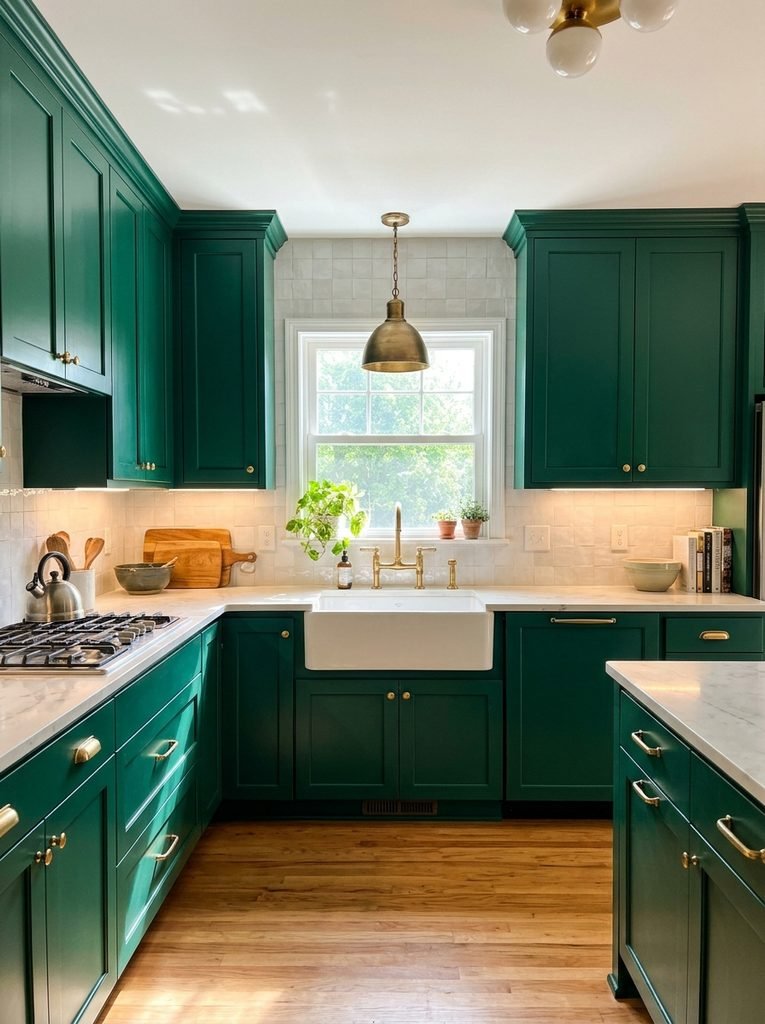
Why Emerald Reads Dark Even When the Chip Looked Bright
Paint companies publish a light reflectance value, usually shortened to LRV, on a scale from 0 (black) to 100 (pure white). A warm white cabinet paint often lands in the 70s or 80s. Deep emerald typically sits in the single digits to low teens. Check the exact figure on the manufacturer’s color page before you buy anything.
In practice, your emerald doors send back roughly a tenth of the light that white doors would. Spread that across 100 square feet of door and drawer faces, and the room loses real brightness even though nothing else changed.
The chip misled you in two smaller ways. It was lit evenly and viewed flat, while your cabinets sit in the shadow of the uppers and pick up whatever color the floor and walls throw at them. And a swatch has no neighbors. Emerald beside a stark white counter looks crisp. Emerald beside a beige one looks swampy.
Here is the working rule for the rest of this guide: the darker the green, the more work the rest of the room has to do. With one window and an emerald run longer than about 12 feet, you need a bright counter, a reflective backsplash, and better lighting to make up the difference.
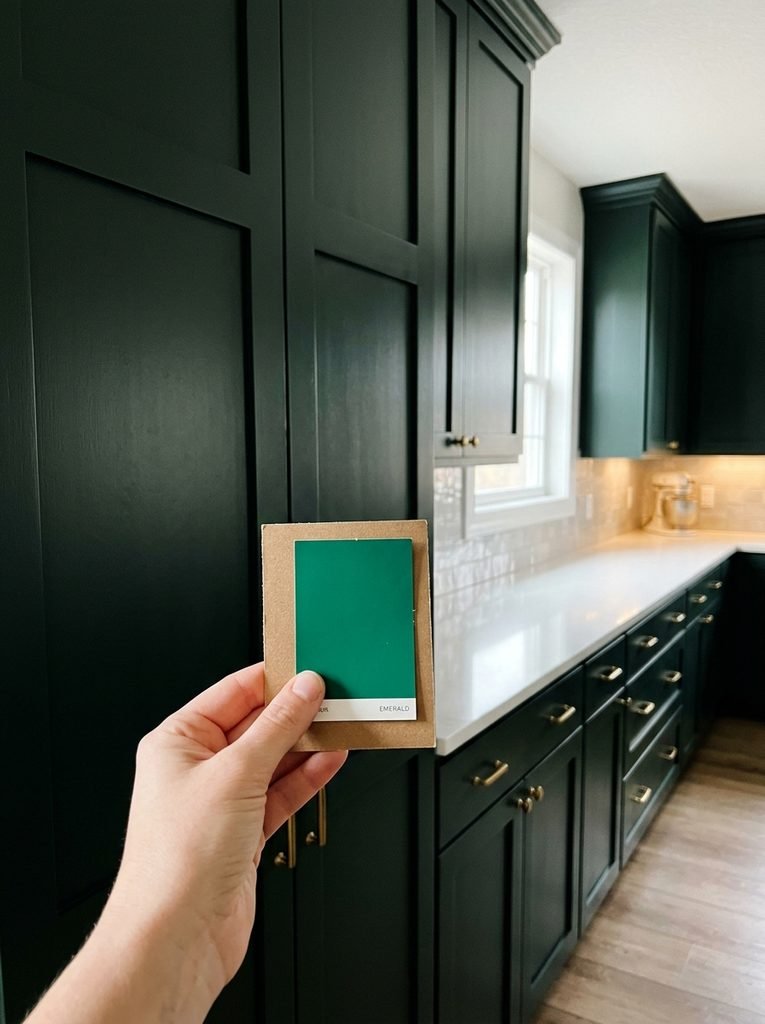
Fix the Lighting Before You Touch the Paint
Light quality changes emerald more than almost any other cabinet color. The U.S. Department of Energy’s lighting basics page describes the Color Rendering Index as a 1-to-100 scale showing how faithfully a bulb renders color compared with sunlight, and it treats 80 or higher as acceptable for most homes. It also recommends a color temperature between 2700 and 3600 K for general and task lighting.
For green cabinets, aim for the top of that range. Choose 90 CRI or better for every bulb and LED strip that lights the cabinets, at 2700 to 3000 K. At lower CRI, deep greens tend to look flat and grayish. At 4000 K and above, emerald turns cold and slightly teal beside a warm wall. Both numbers are printed on the bulb box or spec sheet.
Placement matters as much as the bulb. Mount under-cabinet strips in the front third of the cabinet bottom, behind a small light rail or lip. Pushed to the back, they throw a hot streak up a glossy backsplash and leave the counter edge dim. Use an aluminum channel with a frosted diffuser so you do not see individual LED dots reflected in the tile.
Then build three layers. Ceiling fixtures provide the base. The strips give task light on the counter. Pendants or a chandelier add the glow that makes dark cabinets look rich at night. Hang island pendants so the bottom sits roughly 30 to 36 inches above the counter, and put everything on dimmers. Emerald at noon and emerald at 9 p.m. are two different moods, and a plain on/off switch forces you to pick one.
The same logic applies to storage. A pantry or butler’s pantry painted emerald benefits from a door-activated LED strip along the inside of the frame. It lights every shelf evenly and shows off the green without glare.
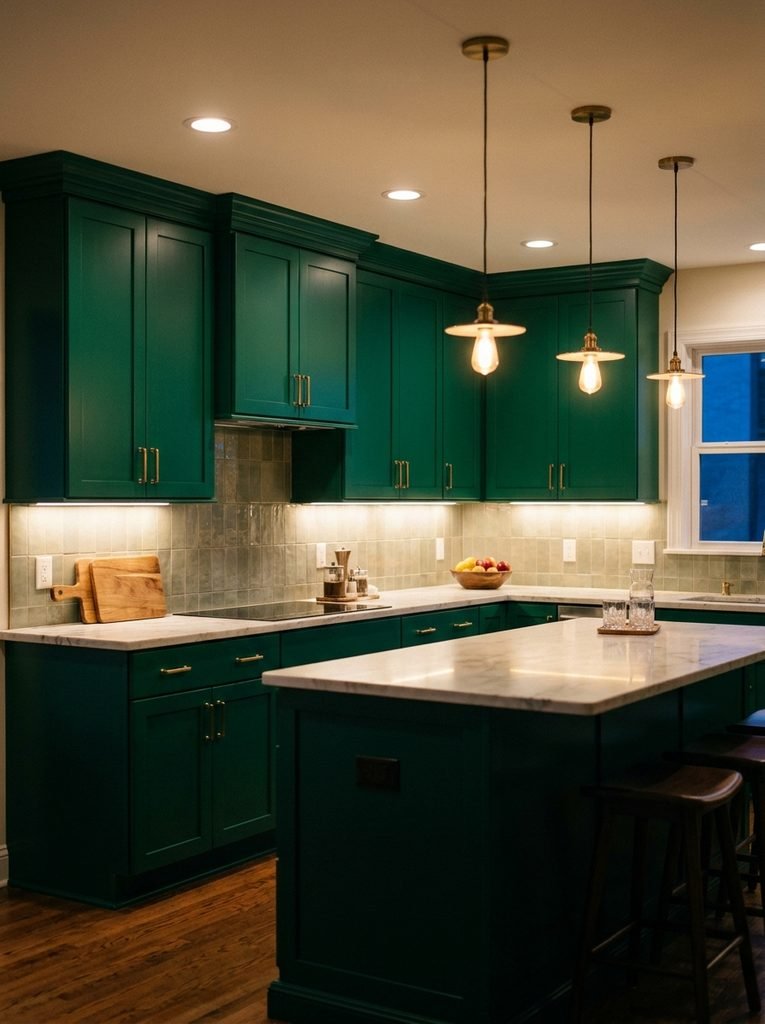
Give the Green One Bright Surface to Push Against
Deep color needs a light partner at eye level. In most kitchens that means the countertop and the backsplash, the two surfaces you look at while you cook.
White veined marble or a marble-look quartz is the usual answer. The veining adds movement, and the pale ground bounces light into the green. If you choose real marble, pick honed over polished. Polished marble shows etch marks from lemon juice, wine, and vinegar as dull spots, and they stand out against dark cabinets. Quartz avoids that, though some patterns repeat across a long run, so look at a full slab instead of a four-inch sample.
The backsplash is your second chance to add light. Glossy tile bounces more than matte, and a pale tone bounces the most. If you choose a patterned tile, keep the counter plain. Emerald cabinets, a geometric backsplash, and a heavily veined slab all at once leave the eye nowhere to rest.
One quick check: hold a sheet of white printer paper against the countertop sample, then against a cabinet door. If the counter looks gray next to the paper, it will not lighten the room, and the green will still dominate.
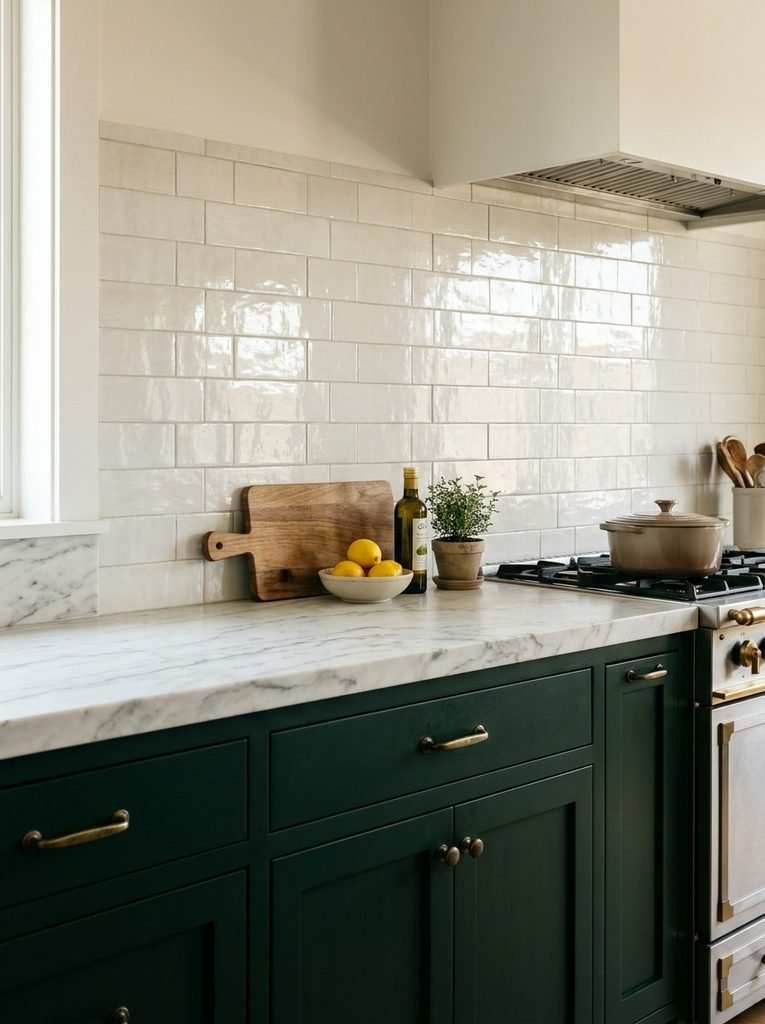
Match the Sheen to the Door Style
Sheen changes how dark the green reads. High gloss reflects light and its surroundings, which is why lacquered emerald can look brighter than the same color in matte. Matte absorbs more light and makes the color feel deeper and calmer.
Gloss is demanding. It shows every dent, drip, and warped door, so it suits flat slab fronts on a straight, well-built cabinet box. It is usually sprayed rather than brushed, since brush strokes show. Ask a finisher about a catalyzed or two-part polyurethane, which holds up to cleaning better than standard enamel.
Satin is the forgiving middle. On shaker doors it softens the shine while still catching some light, and it hides small flaws better than gloss. Traditional doors with molding and framed panels add shadow lines of their own, so satin keeps those details readable without glare.
Matte emerald makes the most sense on flat, minimalist doors in a room with plenty of daylight and a strong lighting plan. Without those, it is the finish most likely to produce the cave from the opening of this guide.
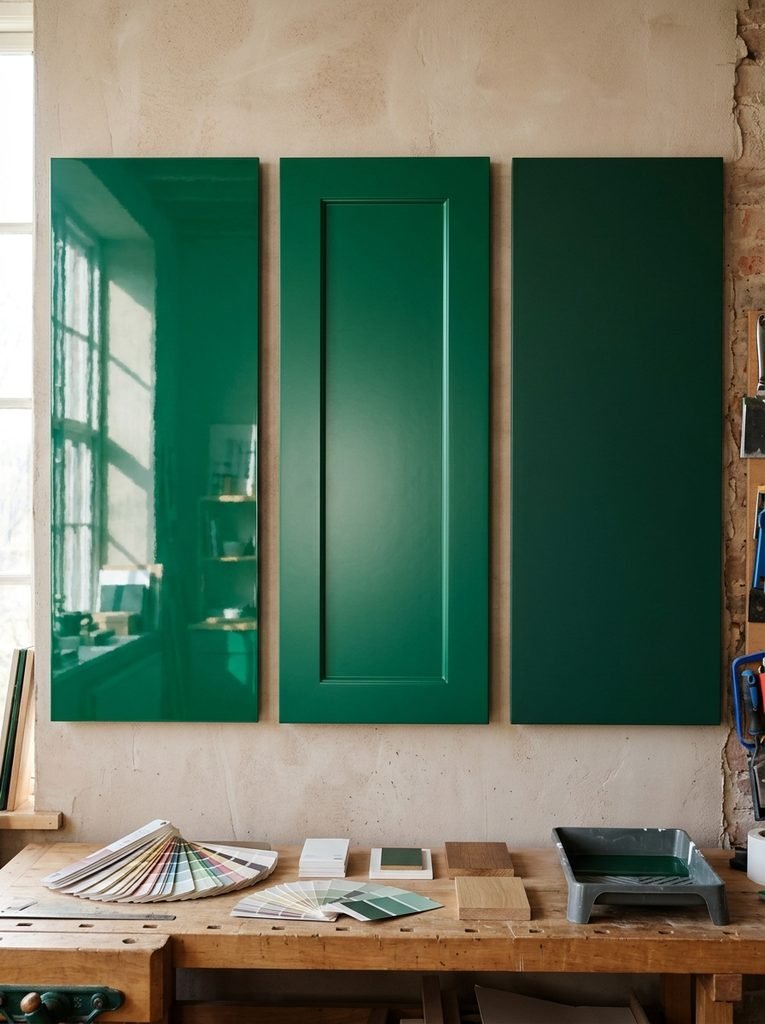
Undertone Decides Your Whites, Stones, and Metals
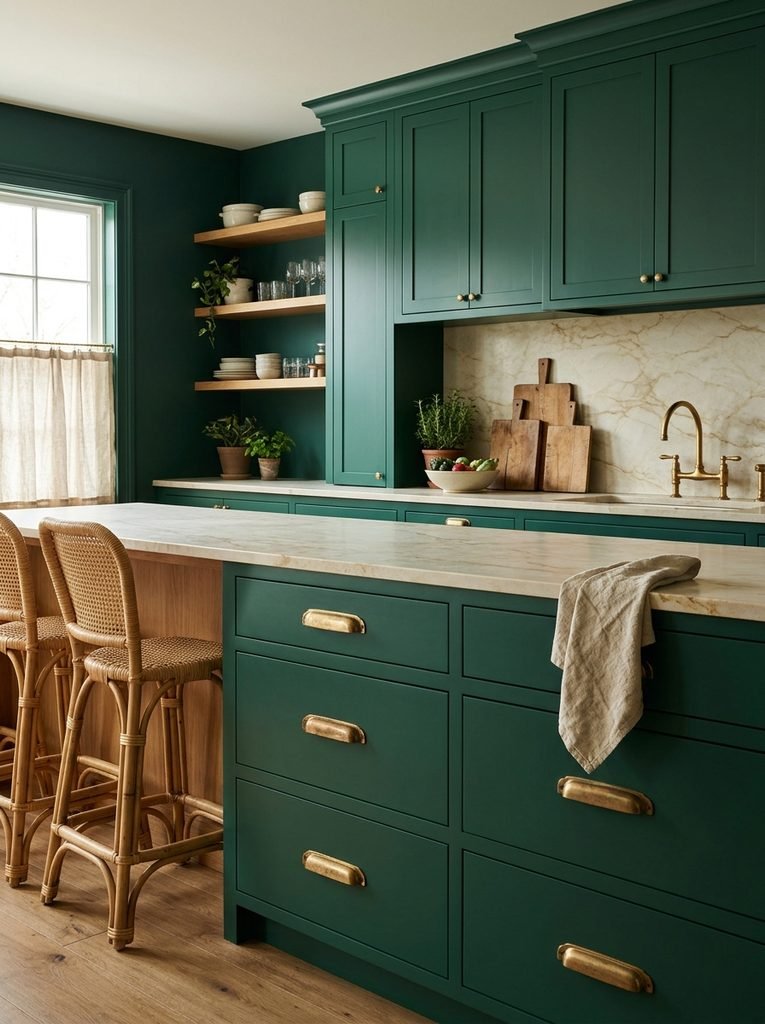
Emerald leans blue-green, so it behaves like a cool color even though it feels rich. That undertone is why it gets along with warm partners such as cream, oak, aged brass, and linen. It fights cold ones: stark blue-white walls, chrome, and bluish-gray stone.
Hardware shows the effect fastest. Brass and gold read clearly against emerald and bring warmth. Matte black can nearly disappear on dark green because the two have so little contrast. Brushed nickel suits a cooler, more modern kitchen, but it needs wood or a warm white nearby to avoid feeling icy. If emerald still looks too blue in your light, a deeper, earthier green may suit the room better, and our forest green kitchen ideas go deeper on that route.
Size counts too. A 3-inch pull looks timid on a wide drawer front, so go to 5 or 6 inches on the larger drawers. If you pick unlacquered brass, expect it to darken within months, especially near the cooktop. That patina suits emerald well. Lacquered brass stays bright if you prefer that.
Soften the palette with natural texture. Rattan stools, wooden boards, and linen curtains add warm undertones without adding more color. When you mix wood, stone, and metal, let one material lead and the other two support it, and keep metals to two finishes at most.
Keep the Floor, Walls, and Ceiling From Joining the Cave
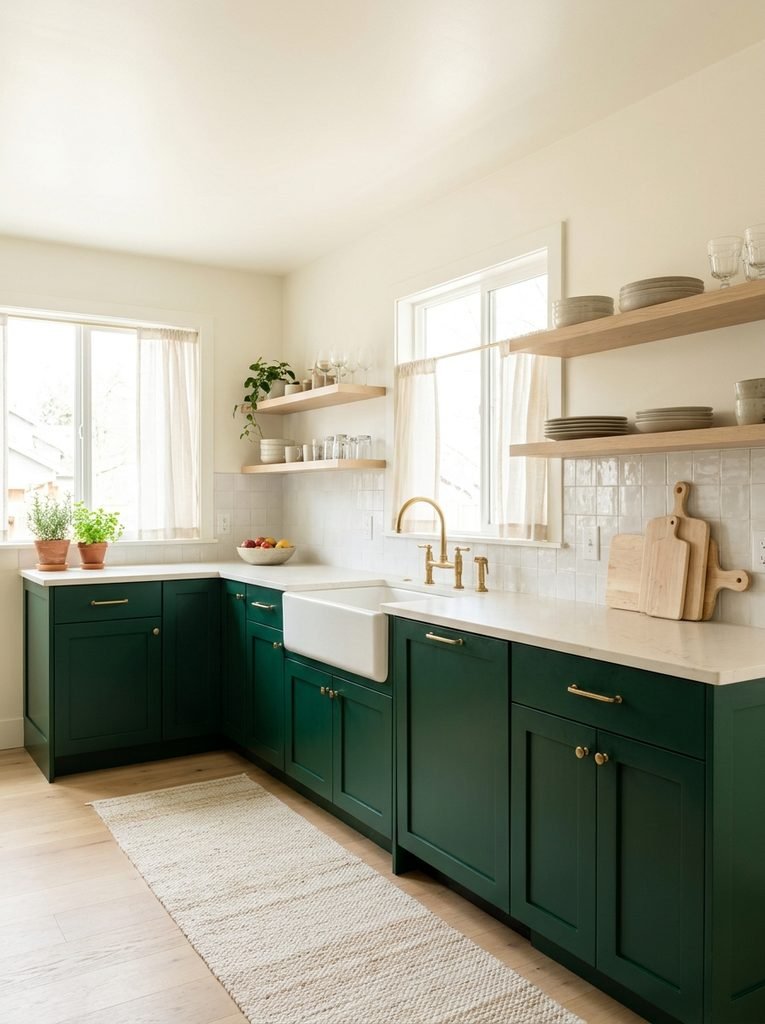
Dark floors plus dark cabinets leave the eye with no horizon, and the whole room sinks. Pale oak, ash, or a light-toned tile gives the green a base to stand on. If you cannot change a dark floor, a light runner about 30 inches wide, laid in front of the sink and range, breaks up the surface.
Walls and ceiling should do the reflecting. Choose a warm white wall paint with an LRV around 80 or higher, and paint the ceiling the same shade or one step lighter. Keep window treatments sheer or minimal. Heavy drapes block the one free light source you have.
Style gives you different routes to a brighter result. A Scandinavian-leaning kitchen pairs emerald with pale wood and white walls, which is the safest path.
In a farmhouse kitchen, a white fireclay apron-front sink and light shiplap or pale beams keep the rustic warmth from darkening the room.
A retro kitchen can lean on a black-and-white checkered floor, where the white squares carry the light the cabinets absorb. Twelve-inch squares read as a confident pattern. Smaller ones look busy.
How Much Emerald Your Room Can Carry
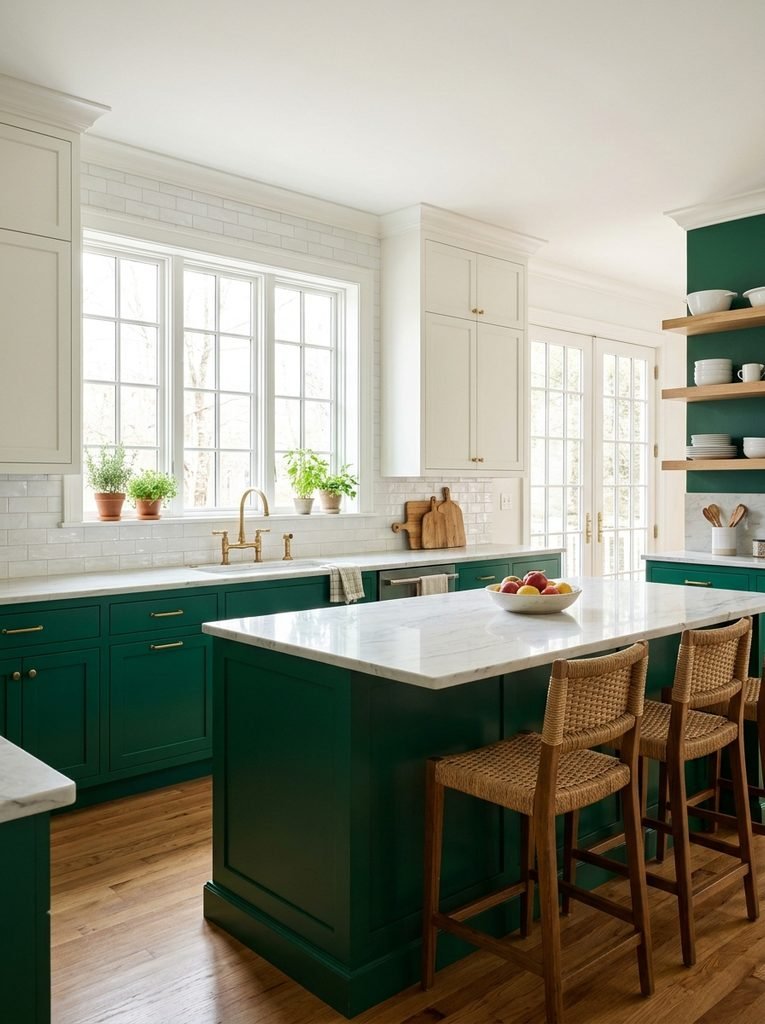
Count windows, not square footage. A kitchen with a large window or a glass door can handle a full emerald run. A kitchen with one small window usually cannot, and partial use pays off there.
A two-tone layout puts emerald on the lower cabinets and white above. The dark base grounds the room, and the white uppers carry light at eye level.
An island is another contained option. At the standard 36-inch height with a 12-inch overhang for stools, it is big enough to anchor the room and small enough to leave the walls light. A white marble top is the usual partner.
Smaller doses work as well. Paint the wall behind open shelves emerald so white dishes stand out against it.
A built-in dining bench upholstered in deep green, with a seat height around 17 to 18 inches, extends the color without adding heavy cabinetry.
In a small kitchen, keep emerald to the lowers and pair it with glossy tile and a pale counter so reflections do the work. If you would rather keep the green quieter overall, our guide to timeless kitchen cabinet colors covers muted sage and olive as softer alternatives.
Hoods, Panels, and the Details That Make It Look Planned
A range hood painted to match the cabinets pulls the whole wall together, but it sits closest to the heat. Ask the hood maker or a custom finisher about heat-rated enamel, because standard cabinet paint can discolor or blister near burners.
Panel-ready appliances disappear into the cabinet run, but each model accepts a specific panel thickness and weight. Get the spec sheet before the cabinet maker cuts a single door. A panel-ready dishwasher and refrigerator are the fastest way to make the green look continuous.
Industrial materials give emerald a rougher partner. Exposed brick, concrete counters, and matte black fixtures all work. Concrete needs sealing, and periodic resealing, because it stains easily. And since black fixtures lose contrast on dark green, add one warm material, such as a wood shelf, so the corner does not go heavy.
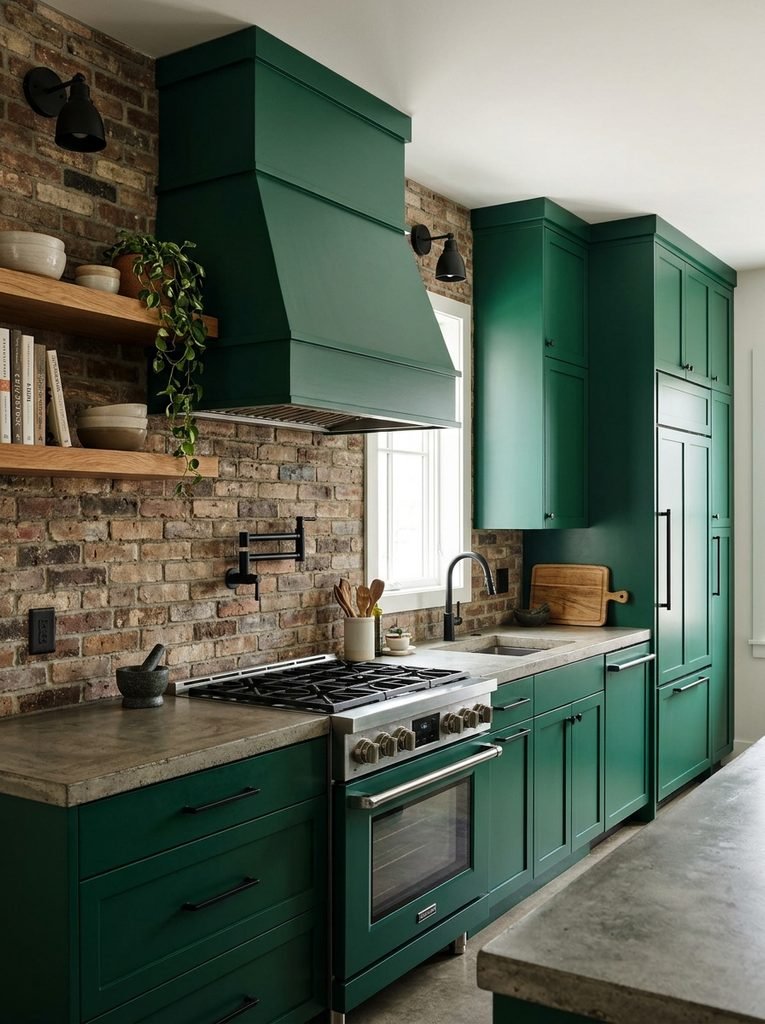
Color-Drenching Without the Cave Effect
Drenching paints cabinets, walls, and trim in the same emerald. It looks dramatic when done well and flat when one sheen is repeated everywhere. Vary the sheen instead: matte on the walls, satin on doors and trim. The surfaces catch light differently even though the color is identical.
Lighting does more work here than in any other approach. Add a fixture you would not need in a pale kitchen, such as sconces or a second pendant, and keep every bulb at 2700 to 3000 K. Paint the ceiling a tint several shades lighter than the walls so some light still bounces overhead.
A minimalist version uses the same idea with fewer objects. Flat matte doors, concealed pulls, and almost no countertop décor let the color carry the room. That only works with strong daylight and layered lighting, so treat it as the advanced option.
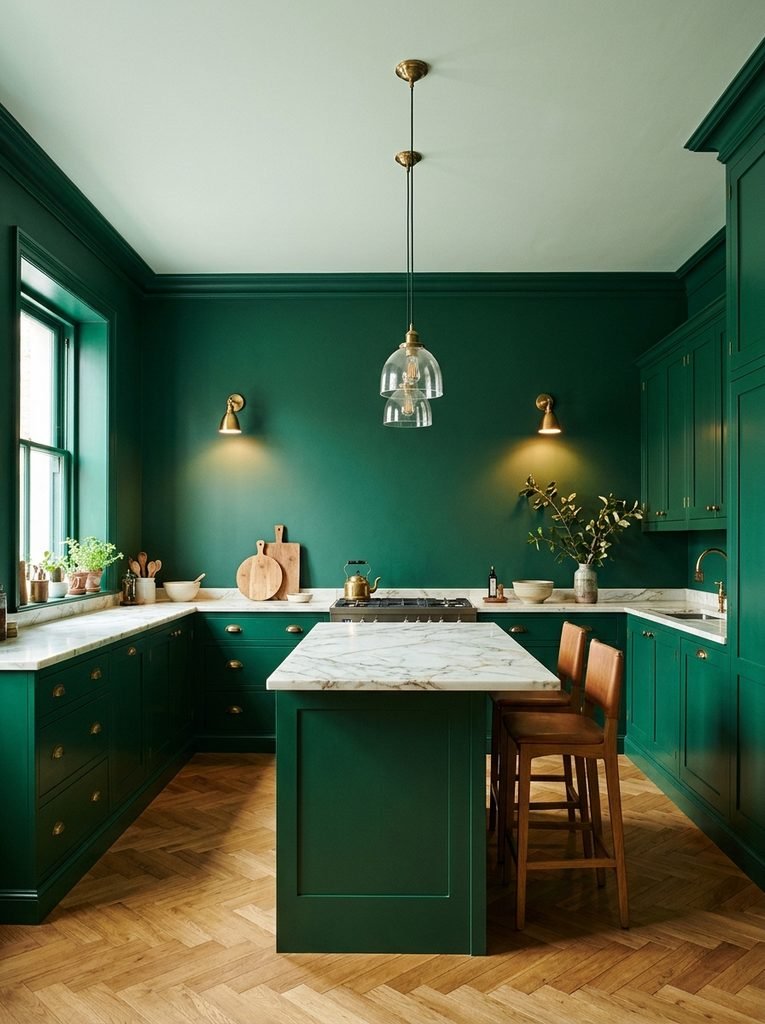
The Weekend Test Before You Order Paint
Skip the three-inch chip. Paint a 24-by-24-inch board with two coats and tape it to a lower cabinet beside the range. Tape a second board to an upper door near the window. Compare both against your actual countertop sample and hardware.
Then run two checks. First, switch off the ceiling lights and leave only the under-cabinet lights on. That is your worst case. Second, photograph the boards and convert the photo to black and white. If the board and the counter turn the same gray, you need more contrast between them.
When the test passes, order about 10 to 15 percent more paint than the math suggests. Deep colors show scuffs fast, and a labeled leftover pint saves you from color-matching later.
Emerald Green Kitchen Questions People Actually Ask
How much does it cost to paint kitchen cabinets emerald green?
Expect roughly $300 to $700 in materials if you do it yourself, and about $3,000 to $8,000 from a professional for an average kitchen. Deep colors usually need a bonding primer plus two topcoats, so labor runs higher than for white. Quotes swing with cabinet count, region, and whether doors are sprayed off-site, so collect at least three.
Can I paint emerald green kitchen cabinets myself?
Yes, if you can commit to the prep, which takes longer than the painting. Degrease every door, scuff-sand the finish, then apply a bonding primer before two thin coats of cabinet enamel. Paint feels dry within hours but can stay soft for around 30 days, so skip heavy scrubbing and avoid stacking items against doors during that time.
Do dark green cabinets show fingerprints and grease?
Dark satin and gloss finishes show oily fingerprints more than white does, especially on doors beside the range and the trash pull-out. Matte hides smudges but can burnish where hands touch. Wipe weekly with a damp microfiber cloth and a drop of dish soap, and skip abrasive pads, which leave dull patches you cannot buff out.
Do stainless steel appliances work with emerald green cabinets?
Yes, brushed stainless is a neutral that sits comfortably beside deep green, but it also reflects the color. Expect a slight green cast on refrigerator doors next to the cabinets. If that bothers you, choose a panel-ready fridge, or pick a satin-grain stainless and repeat that finish on the faucet so the metals read as one family.
Will an emerald green kitchen hurt resale value?
Buyers respond to condition and light more than to any single cabinet color. Paint is also one of the easiest finishes to reverse, since repainting uses the same primer-plus-two-coats process as the original job. If you plan to sell within a few years, budget the repaint from the cost question above and pick a neutral that matches your counters.
1 comment