
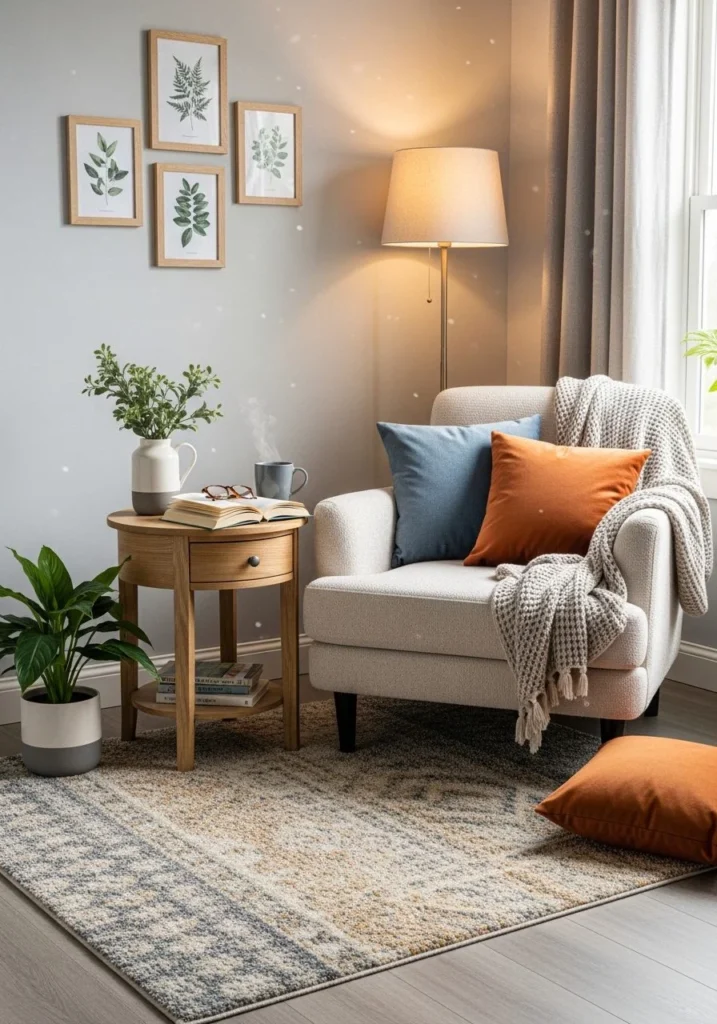
You unroll the new 8-by-10, nudge it under the sofa, and step back. The rug is straight. The sofa is straight. Yet the two look like decisions made in different stores.
That feeling rarely comes from the rug itself. It comes from where the rug lands in relation to the furniture, the walls, and the path people walk. Placement is closer to arithmetic than taste, and most of the arithmetic fits on the back of an envelope.
The twelve ideas below are grouped by the problem each one solves: a seating group that floats, an open plan with no walls to define it, a corner chair that looks stranded. Each comes with measurements you can check before you buy. Two rules hold throughout. Size the rug to the seating group, not to the room. And leave some bare floor visible around the edge.

Center the Rug on the Seating Group, Not the Room
Rooms rarely have a tidy center. A fireplace sits off to one side, a window pushes the sofa left, or the TV wall is wider than the seating wall. Center the rug on the room and the furniture ends up fighting it.
Center it on the furniture instead. Measure the full seating group from the outer edge of the left chair to the outer edge of the right one. Find the midpoint, mark it on the floor, and line the rug’s center up with it.
In a 12-by-14-foot room, an 8-by-10 rug leaves 24 inches of bare floor on every side when the group sits dead center. If a fireplace pulls the group off to one side, accept uneven margins. Just keep the rug parallel to the walls. Measure from the rug to the baseboard at both ends of each edge. A gap that differs by more than half an inch shows from the doorway, because the eye compares the rug’s edge to the baseboard line.

Put All Four Legs on the Rug When the Room Can Hold It
All legs on works when the seating group is big enough that a smaller rug would look like it ran out of floor. The sofa, chairs, and coffee table read as one island. It also demands the largest rug, so check the numbers first.
| Room size | Rug size | Bare floor on each side |
|---|---|---|
| 12 by 15 feet | 9 by 12 feet | 18 inches |
| 13 by 16 feet | 9 by 12 feet | 24 inches |
| 14 by 18 feet | 10 by 14 feet | 24 inches |
Two checks catch problems that product photos hide. First, the door swing. A half-inch pile plus a pad can catch the bottom of a door that opens inward, so open it fully with a rug sample underneath. Second, the floor vents. A rug over a supply register blocks airflow and traps warm air under the pile. If a vent sits inside the rug’s footprint, shift the rug or move to a smaller size.

Anchor Only the Front Legs When Floor Space Is Tight
Front legs on is the workhorse layout for rooms around 11 by 13 to 12 by 14 feet. Slide the rug 6 to 8 inches under the front of the sofa and each chair, and leave the back legs on bare floor.
Two hands-on details matter. A plush pile lifts the front legs by half an inch or more, which tilts the sofa slightly backward. Flat weaves under a quarter inch barely register. Also, no piece should sit half on the rug’s side edge. An 84-inch sofa on an 8-by-10 rug (96 inches wide) overhangs by 6 inches per side, which is about the minimum before the rug looks cramped.
If a 6-by-9 is all that fits, run the 9-foot side along the sofa. Expect the chairs to sit entirely off it, and choose chairs that look fine that way.

Decide Where the Rug Edge Lands at the Sofa Ends
The edge beside the sofa is where layouts quietly go wrong. If the rug stops halfway under an end table, one or two legs sit on the pile and the others on the floor. The table rocks every time you set down a glass.
You have two clean options. Run the rug far enough past the sofa that the whole table sits on it. For an 84-inch sofa and two 24-inch tables, that means at least 11 feet along the sofa wall, so a 10-by-14 turned with its long side parallel to the sofa. Or stop the rug flush with the sofa’s outer arm so the tables stand fully on the floor. Either works. Half on never does.
If a table must straddle the edge, slip a thin felt shim under the short legs, or choose a table with a solid base. A rug pad adds roughly an eighth to a quarter inch, enough to make a light table wobble.

Use a Small Rug Under the Coffee Table Only When It Stops Short of the Sofa
A table-only rug is the hardest layout to get right, because it becomes a doormat the moment it is too small. The fix is arithmetic. The usual gap between sofa and table is 14 to 18 inches. If the rug extends 18 inches past the table, it reaches the sofa’s front legs, and you have accidentally built a front-legs layout.
For a true table-only rug, keep the margin near 12 inches. A 4-by-6 rug under a 24-by-48-inch table leaves exactly 12 inches all around and stops just short of the sofa. Choose a color or pattern with real contrast against the floor. A rug that blends in reads as a stain. This layout suits round tables, wall-hugging sofas, and floors worth showing off.

Choose a Round Rug When the Room Already Has Plenty of Corners
A rectangular room, a rectangular sofa, a rectangular media console. A round rug is the one shape that interrupts all that. It suits curved sofas, circular tables, and chairs grouped around a window or hearth.
Size it by the table. A 6-foot round under a 36-inch round table leaves 18 inches all around. Under a straight-fronted sofa, round rugs behave oddly. The front legs cross the curve at different depths, so the sofa looks half tucked in. Either go to 8 feet or larger so every leg lands on the rug, or keep round rugs for chair groupings.
Round rugs also waste floor. A 9-foot round in a 12-by-12 room leaves nearly four feet of bare floor along each corner diagonal. That is a handy spot for a floor lamp or a tall plant.

Turn the Rug on the Diagonal in a Square Room
A diagonal rug works in square or nearly square rooms, where straight layouts can feel static. It fails in long rooms, where it looks like the rug slipped.
Check the footprint first. A rug turned 45 degrees takes up roughly its width plus its length, divided by 1.4, across the room. A 5-by-8 rug works out to about 9.2 feet. In a 12-by-12 room that leaves about 17 inches at the nearest points.
Keep the furniture square. The coffee table and one or two chairs sit on the rug, but a sofa whose front legs straddle the diagonal edge looks accidental. Pick a rug with no fringe and no obvious top or bottom, since a medallion or fringe will look sideways. Commit to the full 45 degrees. A rug turned just a few degrees looks crooked, not deliberate.

Zone an Open Plan With Rugs That Don’t Touch
An old rule says to leave 18 inches of bare floor between rug and wall. A Houzz roundup of rug rules points out that this convention suits enclosed rooms better than open plans, and relaxes to about eight inches in small rooms. In an open plan you have no walls on one or two sides, so measure from the dining table, the island, or the traffic path instead.
The living rug has to stop where the dining chairs pull out. Chairs need roughly 24 inches of clearance beyond the table edge, so a dining rug runs large. Leave at least a foot of bare floor between the two rugs so each zone reads as its own. If the rugs must sit closer, match their thickness. Chair legs catch on the step between a thick pile and a thin one.
Share a color family but not a pattern, and the two rugs will read as a pair. Keep a path about three feet wide between zones.

Layer a Patterned Rug Over a Flat Weave Base
Layering earns its place when you want pattern without committing to an 8-by-10 of it. Start with a neutral base in jute, sisal, or flat-weave wool. Add a smaller patterned rug, centered on the coffee table.
Proportions matter. A 5-by-8 top rug on an 8-by-10 base leaves 18 inches of base along the long sides and 12 inches at the ends. Show less than a foot of base and the two rugs look stacked by accident.
The mechanics are where layered rugs fail. Put a pad under the base. Add double-sided rug tape under the top rug’s corners, because it creeps and bunches on coarse fibers. Keep the sofa’s legs on the base only, since a double thickness will tilt it. Know the base material’s trade-offs. Jute sheds for the first few weeks and feels rough on bare feet. Sisal marks easily when wet.
Still choosing the base? Our guide to modern area rug styles that make a living room look bigger covers colors, weaves, and patterns.

Give a Reading Corner Its Own Rug
A chair in a corner looks stranded until something ties it to the floor. A small rug does it, if it is the right size. A 3-by-5 holds only the chair’s front legs. For a chair, an ottoman, and a side table, start at 4 by 6. A 5-by-8 is more comfortable.
Keep at least a foot of bare floor between the corner rug and the main rug. Change the pile height too. A low flat weave in the seating area and a plusher rug in the corner read as two decisions. Matching piles read as a failed attempt at one rug.
Watch the lamp. A floor lamp whose base sits on the rug’s edge stands slightly crooked, so place the base fully on the rug or fully off it. For help choosing and angling the chair itself, see how to place and style an accent chair.

Build the Room Around One Patterned Rug
Buy the rug first and the rest of the room follows. This approach gives you a ready color palette and a clear rule: one bold pattern, everything else quiet.
Pull two colors from the rug for the sofa and cushions. Keep the sofa solid. If you add a second pattern, such as a striped pillow, make it much smaller in scale than the rug’s.
One practical point most guides skip is that furniture hides rugs. A front-legs layout covers roughly 8 inches of the rug under the sofa, and a coffee table covers the middle. A medallion design loses its center. If furniture will cover much of the rug, choose an all-over pattern. Prices vary widely. A machine-made 8-by-10 often costs a few hundred dollars, while hand-knotted wool in that size can run into the thousands.

Pick a Neutral Rug by Weave, Not Just Color
A solid ivory cut-pile rug shows footprints, crumbs, and vacuum lines within a week. A neutral rug that lasts is usually chosen by texture. Heathered or marled wool, loop pile, and chunky flat weaves with two tones in the yarn hide debris far better than a flat single color.
Dark neutrals are not the easy answer. Charcoal solids show lint and pet hair clearly. A mid-tone heathered beige or gray hides both.
Pile height affects daily life. Under about half an inch is easy to vacuum and kind to robot vacuums, while deep shags can snag them. Check the undertone against your floor, too. A cool gray rug on warm oak looks muddy along the edge, where the two meet.

Run a Tape Test Before You Order
Mark the rug on the floor with painter’s tape at its exact size. Leave it for a full day, then live with it. Open the door all the way. Check that no vent sits inside the outline. Walk from the entry to the sofa and confirm the main path stays about three feet wide.
Then move the furniture, not just the tape. Set each leg where it would land and look from the doorway. If the tape looks right but the room feels crowded, drop one size and switch to front legs on. An hour with a roll of tape settles most of these questions before the rug ships.
Frequently Asked Questions About Living Room Rug Placement
Do I need a rug pad under a living room rug?
Yes, almost always. A felt-and-natural-rubber pad about a quarter inch thick stops creeping and adds cushioning. Cut it an inch smaller than the rug on every side so the edges stay hidden. Some rubber or vinyl backings can mark finished wood floors, so read the floor manufacturer’s care notes first.
What size rug do I need for a sectional?
Size for the sectional’s footprint, not its label. Measure both legs of the L, then choose a rug that at least covers the front legs of each. A sectional about 9 feet by 6 feet usually pairs with a 9-by-12, which puts the whole piece on the rug. An 8-by-10 works with front legs on.
Can I put an area rug over wall-to-wall carpet?
Yes, and a low-pile flat weave works best. High-pile rugs bunch on carpet because the two piles grab each other. Use a grip made for carpet-on-carpet, cut slightly smaller than the rug. Choose at least an 8-by-10 so the edge does not read as a patch.
Which way should the rug run in a long, narrow living room?
Run the long side parallel to the long wall. In a room 10 feet wide, a 6-by-9 rug placed that way leaves 24 inches of floor on each side. Turning it across the width chops the room into segments and leaves the sofa nowhere to sit squarely.
How often should I rotate a living room rug?
Turn it 180 degrees about every six months so foot traffic and window sun wear it evenly. Do it when you vacuum underneath, and settle the pad back into place before the furniture goes back down. Rugs near large south-facing windows are the ones to watch.
7 comments