
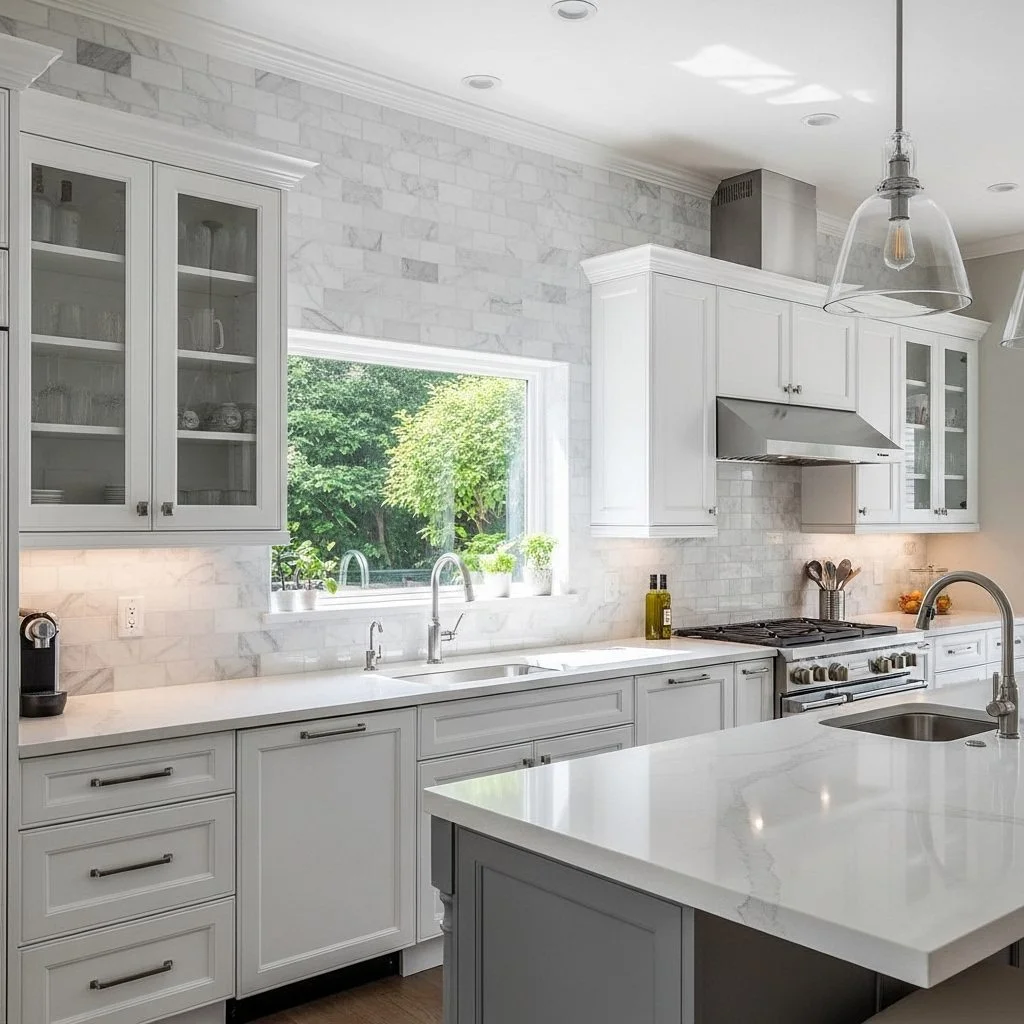
Two kitchens can share the same white cabinets and still look nothing alike. In one, the backsplash keeps the room crisp and bright. In the other, the same tile turns faintly yellow by late afternoon or goes cold and gray after dark. The cause is almost always the undertone, the hint of another color hiding inside the white. Find that undertone first and the backsplash choice gets much simpler. The fifteen ideas below are grouped by undertone, with practical notes on cleaning, sealing, and cost.
Find Your Cabinet’s Undertone First
Cabinet white is almost never pure white. Warm whites carry cream, ivory, or a faint yellow. Cool whites lean gray, blue, or slightly green. The fastest check takes about five minutes. Hold a loose tile sample or a sheet of plain white paper beside a cabinet door in daylight. Warm whites look buttery against the paper, while cool whites look crisp or grayish.
Then check the lighting, because it changes the answer. Warm LED bulbs around 2700K add yellow to everything, so a cool white can turn muddy and a cream white can look orange. Daylight-style bulbs at 4000K and above sharpen blue tones. A south-facing kitchen gets warm afternoon sun that pushes cream tones forward, while a north-facing kitchen pulls cool tones out of nearly any white. Test the sample in the room at the hour you usually cook, not in a showroom at noon. For a broader look at cabinet shades, see kitchen cabinet color options.
Pairings for Cool-Leaning White Cabinets
These backsplashes lean into the blue-gray side of white cabinetry. Gray veining, blue-gray glazes, and metal finishes keep the palette crisp.
Herringbone Carrara-Look Porcelain
Herringbone sets tiles in a zigzag, and it suits cool whites because the gray veining of Carrara-style marble sits comfortably beside blue-gray paint. Choose porcelain printed to look like marble if you cook often. Real marble etches when lemon juice or vinegar sits on it, and oil can stain it unless it is sealed. Porcelain resists both, and a damp cloth is usually enough. A herringbone layout produces many cut pieces, so order about 15 percent extra. Ask your installer to center the pattern on the range rather than starting it at a corner, so the zigzag lands where your eye goes first.

Glossy Black Subway With Thin Grout
A glossy black 3-by-6-inch subway tile makes a sharp contrast against cool white cabinets, but it needs attention. Glossy dark tile shows water spots, splatter, and fingerprints quickly, so keep a microfiber cloth near the sink. Use a narrow grout joint of about one-eighth inch and pick a grout close to the tile color. That keeps the wall reading as one plane instead of a grid. The contrast comes from the tile itself, so the rest of the kitchen can stay quiet, with plain hardware and no added pattern.

Pale Blue-Green Zellige
Zellige is handmade Moroccan tile with slight variations in thickness and glaze. A pale celadon or sea-glass tint softens cool white cabinets without adding warmth. Because each piece varies, ask the installer to dry-lay a row before setting anything, and choose a grout joint wide enough to absorb the size differences. Glaze also pools in small patches, so a single tile can look different at breakfast and at dinner. Zellige costs more than standard ceramic, so many homeowners limit it to the range wall and use a simpler tile on the sink wall.

Light Gray Concrete-Look Porcelain
Porcelain printed to look like poured concrete gives you a cool gray and soft surface variation without the upkeep of real cement. Real cement tile is porous and needs regular sealing, or it stains around the burners. A matte or lightly textured finish hides fingerprints far better than gloss. A 12-by-24-inch format keeps grout lines to a minimum, and a rectified edge, meaning the tile edges are cut square, lets you use tight joints that do not look busy.

Gray Terrazzo
Terrazzo is a mix of marble, glass, or stone chips set in a cement or resin base. A gray version reads as calm speckle beside cool whites. The pattern also hides crumbs and light splatter better than plain tile does, which matters on a range wall. Cement-based terrazzo needs sealing, while resin-based versions are more forgiving. Choose tiles 12 inches square or larger to reduce grout lines, and pick a finer chip if your kitchen is small, since big chips can look busy at close range.

Brushed Stainless Steel Panels
Brushed stainless panels suit cool white cabinetry in a modern, professional-style kitchen. A brushed finish hides fingerprints better than mirror polish, and it wipes clean quickly. Have a fabricator cut panels to fit the wall, then seal the edges with a silicone bead, because open seams collect grease. Stainless reflects light, so a nearby window or an under-cabinet fixture will bounce around the room. Ask about gauge too, since thinner sheets dent more easily when a pot knocks against them.

Pairings for Warm Cream and Ivory Cabinets
Warm cabinets need backsplashes with matching warmth, or the contrast turns harsh. These options add beige, honey, and cream tones that sit comfortably beside ivory cabinetry.
Honed Travertine
Honed travertine brings cream and beige tones that match warm white cabinets without competing with them. Travertine is full of small pits, so ask for a filled and honed finish if you want a smooth wall. Unfilled stone holds crumbs and liquid in its pits. Use a sealer labeled for natural stone and reapply on the schedule the label lists, which for many products is about once a year. To check the seal, drop a little water on the stone and time how long it takes to soak in. Fast absorption means it is time to reseal.

Wood Planks Beside the Sink
Wood planks give cream cabinets a natural counterpart, especially in oak or ash with honey tones. Keep wood off the wall directly behind the range, since heat and grease will darken and dry it out. A sink wall works better, where the planks sit beside a faucet that is sprayed only occasionally. Use a waterproof finish rated for kitchen use, and coat every face, including the cut edges at the top and bottom, because those absorb moisture first.

Cream Chevron Ceramic
Chevron is a zigzag built from angled tiles, and cream versions soften warm white cabinets while adding movement. Choose tiles with factory-cut edges, since hand-cut edges leave gaps that show. The angled layout wastes more material than a straight pattern, so order about 15 percent extra. Center the zigzag on the range so the pattern reads as a focal point, and choose a grout one shade darker than the tile, which hides haze and keeps the chevron crisp.

Painted Pressed Tin
Pressed tin panels painted cream or soft white bring vintage texture to a warm kitchen. Tin is lightweight, and its embossed motifs give the wall real depth under cabinet lighting. Use a semi-gloss enamel made for metal, and keep the panels out of the direct spray at the sink, since paint chips and exposed seams can rust. Check the paint’s heat rating before you mount tin close to a cooktop, and wipe grease off promptly. Tin reads best on a range wall that does not get splashed with water.

Pairings That Work With Either Undertone
These pairings bridge the gap. They use either a neutral white tile or a material with enough texture and contrast to work with warm or cool cabinets.
Classic Subway With Dark Grout
A white 3-by-6-inch subway with charcoal grout is the most dependable pairing for any white cabinet, because the grid lines do the design work. Dark grout frames each tile and makes the wall look crisp under both warm and cool light. The trade-off is that dark grout shows dirt and mineral haze more than light grout. Use an epoxy or stain-resistant grout on the range wall and a standard cement-based grout elsewhere. A running bond, where each row shifts by half a tile, is the most common layout and the least costly to install.

Soft White Hexagon Mosaic
A two-inch hexagon mosaic, usually sold on mesh sheets, reads as pattern without changing the room’s color. Mesh sheets speed installation because the tiles go up in pre-set sections. Expect more grout joints than a subway would need, and choose unsanded grout for joints narrower than one-eighth inch, since sanded grout can scratch small glossy tiles. Hex works best on one wall, such as behind the sink, rather than across the whole kitchen, where repeated shapes can start to feel busy.

Pearl Glass Mosaic
Glass mosaic in pearl or iridescent finishes reflects light and softens both warm and cool whites. Glass is nonporous, so it wipes clean and resists staining. The surface shifts with the light, so view a sample at the hour you cook. Glass can chip if a heavy pan is dropped on it, and small pieces need fine, unsanded grout. A glass accent strip above a standard tile field costs less than covering the whole wall and gives much of the same reflective lift.

Mother-of-Pearl Accent
Mother-of-pearl is cut from the iridescent inner layer of shell, and it shifts color as you move past it. It looks luxurious beside any white cabinet, but it works best as a strip or framed panel rather than a full wall. Shell is delicate, and heat and standing water can damage it, so keep it away from the range and out of the sink’s spray zone. Place it where you can see it from the table or doorway, such as a coffee station wall.

Book-Matched Quartzite Slab
Quartzite is harder than marble and handles heat and scratches better, which makes it a practical choice for a range wall. A book-matched slab mirrors the veining across two panels, creating a centered design that reads as a focal point. Quartzite often costs several times more per square foot installed than standard ceramic, so most homeowners limit it to one wall. Ask for a remnant or a smaller panel first, and check that the slab’s seams fall at a corner rather than across the middle of the backsplash.

What Each Option Costs and Demands
Material prices vary by region and supplier, so treat these as rough U.S. ranges before labor. Standard ceramic and porcelain usually run from a few dollars to around 15 dollars per square foot. Terrazzo, zellige, and glass mosaic often sit higher, and natural stone or quartzite can exceed that substantially. Installation adds labor, and a patterned layout such as herringbone or chevron typically costs more to set than a straight grid. Maintenance follows the same split. Glass, stainless, and glossy porcelain wipe clean in seconds. Stone and cement-based surfaces need sealing and gentle cleaners, and grout lines need cleaning more often than the tile itself. If you are deciding how high the tile should run or how to frame the range wall, the height and framing guide covers those choices in depth before you order.
Start With a Sample Test
Before you order anything, take a sample of your top two choices to the kitchen. Tape each one to the wall beside a cabinet door, then look at them on a bright morning and again under the bulbs you use at dinner. The pairing that holds up under both lights is almost always the right one.
Frequently Asked Questions
Is marble safe behind a range with white cabinets?
Marble can work behind a range, but it needs sealing and gentle cleaning. Heat alone does not damage marble. Grease and acidic splatter, such as tomato sauce or wine, can etch the surface and leave dull spots. Seal the stone before use, reseal it about once a year, and wipe spills right away. If you cook heavily, porcelain printed to look like marble gives you the same visual result with far less upkeep.
How many square feet of backsplash tile do I need?
Multiply the wall length by the height from the counter to the upper cabinets, then subtract large openings like windows. Add about 10 percent for cuts and breakage. A 12-foot wall with 18 inches of backsplash height is 18 square feet, so order about 20. Herringbone and chevron layouts waste more, so add closer to 15 percent for those patterns. Full-height tile needs a different calculation, so measure from the counter to the ceiling line first.
Can I install a backsplash over painted drywall?
Yes, if the paint is clean, flat, and lightly scuffed. Glossy paint blocks thinset from bonding, so sand it with a fine grit and wipe away the dust before setting tile. If the surface still feels slick under your hand, it likely needs more sanding. Peel-and-stick tile works over painted walls, but the adhesive can lift near steam and heat, so it suits light-duty areas better than a range wall.
Should grout match the tile or contrast with it?
Matching grout makes the wall read as one surface and hides small size differences, which suits zellige and other handmade tile. Contrasting grout outlines each piece and emphasizes patterns such as subway or chevron. Light grout shows fewer stains on white tile, while dark grout hides splatter in busy zones. Whichever you choose, epoxy or stain-resistant grout costs more but resists oil and water better than standard cement-based grout, so it is worth it behind a range.
Is a glass backsplash hard to keep clean?
No. Glass is nonporous, so most splatter wipes off with warm water and a soft cloth. The harder part is the grout between pieces, which can collect soap film and grease. Use a grout-safe cleaner, and seal cement grout if you choose it. Avoid abrasive pads, which can leave fine scratches on the surface. Plan to wipe glass weekly near the range and less often elsewhere.
1 comment